Category: Investigation Notes

  • Bradenton’s Best 2026: Silver, Private Investigator

    Bradenton’s Best 2026: Silver, Private Investigator

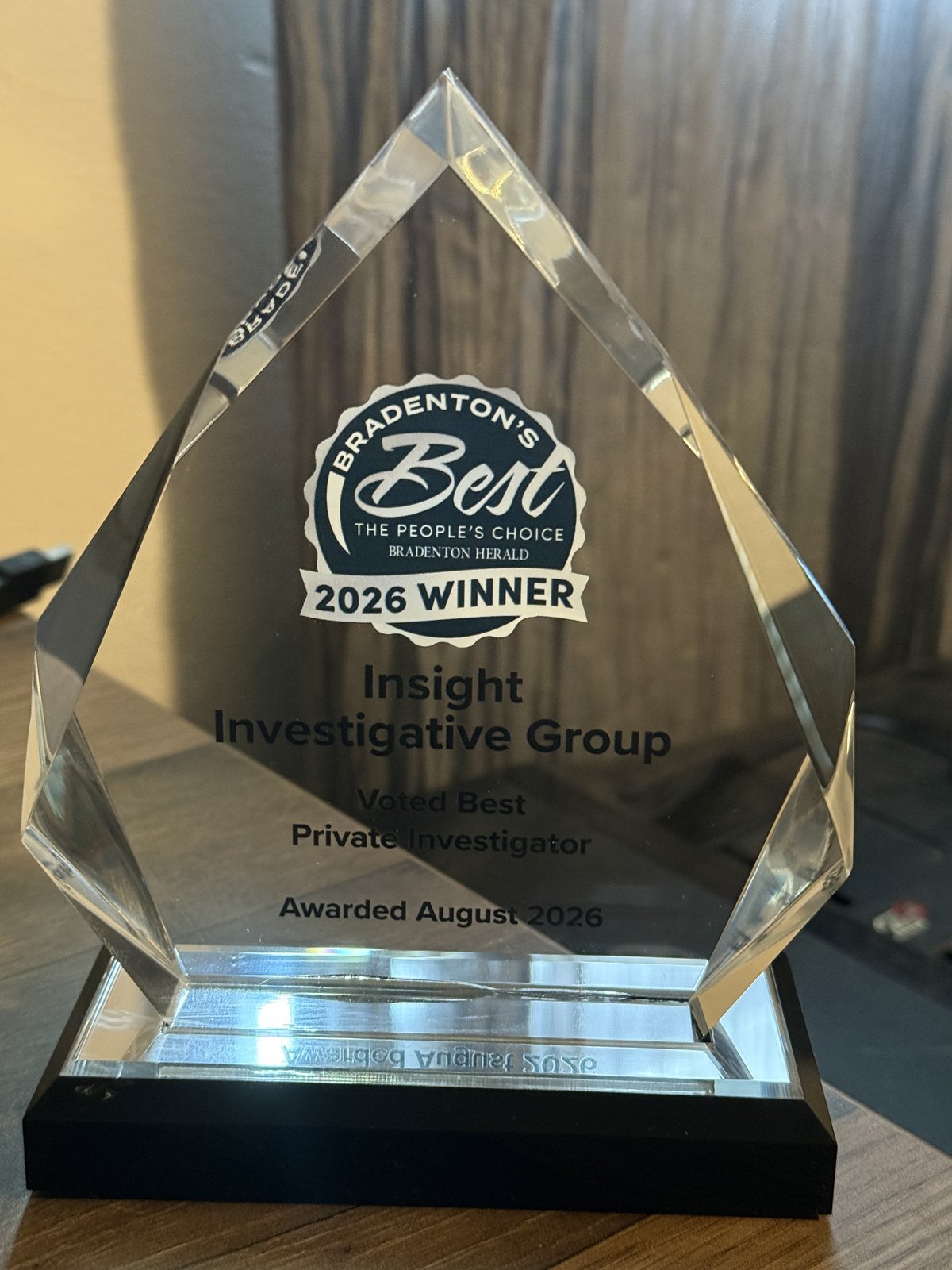
    The results of the Bradenton Herald’s 2026 Bradenton’s Best are in, and Insight Investigative Group has again been voted Silver for Best Private Investigator.

    That is two years running. We took Silver in the same category in 2025.

    More than 341,000 votes were cast across all categories this year. Bradenton’s Best is a community vote — readers nominate, readers decide. There is no panel, no application, and no way to buy a place on the list. That is exactly what makes it worth something to us.

    What it actually means

    Most of what we do is invisible by design. A surveillance file does not come up at dinner. A background investigation that keeps someone out of a bad business deal never makes the paper. Clients come to us at difficult moments and, if we have done the job properly, they move on without ever needing to mention us again.

    So an award decided by the people of this community carries a particular weight. It says that somewhere behind the confidentiality, the work was worth recommending.

    Thank you

    To every client who voted, and to everyone who quietly passed our name to a friend, a colleague, or a client of their own — thank you. Referral is the only real advertising in this business, and it is never given lightly.

    About Insight Investigative Group

    We are a licensed Florida private investigation agency on 49th Street West in Bradenton, serving Manatee and Sarasota counties and the wider Tampa Bay area.

    • Florida Agency License A3400127
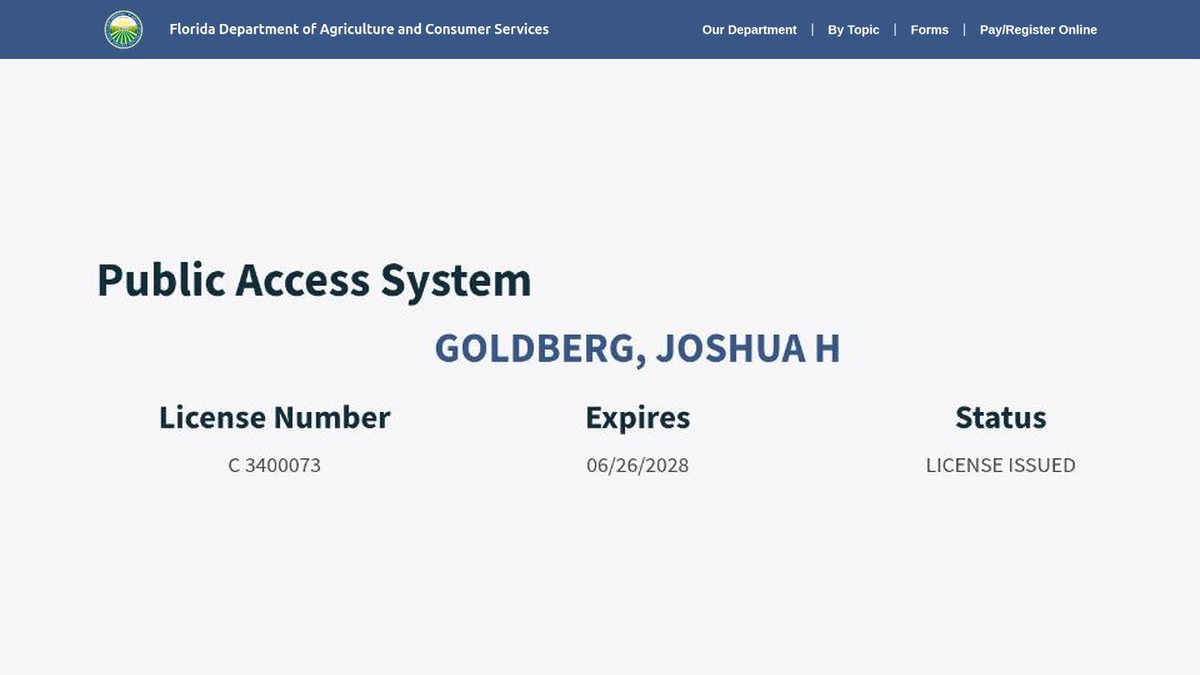
    • Florida Investigator License C3400073
    • Owner-operated and veteran-owned

    We handle surveillance, background investigations, insurance and workers’ compensation matters, domestic and custody cases, missing persons, asset searches, cyber investigations, and TSCM electronic sweeps.

    If you need us

    The phone is answered day or night by a licensed investigator: 941-297-8213. Written inquiries are answered within 48 hours.
    Talk to an investigator →

  • Background Check Before Hiring

    Background Check Before Hiring

    In today’s competitive and sometimes volatile business world, safeguarding your business has never been more important. One of the most effective ways to safeguard your business is by performing comprehensive background checks on potential employees. Background checks can provide valuable information not always obvious during the interview process, allowing you to make smart hiring decisions. In this blog post, we will explore how background checks can protect your business, enhance workplace safety, and protect the reputation of your organization.

    Understanding Your Background Checks

    Before delving into the advantages, it would be helpful to understand what exactly a background check is. A background check is a thorough examination of the personal, professional, and at times even financial history of an individual. There are different kinds of background checks which include:

    Criminal Background Checks: These checks offer a database search on an individual’s criminal history. These checks help the employer ensure that anybody’s history has such history ought not to be.

    Employee Verification: Applicant’s employment record is verified for the truth and accuracy of data provided.

    Education Verification: Verifies claimed educational qualifications of the candidate.

    Credit Checks: These are usually used for positions that are connected to financial work, and they show the person’s credit report.

    Reference Checks: Taking interviews of previous employers or personal references to get a clear understanding of the candidate’s attitude and working pattern.

    Employer Benefits of Background Checks

    Background screening provides many benefits which, over the long-term, can grow the safety and profitability of your business in real ways.

    Enhancing Workplace Safety

    The biggest positives that come when you operate background checks involve enhanced safety in the workplace. When you examine prospective employees for criminal activity in their background, especially ones that are violent or dangerous, you will be in a place to mitigate the exposure of workplace accidents. In one example, one logistics company once discovered from a background check that one potential driver had a history of multiple DUIs, and thus avoided making a potentially dangerous hiring.

    Protecting Company Reputation

    Your employees are the face of your company. Making the choice to employ someone with a less-than-stellar history could ruin the reputation of your company. In one example, a major retail chain experienced a public relations disaster when it was found that one of the chain’s managers had a prior history of embezzlement that a proper background check would have caught.

    Met the Legal and Regulatory Requirements for Compliance

    Many of the industries have extremely stringent laws and regulations regarding the nature of the employees as well as their background. Background checks help the organizations come in line with the compliance, therefore saving them from fines as well as legal ascription. For instance, healthcare organizations need to oblige by the state and federal laws that require strict background checks for all their employees in order to ensure the safety of the patients.

    Reducing Employee Turnover

    It can also be a money-saving plan to avert a mismatch between the job and the candidate. Background checks can enable a company to screen out job candidates who are prone to leave your organization in the long term, and as such, turnover rates can be reduced. A technology company, for example, was able to cut its turnover rate by as much as 30% after engaging in thorough background checks, as this enabled the company to hire job seekers with long-term stable work histories.

    Protecting Confidential Information

    In the present age of digitization, one needs to be careful regarding sensitive information. Background checks help you refrain from hiring individuals that pose a threat to security. A financial company, for example, barely averted a massive loss when it came to know of the involvement of a candidate in some past data theft incidents through the assistance of a background check.

    Real-Life Examples of Background Checks Saving Businesses

    Case Study 1: Preventing Workplace Violence

    One manufacturing company was heading straight towards a possible crisis when a routine background check discovered that the applicant for the job had a previous record of manifesting signs of violence in a workplace environment. By not hiring the applicant, the company was saved from ominous confrontations that may have placed its workforce and its entire business to a standstill.

    Case Study 2: Prevention of Financial Fraud

    An average-sized accounting firm almost recruited a person with a history of financial fraud. A complete background check exposed the fraudulent activities of the prospective candidate and thereby saved the firm from suffering losses not only in terms of money but also reputation.

    Case Study 3. Information Security from Insider Threats

    One IT company that was conducting background check found out that a potential IT professional was previously involved in a case of data breach in his prior employment with another firm. The company, thus, managed to prevent insider threats by not hiring the culprit.

    Carrying Out Background Checks in Your Company

    Successful background checks will need a systematic approach:

    The Right Way to Conduct Background Checks

    1. Determine Your Need: Think of what kind of background checks you require for your business.

    Policy Formation: Form a detailed background check policy that will include the procedure and standards of quality.

    2. Applicant Notification: Confirm that the applicants are notified that the background checks are conducted during recruitment.

    3. Consent Creation: Create written consent of the applicants prior to the initiation of the checking process.

    4. Reliable Source Utilization: To check the reports of background checks, to achieve accuracy and reliability, be contacted with a reliable service provider of background check.

    Selection of a Reliable Background Check Service Provider

    In the selection of the background check service provider, choose it on the basis of:

    – Compliance: Make sure that the service provider is compliant with the FCRA and other applicable laws.

    – Reliability: Select a provider offering accurate as well as reliable reports in a concise and detailed format.

    – Customer Support: Choosing the providers who have good customer support that can take care of any issue that may come up from time to time.

    Incorporating Background Checks within Your Hiring Process

    Easily integrate background checks into your hiring process with:

    – Standardize Procedures: Issue standardized procedures to all the applicants.

    – Train Human Resources Staff: Make the human resources department conversant with conducting and interpreting background checks.

    – Maintain Confidentiality: Keep in the strictest confidence all information gathered in the process of checks.

    Legal and Ethical Considerations

    One needs to act in compliance with legal and moral norms when conducting background verification:

    Understanding Compliance Under FCRA

    The Fair Credit Reporting Act (FCRA) has laid guidelines on how background checks should be carried out. Ensure that you follow the following:

    – Give Disclosure: Inform candidates that a background check will be made.

    – Obtaining Authorization: Secure written permission from candidates.

    – Adverse Action Notice: Should you decide not to hire based on the background check, you will need to provide the candidate with a report as well as a summary of their rights.

    Ensuring Non-Discriminatory Practices

    Background checking should be performed in a fair and non-discriminatory way. Do not indulge in practices that may potentially lead to discriminatory hiring, such as:

    – Uniform Criteria: Apply uniform background check criteria to all candidates.

    – Do Not Assume: Assess each applicant on his individual merit and do not draw prejudiced conclusions on the results of background check.

    Dealing with Sensitive Information with Caution

    Store appropriately and access responsibly all the information obtained from background checks. Allow access to the information to individuals who are directly concerned.

    Common Challenges and How to Solve Them

    There are some pitfalls that one might encounter while conducting background checks. Here are ways of avoiding the pitfalls:

    Dealing with Inaccurate or Incomplete

    – Cross-Reference Check: Verify information from different sources.

    – Explain with Candidates: Allow candidates time to explain any discrepancy.

    Handling Resistance of Applicants

    – Explain Clearly: Explain to job seekers clearly the significance of background checks.

    – Establish Trust: Assure job candidates that the use of such a process is confidential and that it is only used to ensure a safe and secure work environment.

    Balancing Thoroughness and Efficiency

    – Focus on the Checks that Matter Most: Focus on the most relevant background checks relative to the position.

    – Automate Processes: Use automated systems where such can hasten the process without sacrificing the quality.

    In conclusion, background checks are a really useful thing that helps safeguard your business from various types of risks. By making the workplace more secure, safeguarding the business’s reputation, promoting compliance with industry standards, lowering employee turnover, and safeguarding your confidential information, background checks can rescue your business from potential threats. A well-structured and legally compliant background check process will enable you to make informed hiring decisions and create a safe and productive work environment. Take the right steps today to implement background checks in your own hiring process and reap the many benefits they have to offer.

    These background checks should not be seen as a formality but as a very useful tool in the creation of a reliable and safe labor force. By allowing background checks, you are investing not only in long-term safety but also in the future success of your business.

    Why a licensed investigator asks what the report is for

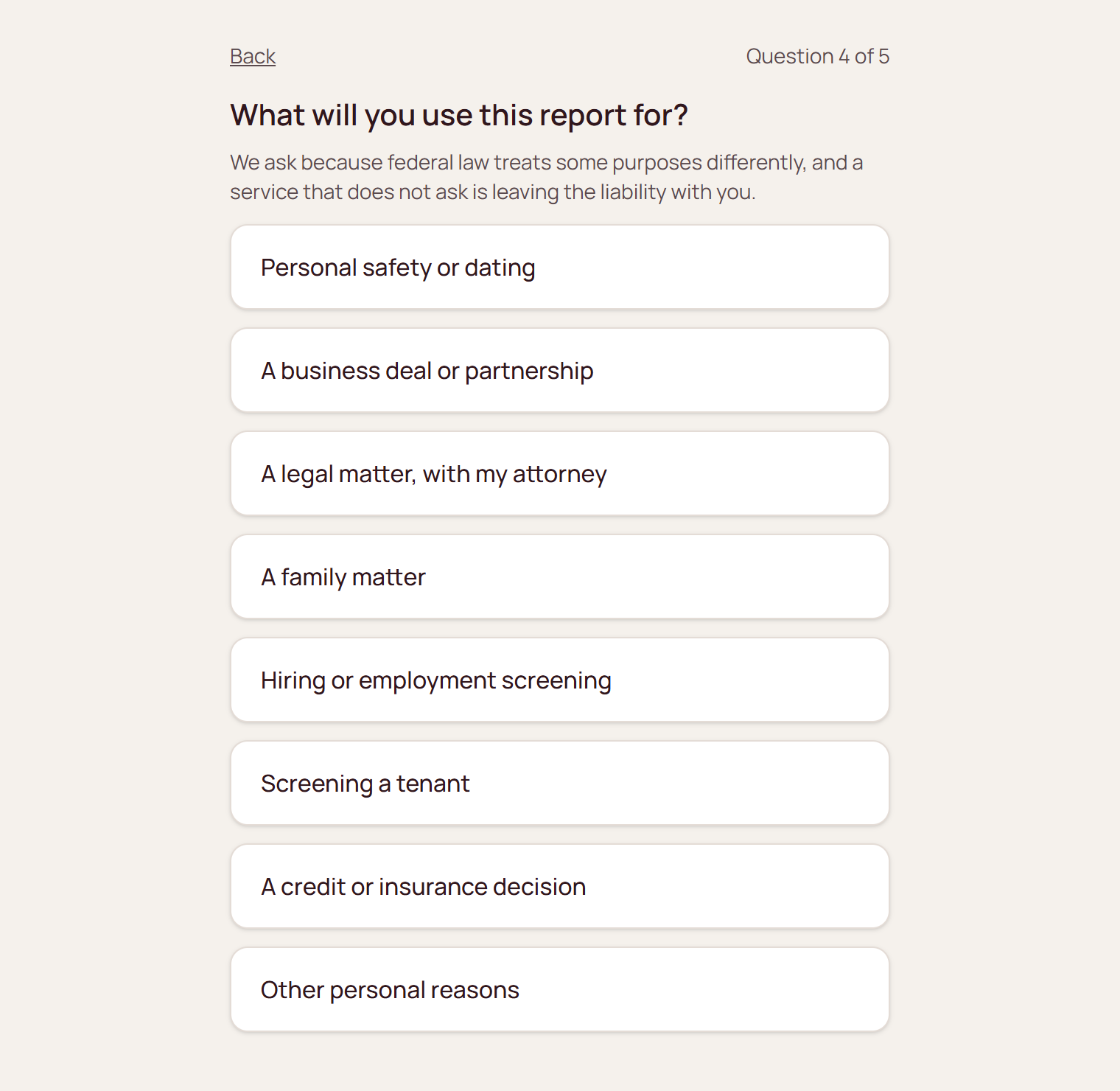
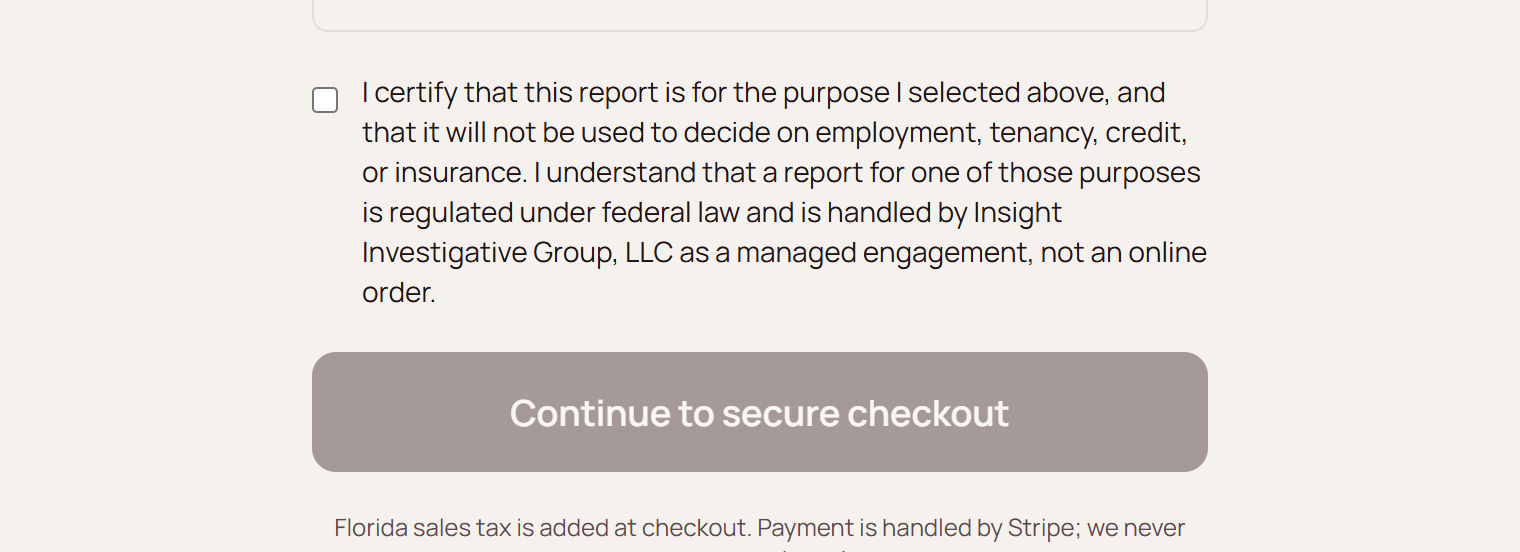
    Employment screening is a regulated purpose. Under the federal Fair Credit Reporting Act, a report used to decide whether to hire, promote, retain or reassign someone is a consumer report, and whoever supplies it is acting as a consumer reporting agency. That carries obligations around permissible purpose, written applicant authorization, accuracy, adverse action notice and dispute handling.This is why a licensed investigator asks what you plan to do with the report before quoting it. A service that does not ask is not avoiding the law. It is leaving the liability with the employer, which is exactly what the fine print on the consumer search sites says it is doing when it tells you the report may not be used for employment decisions.Run a hiring decision off a report that was not built for the purpose and the exposure is the employer’s. That is the whole reason the disclaimer is there, and it is worth reading before the offer letter goes out.

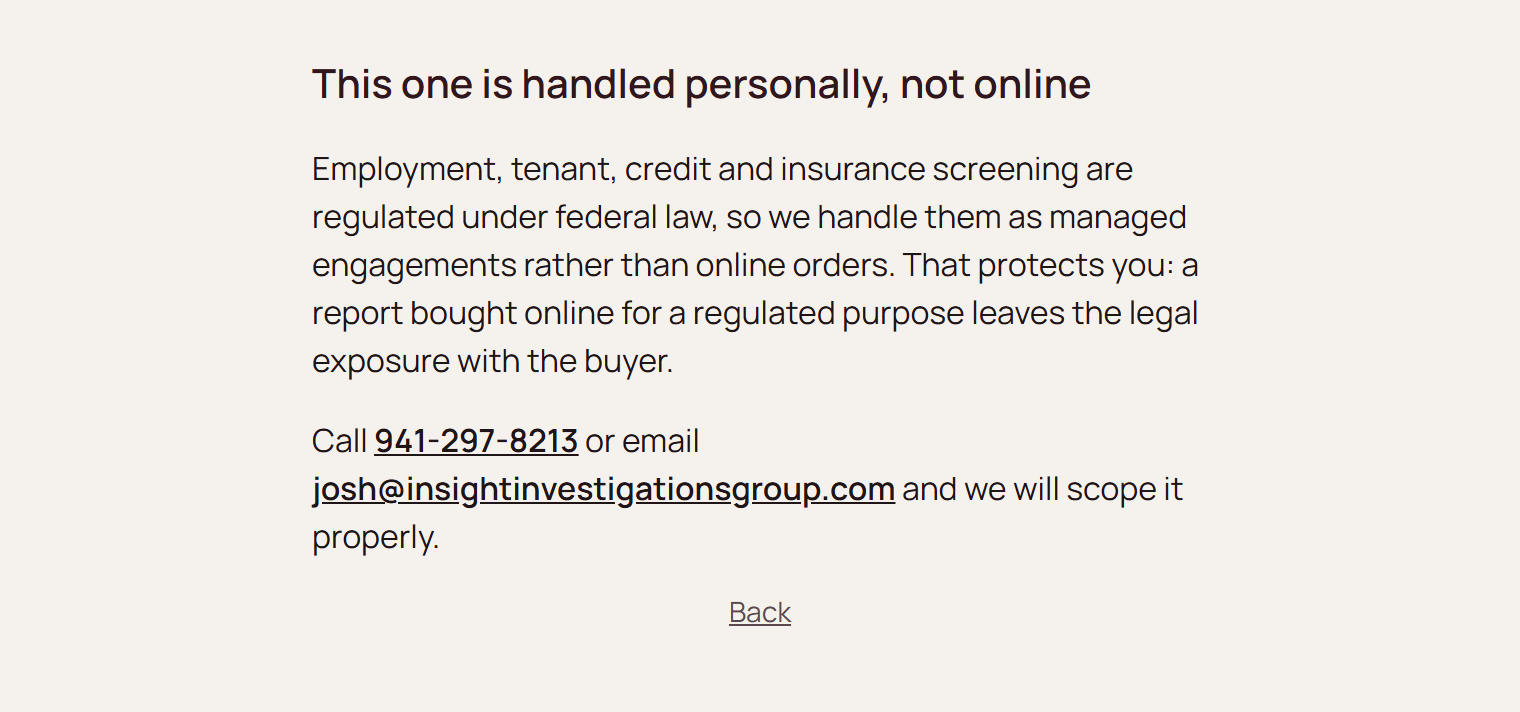
    Employment and tenant screening are regulated under federal law, so we handle these as managed engagements rather than online orders. Call 941-297-8213 or email josh@insightinvestigationsgroup.com and we will scope it properly.


    Written by Joshua Goldberg, Florida private investigator license C3400073, owner of Insight Investigative Group, LLC, agency license A3400127, Bradenton, Florida.

    Related: background checks.

    Ask an investigator

    Employment screening is FCRA regulated and handled as a managed engagement. Call to scope it properly.

    Call and a licensed investigator answers, day or night, including weekends. Written enquiries are answered within 48 hours.
  • Tenant Background Check Florida

    Tenant Background Check Florida

    How to Conduct a Background Check on a Potential Tenant

    In the world of property management, ensuring you have reliable and trustworthy tenants is crucial for the security and profitability of your rental properties. Conducting a thorough background check on potential tenants is an essential step in this process. This article will guide you through the process of conducting a background check on potential tenants, providing you with practical tips, real-life examples, and valuable insights.

    Why Conduct a Background Check on Potential Tenants?

    Before diving into the how-to, it’s important to understand the reasons behind conducting a background check. As a landlord or property manager, your goal is to:

    Ensure Reliability: Confirm the tenant’s ability to pay rent on time.

    Maintain Property Safety: Avoid renting to individuals with a history of criminal behavior.

    Protect Your Investment: Prevent potential property damage by verifying past rental behavior.

    A comprehensive background check helps you achieve these goals and mitigates the risks associated with renting out your property.

    Step-by-Step Guide to Conducting a Background Check

    1. Obtain the Tenant’s Consent

    Before starting any background check, you must obtain written consent from the prospective tenant. This is not only a legal requirement but also a best practice that ensures transparency and trust.

    Create a consent form that clearly states what information you will be checking, including credit history, criminal records, and rental history. Have the tenant sign and date the form.

    2. Verify Identity and Personal Information

    Begin by verifying the tenant’s identity and personal information. This includes:

    Social Security number (SSN)

    Current and previous addresses

    Checking Identification Documents

    Ask for a copy of the tenant’s government-issued ID, such as a driver’s license or passport. This helps confirm their identity and ensures the information provided is accurate.

    3. Evaluate the Tenant’s Credit Report

    A tenant’s credit report provides insights into their financial responsibility and reliability. It includes their credit score, payment history, and outstanding debts.

    You can obtain a credit report from one of the major credit bureaus: Experian, Equifax, or TransUnion. Some tenant screening services offer comprehensive reports that include credit information.

    4. Conduct a Criminal Background Check

    Safety is a top priority for any landlord. A criminal background check reveals any past criminal activities or charges against the tenant.

    Utilizing National and Local Databases

    Use national and local databases to search for criminal records. Many tenant screening services provide access to these databases and streamline the process.

    5. Verify Employment and Income

    Confirming a tenant’s employment and income ensures they have the financial stability to pay rent consistently.

    Request recent pay stubs or an employment verification letter. Contact the employer directly to verify the tenant’s employment status and income.

    A tenant’s rental history provides valuable insights into their behavior as a renter, including timely rent payments and property care.

    Contacting Previous Landlords

    Reach out to previous landlords to inquire about the tenant’s rental history. Ask specific questions about their payment behavior, any property damage, and overall conduct.

    Real-Life Example: The Importance of Thorough Background Checks

    Consider the case of Jane, a landlord who owns several rental properties. Jane once rented her property to a tenant without conducting a thorough background check. The tenant had a poor credit history and a record of late rent payments, which Jane discovered too late. The tenant eventually defaulted on the rent, causing financial strain and requiring an eviction process. This experience highlighted the importance of a comprehensive background check for Jane.

    Using Tenant Screening Services

    Tenant screening services simplify the background check process by providing comprehensive reports that include credit checks, criminal background checks, and rental history. Some popular tenant screening services include:

    These services offer various packages to suit different needs and budgets, making the background check process efficient and reliable.

    When conducting background checks, it’s essential to comply with legal requirements to avoid potential lawsuits and penalties.

    1. Fair Credit Reporting Act (FCRA)

    The FCRA regulates the collection and use of consumer information, including credit reports. Ensure you adhere to FCRA guidelines by obtaining written consent and providing adverse action notices if needed.

    2. Anti-Discrimination Laws

    Comply with federal, state, and local anti-discrimination laws, such as the Fair Housing Act, which prohibits discrimination based on race, color, religion, sex, national origin, familial status, or disability.

    Common Challenges and How to Overcome Them

    1. Incomplete Information

    Sometimes, tenants may provide incomplete or inaccurate information. To overcome this, cross-verify information using multiple sources and request additional documentation if needed.

    Occasionally, tenants may provide false references. To avoid this, independently verify contact information for previous landlords and employers.

    Obtaining information from previous landlords or employers can sometimes be delayed. To mitigate this, start the background check process early and follow up promptly.

    Conducting a thorough background check on potential tenants is a crucial step in property management. By following the steps outlined in this guide, you can ensure you select reliable and trustworthy tenants who will maintain your property’s safety and financial stability. Remember to use tenant screening services, comply with legal requirements, and stay vigilant in verifying information to make informed decisions.

    By investing time and effort in conducting comprehensive background checks, you protect your investment and create a positive rental experience for both you and your tenants.

    Why a licensed investigator asks what the report is for

    Tenant screening is a regulated purpose. Under the federal Fair Credit Reporting Act, a report used to decide whether to rent to someone is a consumer report, and whoever supplies it is acting as a consumer reporting agency. That carries obligations around permissible purpose, accuracy, adverse action notice and dispute handling, and those obligations do not disappear because the report was cheap.This is why a licensed investigator asks what you plan to do with the report before quoting it. A service that does not ask is not avoiding the law. It is leaving the liability with you, which is exactly what the fine print on the consumer search sites says it is doing when it tells you the report may not be used for tenant screening.Screen a tenant with a report that was not built for the purpose and the exposure is yours, not the vendor’s. That is the whole reason the disclaimer is there.

    Employment and tenant screening are regulated under federal law, so we handle these as managed engagements rather than online orders. Call 941-297-8213 or email josh@insightinvestigationsgroup.com and we will scope it properly.


    Written by Joshua Goldberg, Florida private investigator license C3400073, owner of Insight Investigative Group, LLC, agency license A3400127, Bradenton, Florida.

    Related: background checks.

    Ask an investigator

    Tenant screening is FCRA regulated and handled as a managed engagement. Call to scope it properly.

    Call and a licensed investigator answers, day or night, including weekends. Written enquiries are answered within 48 hours.

  • Public Record Asset Search

    Public Record Asset Search

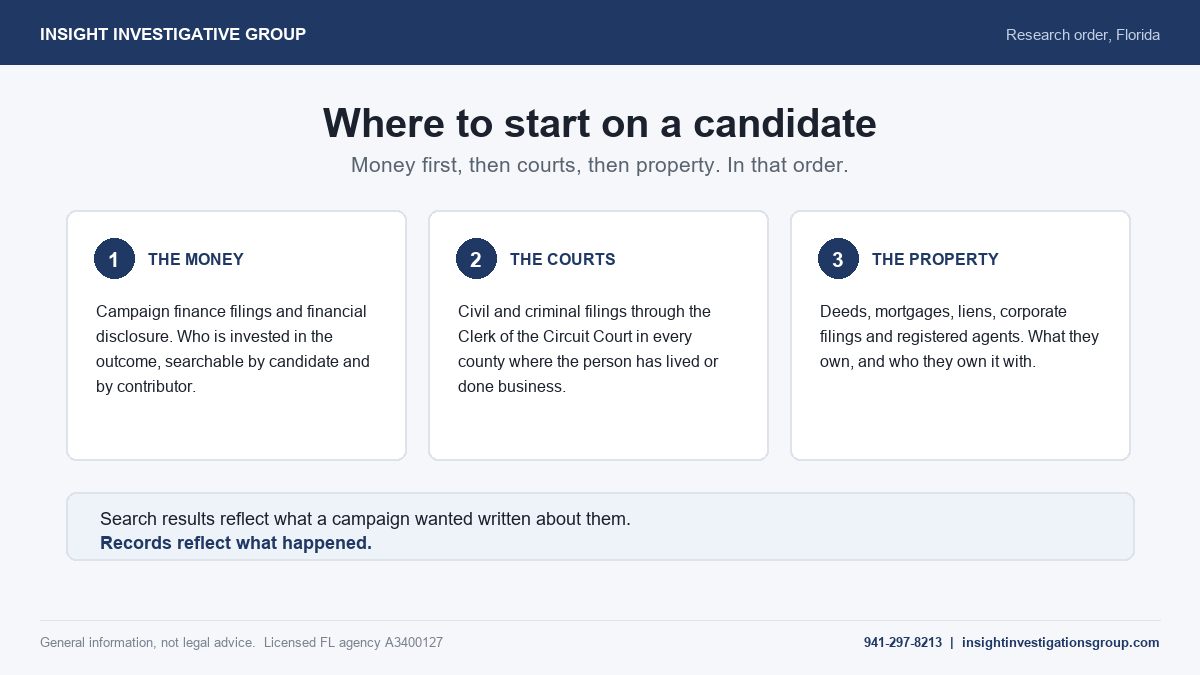
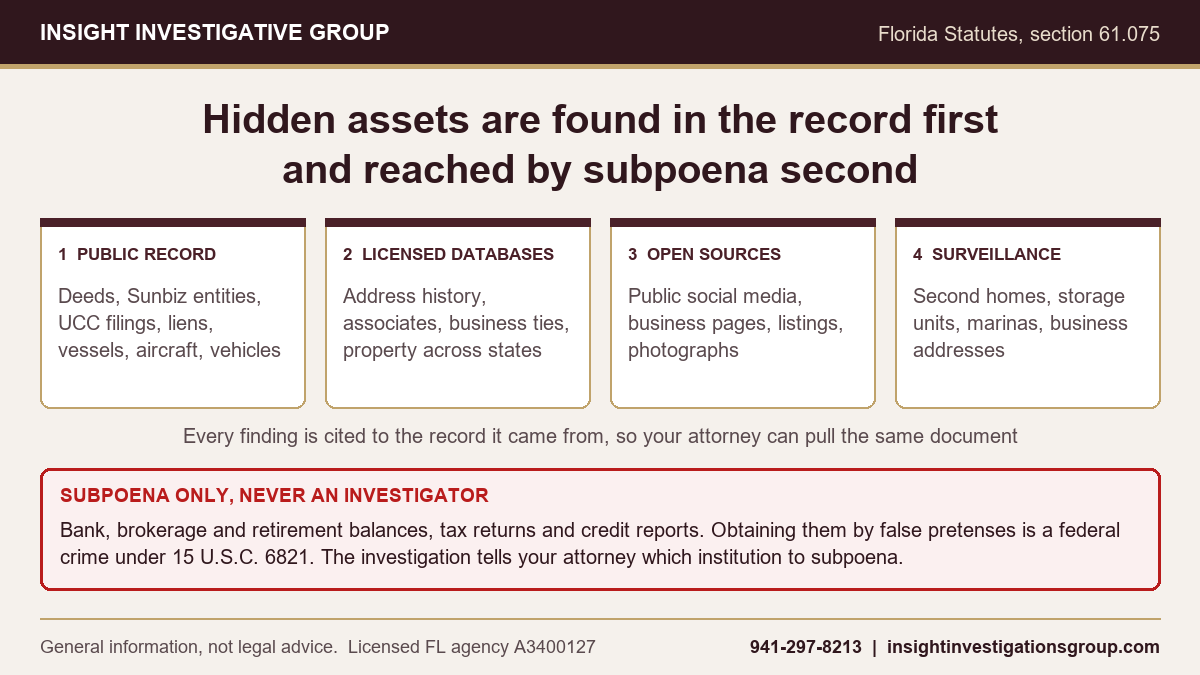
    Finding what someone owns is a public records exercise, not a hacking one. Property deeds, recorded mortgages, liens, judgments, corporate filings and vehicle titles are all matters of record, and an asset search is the discipline of assembling them into a picture rather than a list.

    How to find property someone owns

    Start with the county property appraiser and the clerk of court in every county where the person has lived, then widen nationwide. The complication is almost never the search. It is that people do not hold property in their own names. Title sits in an LLC, a trust, a spouse’s name, or a entity formed in another state, and connecting those back to a person is where the actual work is.

    What an asset search will not find

    Bank balances and account records are not public and cannot be obtained by an investigator. Neither are brokerage holdings, retirement accounts, or the contents of a safe deposit box. Reaching those requires a subpoena or a court order, which means it requires a case and a judge, not a search.What a public record asset search gives you is the documented picture: what is titled, what is encumbered, what is owned through an entity, and what the recorded history says about how it got there. In a collection or a settlement negotiation that is usually the picture that matters.

    Order a licensed background investigationPrepared by a Florida-licensed investigator, agency A3400127, and documented to evidentiary standards.

    In the realm of real estate and business transactions, the importance of title research cannot be overstated. Title research involves delving into the historical and current ownership of property, reviewing liens, claims, and other potential encumbrances that could affect the transfer of property rights. Traditionally, this process has been conducted through public records, but in recent years, the use of specialized private investigator databases like IDI (Information Data Inc.), IDR (Information Data Research), and TLOxp (TransUnion’s Legal & Public Records Database) has transformed how professionals approach title research. These databases not only provide access to public records but also offer proprietary information, which can reveal intricate details about property and business dealings not easily found through conventional methods.

    Understanding Advanced Databases

    IDI, IDR, and TLOxp are not your average public record search tools. Here’s what makes them unique:

    IDI: Known for its comprehensive database that includes property records, liens, judgments, and bankruptcies. IDI’s strength lies in its depth of information, offering insights into historical data that might be overlooked in standard searches.

    IDR: Focuses on asset data, providing detailed reports on properties, vehicles, and businesses. This database is particularly useful for tracking down hidden assets or uncovering irregularities in property transactions.

    TLOxp: Integrates public records with proprietary data sources, offering a holistic view of individuals and businesses. It’s particularly effective for background checks but also provides robust data for title research by linking individuals to properties through various data points.

    Applications in Title Research

    Settling Issues with Liens:

    Lien Verification: Using databases like IDI, one can verify if a property has liens attached to it that might not appear in local records. This is crucial for understanding the actual financial encumbrances that could affect a property’s sale or refinancing.

    Lien Resolution: By accessing detailed information, investigators can trace the origin of liens, understand who holds them, and facilitate negotiations or legal actions for their removal or satisfaction.

    Discovering Unusual Sale Patterns:

    Business Transactions: TLOxp and IDR can reveal patterns in how businesses purchase, sell, or transfer properties. This might uncover strategies like flipping properties, transferring assets to avoid liabilities, or engaging in fraudulent activities.

    Corporate Connections: These databases can link properties to corporate entities, revealing hidden ownership or connections that are not apparent in straightforward property records. This is vital in understanding if a business is involved in speculative real estate activities or asset shuffling.

    Asset Location and Valuation:

    Hidden Assets: For cases involving divorce, bankruptcy, or litigation, these tools are invaluable in locating undeclared assets. IDR, with its focus on asset data, can provide locations of properties, vehicles, or other valuables that might not be disclosed.

    Valuation Insights: By cross-referencing property data with sales records, one can estimate property values more accurately, which is crucial in negotiations or when determining collateral value in loans.

    Methodology for Using Databases

    Data Collection: Start with basic public records, then expand using the databases. This layered approach ensures no stone is left unturned.

    Cross-Referencing: Use multiple databases for verification. Discrepancies or additional details can often be found by comparing data from different sources.

    Privacy and Ethical Considerations: Always ensure that the use of these databases complies with legal privacy standards and ethical guidelines. The information gathered should be used responsibly, respecting the rights of individuals and businesses involved.

    Case Study 1: A real estate investor used IDI to uncover an old lien against a property that was about to be sold. This discovery led to a reduction in the property’s selling price due to the cost of clearing the lien, saving the investor from unforeseen future expenses.

    Case Study 2: Using TLOxp, a law firm traced a series of property transfers linked to a shell corporation, revealing a pattern of asset protection that was crucial in a high-stakes litigation case involving corporate fraud.

    The integration of advanced private investigator databases into title research not only enhances due diligence but transforms it into a strategic tool for uncovering hidden truths in property and business dealings. For professionals in real estate, law, or financial sectors, mastering these tools can provide a competitive edge, ensuring that their analysis is thorough, accurate, and insightful. As these databases continue to evolve, the landscape of title research will become even more sophisticated, offering new methods to navigate and capitalize on complex real estate and business data.


    Written by Joshua Goldberg, Florida private investigator license C3400073, owner of Insight Investigative Group, LLC, agency license A3400127, Bradenton, Florida.

    Related: background checks and published rates.

    Ask an investigator

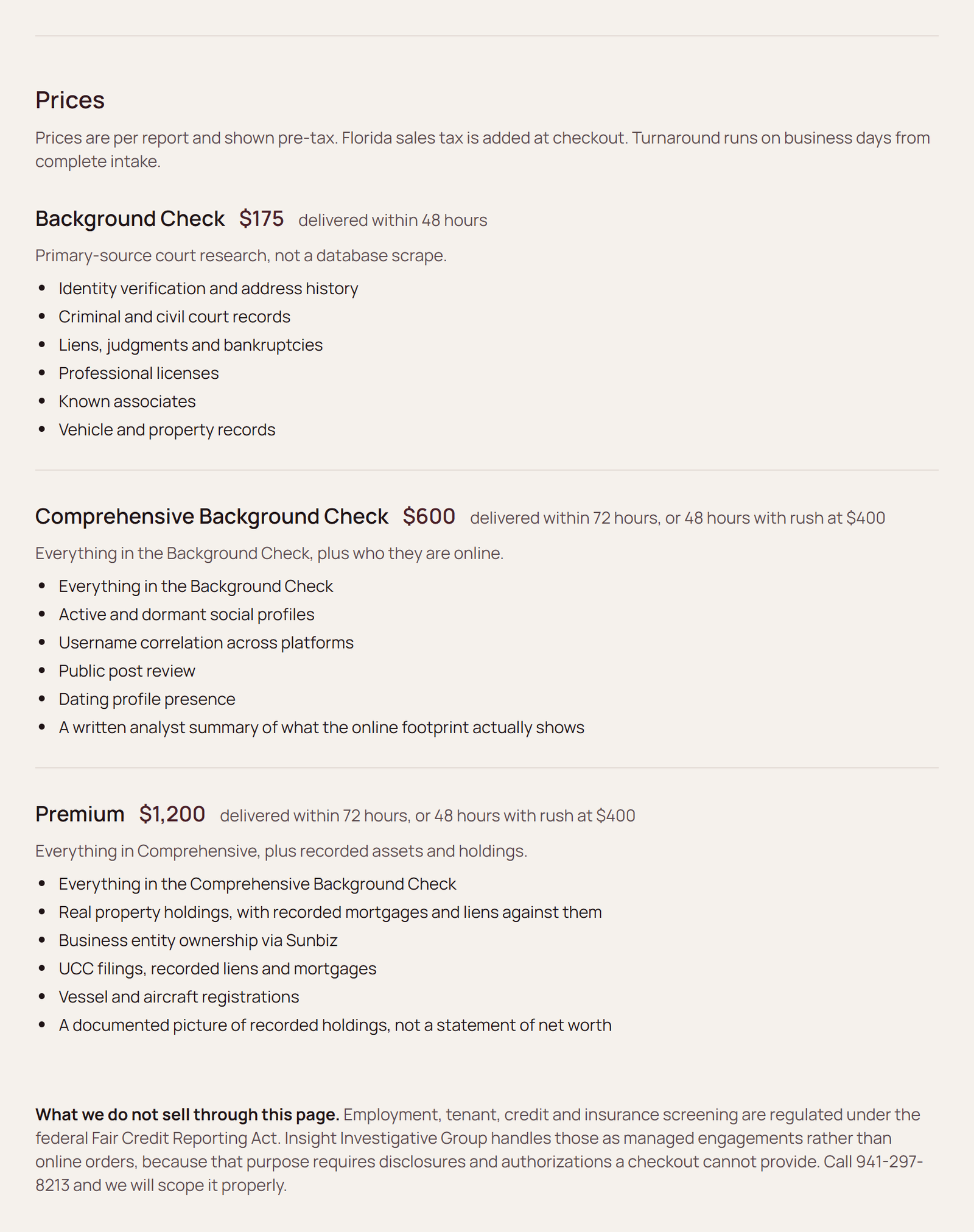
    Premium background investigations including public record asset research are $1,200.

    Call and a licensed investigator answers, day or night, including weekends. Written enquiries are answered within 48 hours.

  • How a Background Check Works

    How a Background Check Works

    A background check is four separate jobs that get sold as one. Identify the person, pull the records that exist under that identity, verify that the records actually belong to them, and write down what could not be confirmed. Consumer platforms do the first two. The value is almost entirely in the second two.

    What a licensed investigator does that software does not

    Software matches on name, age and address history, then returns everything it hits. An investigator starts by pinning the identity down: date of birth, address chronology, known relatives and associates, prior names. Only then do the records get pulled, because a record retrieved before the identity is settled is just a guess with a citation.Then the records get read rather than listed. A charge is not a conviction. A filed lien is not an outstanding one. A dismissed case reported as an arrest is how a person loses a job over nothing. Reading dispositions is unglamorous and it is most of the work.

    Where a background search legally stops

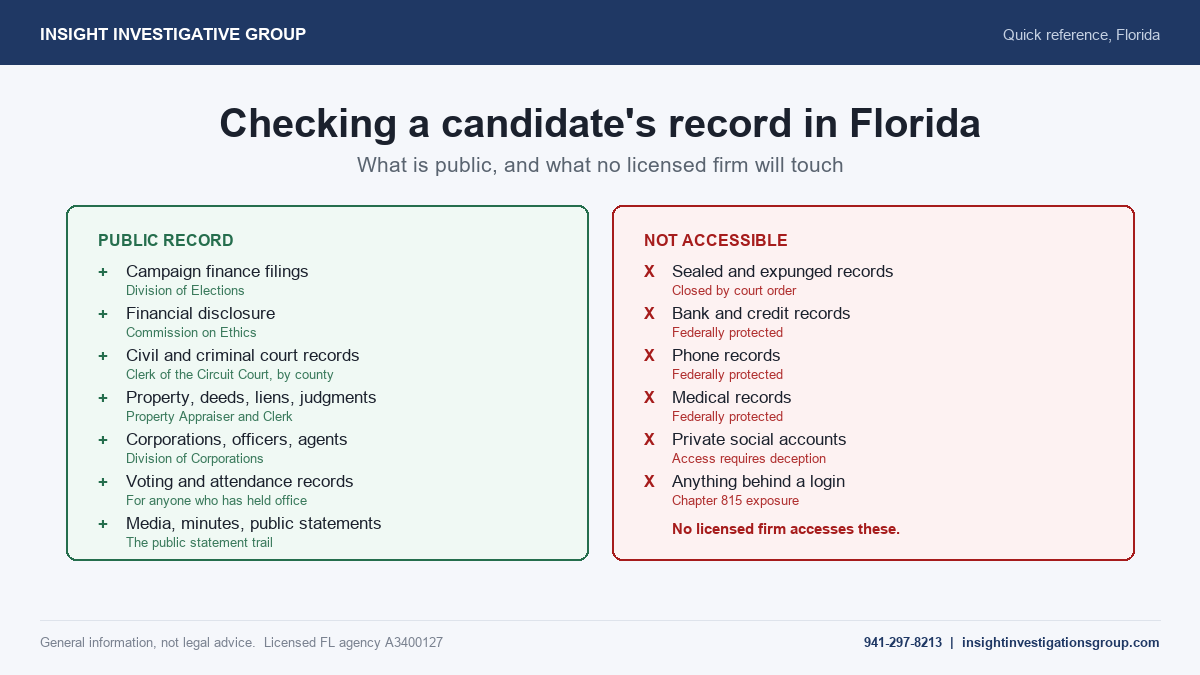
    No licensed investigator can obtain bank balances, telephone call records, sealed or expunged records, credit reports, or medical records. Those are protected by federal and state law and access runs through a subpoena, a court order, or the subject’s own written authorization. Any service implying otherwise is telling you how it treats the law in general.

    In the digital age, where information is both a commodity and a tool, private investigators in Bradenton, Tampa, and Sarasota, FL, find themselves at the intersection of technology and human curiosity. Background searches are not merely a checklist item in an investigator’s portfolio but a critical component that can dictate the success or failure of an investigation. This article delves into the nuances of conducting background searches, emphasizing the pivotal role of utilizing multiple databases and the principle that the quality of information dictates the effectiveness of the outcome.

    The Foundation: Understanding Data and Databases

    At its core, a background search is about compiling and analyzing data to uncover truths hidden beneath layers of public and private records. For investigators operating in Bradenton, Tampa, and Sarasota, leveraging a diverse range of databases ensures accuracy and relevance:

    Comprehensive Coverage: No single database captures everything. Each might specialize in different types of records, such as local criminal history in Sarasota or property records in Tampa.

    Accuracy and Timeliness: Local databases, such as those specific to Manatee and Hillsborough counties, vary in their update frequency. Cross-referencing helps verify data accuracy, ensuring investigators work with the most current information.

    Diverse Data Types: Investigators in Bradenton can access records like local utility bills, while those in Tampa might pull criminal and corporate records to reveal lifestyle or financial patterns.

    The Power of Data in Investigations

    Fraud Detection in Business Partnerships

    Consider a scenario where a business partner in Sarasota suspects fraudulent activities. Here, background searches become not just useful but essential:

    Financial Background: Investigating financial histories and credit reports through local channels in Tampa and Sarasota can highlight patterns of misconduct.

    Corporate Records: Checking Florida’s state and county databases for past business dealings and lawsuits can uncover unethical practices specific to the Tampa Bay area.

    Public Records: Vital records available in Manatee County (Bradenton) and Sarasota County help establish identities and relationships, which might be concealed under different aliases.

    By piecing together information from these local sources, an investigator can paint a detailed picture of a partner’s business ethics, potentially saving a company in the region from significant financial loss or legal complications.

    One of the most emotionally charged investigations involves missing persons, and local expertise in Bradenton and Tampa plays a crucial role:

    Phone Records: Investigators in the Tampa Bay area often begin by examining GPS data from phone records, which can be crucial for pinpointing last known locations.

    Social Media: Local residents of Bradenton, Sarasota, and Tampa frequently use platforms like TikTok, Instagram, and Facebook. Monitoring these can provide leads through posts or check-ins at local spots.

    Public Databases: Accessing traffic camera footage in Tampa or land records in Sarasota offers additional avenues for tracking movements and identifying key locations.

    Localizing these data points makes investigations more robust, increasing the chances of success when locating a missing person in these Florida communities.

    Crafting the Narrative: From Data to Decision

    The true artistry in private investigation lies in synthesizing data into actionable intelligence, particularly when operating in diverse communities like Bradenton, Tampa, and Sarasota:

    Cross-Verification: For example, an address found on a phone bill in Bradenton should match entries in local property records or utility data in the Sarasota area.

    Pattern Recognition: Recognizing behavior patterns, such as movement between Bradenton and Tampa, can help uncover hidden activities.

    Ethical Considerations: Transparency with clients in these areas is essential, as is respecting Florida’s privacy laws.

    Challenges and Considerations

    Data Privacy: With heightened privacy concerns, accessing detailed personal information in Bradenton, Tampa, and Sarasota legally and ethically is crucial.

    Technological Savvy: Staying updated with the latest technology and cybersecurity practices helps protect the information of local clients and the integrity of investigations in the region.

    Human Element: Every data point represents a person, and understanding the cultural nuances of Florida’s Gulf Coast communities ensures sensitivity and discretion.

    In the realm of private investigation, background searches are not just about gathering information; they’re about crafting a narrative that unveils truth from a mosaic of data. Utilizing multiple local and state databases ensures that the information gathered is not only comprehensive but also reliable. As investigators navigate the complexities of human behavior and societal norms in Bradenton, Tampa, and Sarasota, a commitment to thoroughness, accuracy, and ethical practice in data handling remains the cornerstone of effective investigations. Whether it’s uncovering fraud or finding missing loved ones, the art of the background search in private investigation is a testament to the adage: information is power, but only if it’s the right information.

    Order a licensed background investigationPrepared by a Florida-licensed investigator, agency A3400127, and documented to evidentiary standards.


    Written by Joshua Goldberg, Florida private investigator license C3400073, owner of Insight Investigative Group, LLC, agency license A3400127, Bradenton, Florida.

    Related: background checks and published rates.

    Ask an investigator

    Background investigations are $175, $600 or $1,200 depending on depth.

    Call and a licensed investigator answers, day or night, including weekends. Written enquiries are answered within 48 hours.
  • Social Media Background Check

    Social Media Background Check

    Yes, a background check can find social media accounts, and a competent one does. What it cannot do is get inside a private one. The line is public versus private, and it is a legal line, not a technical one.

    Order a licensed background investigationPrepared by a Florida-licensed investigator, agency A3400127, and documented to evidentiary standards.

    Can a background check find social media accounts?

    It can, and account discovery is usually the easy part. People reuse usernames, email addresses and profile photos across platforms, and the connections between accounts are often visible without ever touching a privacy setting. An analyst working from a name, an email and a phone number will typically surface accounts the subject forgot existed.What the accounts are worth is the harder question. A public profile is a claim about a life, and a claim is evidence of something only when it is dated, captured, and set against the rest of the record.

    What a licensed investigator will not do to get in

    We do not create a false identity to send a friend or follow request. We do not log into an account we are not authorized to use. We do not ask a third party to hand over private messages. We do not pretext a platform’s support desk. Pretexting to obtain protected information is unlawful, and evidence obtained that way contaminates the case it was collected for.What we do instead is collect what is publicly visible, timestamp and preserve it properly, and document the collection method so the material survives a challenge later.

    The evolution of Social Media Intelligence (SOCMINT) from a niche capability to a critical asset in modern investigative work is a story of innovation and transformation. My journey began in 2016 when I was deployed with the Joint Special Operations Command (JSOC) to the Middle East, tasked with identifying and targeting ISIS foreign fighters. This experience underscored the enormous potential of SOCMINT, shifting it from a supplementary tool to a core element of strategic intelligence. Today, SOCMINT stands as a cornerstone in a wide range of fields, from military operations to corporate investigations.

    SOCMINT in Combat Operations: A New Frontier in IntelligenceIn 2016, the operational landscape was complex. Foreign fighters were flowing into Iraq and Syria from multiple countries, overwhelming traditional intelligence approaches. SOCMINT became indispensable. At the time, we referred to this as PII (Personally Identifiable Information) OSINT, reflecting the way we leveraged open-source intelligence to gather and analyze sensitive personal data from social media platforms and other digital sources.

    Operational Use: By analyzing social media activities, we mapped out intricate networks. Simple interactions,likes, comments, shared photos,often revealed a wealth of intelligence, identifying affiliations and collaborations among fighters.

    Integration with OSINT: Combining SOCMINT with other open-source data (e.g., satellite imagery, news reports) allowed us to construct comprehensive profiles of these individuals and their support networks. This interdisciplinary approach elevated our capabilities.

    Legal and Diplomatic Impact: SOCMINT also played a crucial role in legal contexts, such as issuing subpoenas and collaborating with international partners, allowing us to share actionable intelligence with foreign governments to dismantle overseas support structures.

    From Military Applications to Mainstream InvestigationsWhat was honed in military operations has since permeated civilian investigations across a range of sectors, making SOCMINT a critical investigative tool in various industries:

    Corporate Investigations: Businesses now deploy SOCMINT for due diligence, insider threat detection, and fraud prevention. Techniques once used to track the movements of foreign fighters are now applied to trace financial irregularities and unauthorized data leaks.

    Law Enforcement: SOCMINT is instrumental in criminal investigations, from locating missing persons to tracking illicit online activities. The speed and accuracy needed on the battlefield are now leveraged to respond to real-time crises such as active shooter situations.

    Civil and Corporate Litigation: SOCMINT has become a valuable asset in courtrooms, where digital footprints often provide key evidence in disputes ranging from defamation to intellectual property violations.

    Advancements and Ethical ChallengesAs SOCMINT has grown, so too has its complexity:

    Technological Evolution: Advances in AI and machine learning have enhanced SOCMINT’s ability to rapidly analyze large datasets and predict patterns, significantly reducing the time needed to identify critical intelligence.

    Ethical and Legal Considerations: The widespread use of SOCMINT has prompted necessary debates around privacy, data ethics, and the responsible use of these powerful tools. These conversations shape how SOCMINT is integrated into both legal frameworks and investigative practices.

    Personal ReflectionLooking back at my time in the Middle East, it is clear that those foundational experiences in SOCMINT paved the way for its current applications across a multitude of sectors. The ability to gather, analyze, and act on intelligence in real-time was revolutionary. However, with this power comes responsibility. Ensuring SOCMINT is used ethically and within legal boundaries is paramount, especially as it continues to evolve.

    ConclusionFrom military operations targeting ISIS fighters to corporate and legal investigations, the story of SOCMINT is one of adaptability and transformation. My expertise in SOCMINT has allowed me to witness firsthand its evolution and its ability to decode human behavior through digital footprints. As the field continues to advance, so too must we, staying ahead of both technological and ethical developments to harness SOCMINT’s full potential.

    Prepared by a Florida-licensed investigator, agency A3400127, and documented to evidentiary standards.


    Written by Joshua Goldberg, Florida private investigator license C3400073, owner of Insight Investigative Group, LLC, agency license A3400127, Bradenton, Florida.

    Related: background checks and cyber investigations.

    Ask an investigator

    Open source and social media investigation is $600, quoted before any work begins.

    Call and a licensed investigator answers, day or night, including weekends. Written enquiries are answered within 48 hours.
  • How to Spot Insurance Fraud

    How to Spot Insurance Fraud

    Insurance fraud is a significant issue that costs the industry billions of dollars annually. As a private investigator or an insurance professional, spotting fraudulent claims is a critical skill that requires a keen eye and meticulous attention to detail. This article will guide you through the process of identifying potential fraud, from recognizing red flags to conducting thorough fraud investigations.

    Understanding Insurance Fraud

    Insurance fraud can take many forms, including false claims, exaggerated damages, and deliberate damage or injury. It is essential to understand the various types of fraud to effectively identify and investigate suspicious claims.

    Common Types of Insurance Fraud

    False Claims: These involve entirely fabricated incidents, such as claiming for an accident that never occurred.

    Exaggerated Claims: In these cases, the claimant exaggerates the extent of damage or injury to receive a larger payout.

    Staged Incidents: These involve deliberately causing an incident, such as a car accident, to claim insurance money.

    Misrepresentation: This includes providing false information when applying for insurance, like lying about health conditions or income.

    Red Flags in Insurance Claims

    Identifying potential fraud starts with recognizing common red flags. While these indicators do not guarantee fraud, they warrant further investigation.

    Unusual Timing and Circumstances

    Immediate Claims: Claims made shortly after obtaining a policy, especially for large amounts, can be suspicious.

    Claims During Policy Changes: Claims made just before or after increasing coverage limits or changing policies.

    Odd Timing: Incidents occurring at unusual times, such as during holidays or late at night.

    Questionable Documentation and Behavior

    Incomplete or Inconsistent Documentation: Missing, altered, or inconsistent documents, such as medical reports or repair bills.

    Reluctance to Provide Information: Claimants who are evasive or refuse to provide additional information or documentation.

    Multiple Claims: Individuals with a history of frequent claims, especially if they involve similar circumstances.

    Specific Red Flags for Different Insurance Types

    Staged Accidents: Witnesses with conflicting accounts, minor damages despite severe injury claims, or unusual accident patterns.

    Phantom Vehicles: Claims involving vehicles that cannot be traced or identified.

    Exaggerated Injuries: Medical claims that do not align with the accident’s severity.

    Unexplained Fires or Thefts: Fires or burglaries with unclear causes or lack of supporting evidence.

    High-Value Items: Claims for expensive items without proper documentation or proof of ownership.

    Repeated Losses: Multiple claims for similar types of damage, like water or fire damage.

    Overtreatment: Claims involving excessive or unnecessary medical procedures.

    Inconsistent Medical Records: Discrepancies between claimed treatments and medical records.

    Unusual Provider Activity: Claims involving healthcare providers with a history of fraudulent activity.

    Conducting a Thorough Investigation

    Once you identify potential red flags, a comprehensive investigation is necessary to determine the claim’s legitimacy. Here’s a step-by-step guide to conducting an effective fraud investigation.

    Step 1: Initial Assessment

    Review the Claim: Examine all documentation provided with the claim, including forms, receipts, and reports.

    Interview the Claimant: Conduct a detailed interview to gather more information and observe the claimant’s behavior and responses.

    Documentation: Gather all relevant documents, including medical records, police reports, and repair bills.

    Witness Statements: Interview witnesses to corroborate the claimant’s account of the incident.

    Surveillance Services: Use surveillance techniques to monitor the claimant’s activities and verify their claims.

    Step 3: Analyze the Evidence

    Compare Documentation: Cross-check all documents for consistency and authenticity.

    Medical Review: Have medical professionals review injury claims and treatment records for legitimacy.

    Expert Consultation: Consult with experts, such as accident reconstruction specialists or forensic accountants, to assess the validity of claims.

    Detailed Report: Prepare a comprehensive report detailing your findings, including all evidence collected and your conclusions.

    Recommendations: Provide recommendations based on your investigation, such as denying the claim or referring the case for further legal action.

    Real-Life Examples of Insurance Fraud

    Example 1: The Phantom Injury

    In one case, an individual claimed to have sustained severe injuries in a minor car accident. The investigation revealed that the claimant had a history of similar claims and that their injuries were inconsistent with the accident’s severity. Surveillance services showed the claimant engaging in physical activities they claimed to be unable to perform, leading to the denial of the claim.

    Example 2: The Vanishing Jewelry

    A homeowner claimed that a burglary resulted in the loss of several high-value jewelry items. Upon investigation, it was found that the claimant had not provided any proof of purchase or ownership for the jewelry. Further, there was no sign of forced entry or a police report filed at the time of the alleged incident. The claim was subsequently denied.

    Preventing Insurance Fraud

    While detecting and investigating fraudulent claims is crucial, preventing fraud from occurring in the first place is equally important.

    Clear Communication: Ensure policyholders understand the terms and conditions of their policies and the consequences of fraud.

    Fraud Awareness: Provide information on common types of fraud and how to avoid being involved in fraudulent activities.

    Enhancing Claim Processes

    Thorough Vetting: Implement rigorous procedures for vetting new policies and claims.

    Advanced Technology: Utilize technology such as data analytics and machine learning to identify patterns and anomalies that may indicate fraud.

    Collaboration: Work with other insurers, law enforcement, and industry groups to share information and resources for combating fraud.

    Strengthening Internal Controls

    Regular Audits: Conduct regular audits of claims and policies to identify potential fraud.

    Employee Training: Train employees on how to recognize and report suspicious activities.

    Robust Policies: Develop and enforce robust policies and procedures for handling fraudulent claims.

    Spotting fraudulent insurance claims requires a combination of vigilance, knowledge, and thorough investigation techniques. By understanding the common types of fraud, recognizing red flags, and conducting detailed fraud investigations, you can effectively identify and prevent insurance fraud. Additionally, implementing preventative measures and educating policyholders can help reduce the incidence of fraud, protecting both insurers and honest claimants.

    Insurance fraud is a complex and evolving challenge, but with the right tools and strategies, private investigators, surveillance services, and insurance professionals can play a crucial role in maintaining the integrity of the insurance industry.


    Written by Joshua Goldberg, Florida private investigator license C3400073, owner of Insight Investigative Group, LLC, agency license A3400127, Bradenton, Florida.

    Related: insurance fraud investigation and surveillance services.

    Ask an investigator

    Confidential case review for carriers, third party administrators and defense counsel.

    Call and a licensed investigator answers, day or night, including weekends. Written enquiries are answered within 48 hours.
  • Are Background Check Sites Accurate?

    Are Background Check Sites Accurate?

    Online background check sites are accurate about some things and unreliable about others, and they do not tell you which is which. They aggregate public records and marketing data, they rarely verify what they aggregate against the source, and they disclaim the accuracy of the result in their own terms of service. That is not a scandal. It is the business model. The problem starts when someone treats the output as a finding.

    Are online background check sites accurate?

    Partly. The underlying public records are usually real. What goes wrong is the matching. These platforms link records to a person using name, approximate age and prior addresses, which is enough to be right most of the time and enough to be confidently wrong the rest of it. Two people with the same name in the same county is the classic failure, and nobody at the company checks.They also age badly. A charge that was later dropped, a lien that was satisfied, an address someone left in 2014: all of it keeps showing up, because refreshing a record costs money and leaving it there does not.

    TruthFinder, like the other consumer search platforms, states in its own terms that it is not a consumer reporting agency, that its reports may not be used for employment, tenant, credit or insurance decisions, and that it does not warrant the information it returns is accurate or current. Read that as written. The company is telling you the output is a lead, not a fact.It is often a useful lead. It is not a verified record, and no licensed professional is accountable for it.

    Why is my background check information wrong?

    Usually one of four reasons. The record belongs to someone else with a similar name. The record is real but stale, and the disposition or satisfaction was never picked up. The record was scraped from an intermediate aggregator rather than the county source, so an error upstream propagated. Or the underlying court record itself contains the error, which happens more than people expect.

    Correcting it means going to the source: the clerk of court, the recorder, the agency that created the record. A consumer platform will remove its listing on request, but that does not fix the record, and the entry frequently reappears on the next data refresh.

    What can a private investigator find that a search site cannot?

    Less than people imagine, and more than it sounds. A licensed investigator has access to regulated databases that consumer platforms cannot resell, but the real difference is verification. We pull the record from the source, we read the disposition rather than the charge, we confirm the record actually belongs to your subject, and we tell you what we could not confirm. A search site cannot do the last one, because it does not know.We also go where no database reaches. Courthouse terminals for counties that never digitised, corporate filings across states, property records under an entity name rather than a personal one, and social media analysis done by an analyst instead of a scraper.

    Who is accountable for the record?

    This is the part that never shows up in a feature comparison. A Florida licensed investigative agency operates under Chapter 493 of the Florida Statutes. Section 493.6121(2) requires it to maintain the case file for at least two years and to produce that file to the state regulator on request. Section 493.6119 prohibits it from divulging the contents of an investigative file to anyone other than the client. Section 493.6119(4) makes a willfully false report to a client a licensing matter, not merely a service failure.A consumer data broker is bound by none of that. It holds no state license that can be suspended, it owes you no statutory duty of confidentiality, and there is no regulator to call about a wrong result. The records may overlap. The accountability does not.

    When a search site is the right tool

    When you want a starting point and nothing depends on the answer. Checking whether a name is worth looking into, confirming a city, getting oriented before you decide whether to spend real money. For that it is fine, and it is cheap for a reason.When something does depend on the answer, when it will be shown to a judge, a board, an insurer or a counterparty, an unverified aggregate is a liability wearing the costume of a report.

    Order a licensed background investigationPrepared by a Florida-licensed investigator, agency A3400127, and documented to evidentiary standards.


    Written by Joshua Goldberg, Florida private investigator license C3400073, owner of Insight Investigative Group, LLC, agency license A3400127, Bradenton, Florida.

    Related: background checks.

    Ask an investigator

    A licensed investigator sources every fact to a record we can name.

    Call and a licensed investigator answers, day or night, including weekends. Written enquiries are answered within 48 hours.
  • How a Modern Private Investigation Actually Gets Done

    How a Modern Private Investigation Actually Gets Done

    A modern investigation is mostly analysis, not stakeouts. Records and open source work establish who a person is and what their pattern looks like, and surveillance is then deployed narrowly to document the specific thing that matters. Reversing that order is how people spend a lot of money for very little.

    Insight Investigative Group is a licensed Florida agency, agency license A3400127, in Bradenton. Our prices are published.

    What happens first in an investigation?

    Identity resolution. Confirming the subject is who you think, and that the records you are about to rely on belong to them and not to someone with a similar name and date of birth. This step is unglamorous and it prevents the single most expensive category of error in this work.

    Then address history, associates, vehicles, property and business affiliations, which together produce a pattern of life: where someone is likely to be, when, and with whom.

    How much of it is open source?

    More than most clients expect. Publicly visible social activity, court filings, corporate records, property records and licensing databases answer a large share of questions outright, and they narrow almost all of the rest.

    Open source work is also what makes surveillance efficient. Knowing that a subject coaches on Tuesdays turns a speculative week into a single chosen day.

    Where does surveillance fit?

    Last, and narrowly. Surveillance documents the specific behaviour the case turns on, once analysis has established when and where to be. Three correctly chosen hours routinely beat twenty spent guessing, which is why we would rather establish the pattern first than sell you days.

    Surveillance is $1,000 per day, flat, including unlimited mileage and travel.

    What does the technology actually change?

    It changes the collection, not the standard. Better cameras, licensed databases and open source tooling mean more can be established faster. What has not changed is that a finding is only worth what its documentation can survive, and that a person has to be able to stand behind it.

    The volume of available data has also made the analyst more important, not less. Anyone can retrieve a hundred records. The work is knowing which three matter and what they mean together.

    What does an investigation cost?

    Background investigations are $175, $600 or $1,200 depending on depth, with rush delivery at $400. Surveillance is $1,000 per day. Locates start at $100. Bug sweeps are $1.50 per square foot with a $500 minimum. Everything is scoped and quoted in writing before any work begins.


    Written by Joshua Goldberg, Florida private investigator license C3400073, owner of Insight Investigative Group, LLC, agency license A3400127, Bradenton, Florida.

    Related: background checks and published rates.

    Ask an investigator

    We will tell you honestly whether an investigator is the right answer for your situation. We have told people the answer was no.

    Call and a licensed investigator answers, day or night, including weekends. Written enquiries are answered within 48 hours.
  • Which Cybercrimes Can a Private Investigator Actually Investigate?

    Which Cybercrimes Can a Private Investigator Actually Investigate?

    A licensed investigator can work most cybercrime matters that turn on identifying a person or documenting a pattern, and cannot work the ones that require compelled access. That single distinction explains almost every answer below.

    Insight Investigative Group is a licensed Florida agency, agency license A3400127. Open source investigation starts at $600.

    Which matters can a private investigator work?

    Online harassment and cyberstalking, where the job is documenting a course of conduct. Attribution of anonymous accounts from open sources. Romance, investment and cryptocurrency fraud, including tracing funds across public blockchain records. Impersonation and cloned business listings. Online defamation, where preserving what was published and when is the whole case. Employee misconduct on systems the employer owns.

    Which matters belong with law enforcement?

    Anything requiring compelled disclosure: subscriber records from a platform, content of communications, financial records held by a bank. Anything involving an active intrusion into critical systems. Anything involving child exploitation material, which must go to law enforcement immediately and should never be collected or forwarded by a private party.

    A private investigation frequently runs alongside a law enforcement one rather than instead of it. A well documented private file is often what gets an overloaded agency to pick a case up.

    Why do people hire an investigator instead of just calling police?

    Volume and threshold. Local agencies triage, and a single harassment complaint with a folder of screenshots usually sits behind matters with clearer immediate harm. A documented chronology with attribution already established changes what a detective is looking at.

    There is also the civil track, which police do not serve at all. If your objective is an injunction, a defamation claim or a recovery action, you need documentation built for that, not a case number.

    What is the hard limit?

    We do not access accounts, devices, email or cloud storage. We do not recover or bypass passwords. We do not intercept communications, which section 934.03 of the Florida Statutes prohibits without the consent of all parties. Any firm offering to hack an account for you is describing a computer crime.

    What should I preserve before calling anyone?

    Everything, and immediately. Full-screen captures showing URLs, account names and timestamps. Intact message threads. A written log of when each thing happened. Do not confront the account and do not warn the person, because the first thing a subject does when warned is delete.


    Written by Joshua Goldberg, Florida private investigator license C3400073, owner of Insight Investigative Group, LLC, agency license A3400127, Bradenton, Florida.

    Related: cyber investigations and background checks.

    Ask an investigator

    Consultations are confidential and we will tell you plainly when a matter belongs with law enforcement rather than with us.

    Call and a licensed investigator answers, day or night, including weekends. Written enquiries are answered within 48 hours.