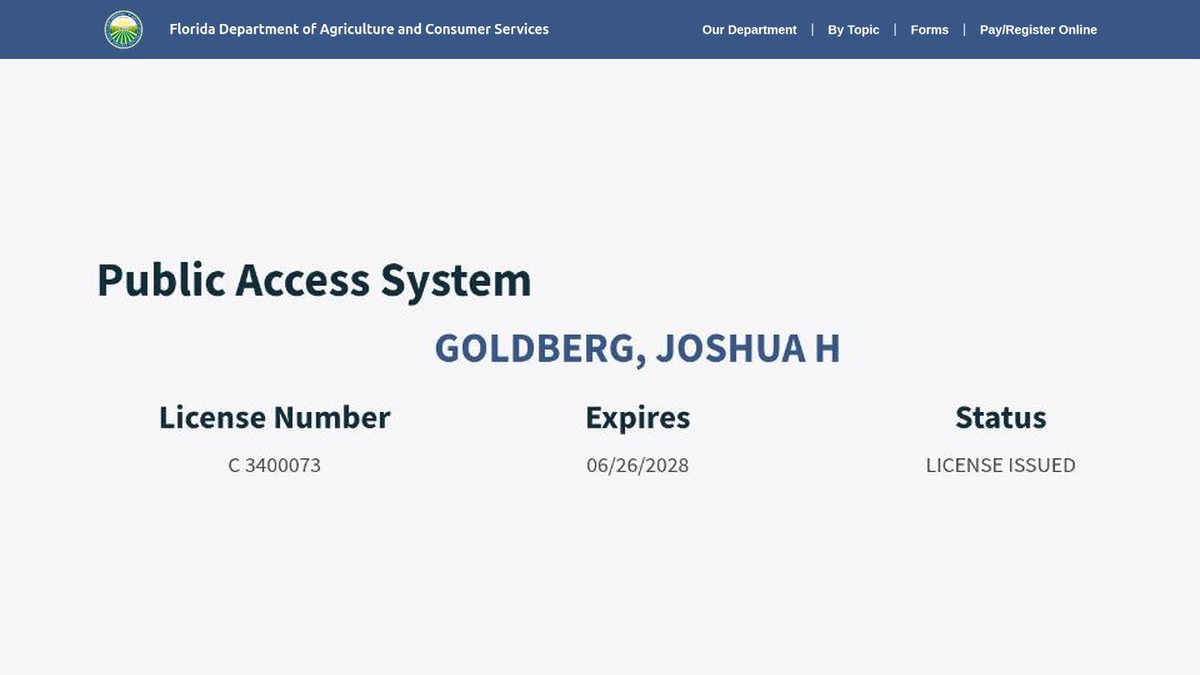
Ask for two license numbers, one for the agency and one for the investigator, then look both up on the state’s public license search. Florida licenses private investigators through the Department of Agriculture and Consumer Services, Division of Licensing, under Chapter 493, Florida Statutes. Insight Investigative Group, LLC is a licensed Florida private investigative agency in Bradenton, agency license A3400127, and our own record is the example below.
This is general information about Florida law, not legal advice. A question about your own situation belongs with an attorney.
Who licenses private investigators in Florida?
The Florida Department of Agriculture and Consumer Services, FDACS for short, through its Division of Licensing. Under section 493.6107(5), the state license lets the holder practice anywhere in Florida without any additional license, permit or registration (an agency may still need a local occupational license for its office), so there is no separate Bradenton, Sarasota or Tampa investigator license to look for.
What do the license classes mean?
Class A is the agency license, which section 493.6201(1) requires of any person, firm, company, partnership or corporation that engages in business as a private investigative agency. Class C is the individual investigator license, which section 493.6201(5) requires of any individual who performs the services of a private investigator. Under section 493.6203, a Class C applicant needs two years of lawfully gained, verifiable, full-time experience or training and must pass an examination on the chapter.
Class CC is the intern license, for private investigative work under the direction and control of a designated, sponsoring Class C, MA or M licensee. Under section 493.6111(2), a Class C license is valid for two years and a Class A license for three.
Does an investigator need an agency license to take your case?
Yes. Section 493.6101(15) defines a private investigative agency as any person who, for consideration, advertises as providing or is engaged in the business of furnishing private investigations, and section 493.6201(1) requires that business to hold a Class A license. A Class C licensee must also own or be an employee of a licensed agency or branch office under section 493.6201(4), and person includes an individual under section 493.6101(2), so a one-investigator firm needs both.
How do you look up a license on the state search?
Start at the department’s Search for a Licensee page, which links to an agency search and an individual search. Each has category and county lists, a name field and a license number field. The department says the search also covers applicants, and that individual address and phone information for private investigators is restricted from public record under section 493.6122.
Each search says a one-letter license type is entered as the letter, a space, and seven numbers, and a two-letter type takes no space, so A3400127 becomes A 3400127 on the agency search and C3400073 becomes C 3400073 on the individual search. Section 493.6111(1) requires every license to show the licensee’s name, license number and expiration date, and each search’s record view has fields labeled License Number, Expires and Status. Read the status and expiration date.
Does a Florida investigator have to show a license number?
In the places the statute names, yes. Section 493.6111(6) reads: “A licensed agency must include its agency license number in any advertisement in any print medium or directory, and must include its agency license number in any written bid or offer to provide services.” That covers print, directories and written bids or offers; it does not mention websites. A written proposal without the number is missing something the statute requires. Ours appear in the footer of this site.
What does Chapter 493 say about your file?
Two sections, both written for licensees. Section 493.6119(1) bars a licensee or an employee of a licensed agency from releasing an investigative file to anyone other than the client or employer, except as the chapter or other law provides, when the client alleges a violation of the chapter, or with the client’s prior written consent. Subsection (4) bars a willfully false report to the client. Section 493.6121(2) requires records to be kept in Florida for two years and produced to the department on request. Our FAQ page covers both.
What are the warning signs of unlicensed work?
Under section 493.6120(1), activity that requires a Chapter 493 license, done without one, is a first degree misdemeanor on a first violation and a third degree felony on a second or subsequent one, when the department may also seek a civil penalty of up to $10,000. The section does not apply within 90 days after the person’s license expires. Signs to watch for:
- A written quote or proposal with no agency license number. Section 493.6111(6) requires one on any written bid or offer to provide services.
- An investigator license with no agency behind it. Section 493.6201(4) requires a Class C or CC licensee to own or be an employee of a licensed agency or branch office.
- A badge or credentials that would cause a reasonable person to believe the holder is a law enforcement officer or has official authority, a ground for discipline under section 493.6118(1)(i).
- A firm that will not name the person doing the work. Under section 493.6118(1)(n), employing or contracting with an unlicensed or improperly licensed person for regulated work is a ground for discipline when that status could have been found by reasonable inquiry, so check that person too.
What does a license not tell you?
A license is a floor, not a grade. Under section 493.6108(1), except as the chapter otherwise provides, it tells you the department investigated the applicant before issuing it, including fingerprint and police records. It does not tell you whether the investigator has done your kind of work or will be the person on your file. It is not a guarantee of quality. For discipline, the department says final orders on Chapter 493 complaints are indexed with the Florida Division of Administrative Hearings.
Verify the license first, then ask what it cannot answer: who will do the work, what the report will contain, and what it will cost, in writing. Our about page sets out who runs our cases and his training. To ask a person, call 941-297-8213 or use the contact page.
Questions we are asked
What is the difference between a Class A and a Class C license in Florida?
Class A is the agency license and Class C is the individual investigator license. Section 493.6201 requires the business to hold a Class A and the person doing the work to hold a Class C. Insight Investigative Group holds agency license A3400127, and Joshua Goldberg holds investigator license C3400073.
How long is a Florida private investigator license valid?
Under section 493.6111(2), licenses run two years, except Class A, Class B, Class AB, Class K, Class R and branch agency licenses, which run three. The department’s FAQ says a license expired for more than three months cannot be renewed and the holder must apply for a new one.
Is it illegal to work as a private investigator in Florida without a license?
Yes. Section 493.6120(1) makes it a first degree misdemeanor for a first violation and a third degree felony after that, when the department may also seek a civil penalty of up to $10,000. Section 493.6102 exempts some people, including attorneys in regular practice and unarmed investigators employed solely, exclusively and regularly in their employer’s own business.
How do I report an unlicensed private investigator in Florida?
Through FDACS. Its website says to contact the nearest regional office or use its online complaint form. Section 493.6121(1) lets the department investigate on the complaint of any person, and section 493.6121(3) lets it issue a cease and desist order or seek an injunction against someone advertising or performing services that require a license.
Written by Joshua Goldberg, Florida private investigator license C3400073, owner of Insight Investigative Group, LLC, agency license A3400127, Bradenton, Florida.
Related: about the firm and frequently asked questions.
Ask an investigator
Call and a licensed investigator answers, day or night, including weekends. Written inquiries are answered within 48 hours.