
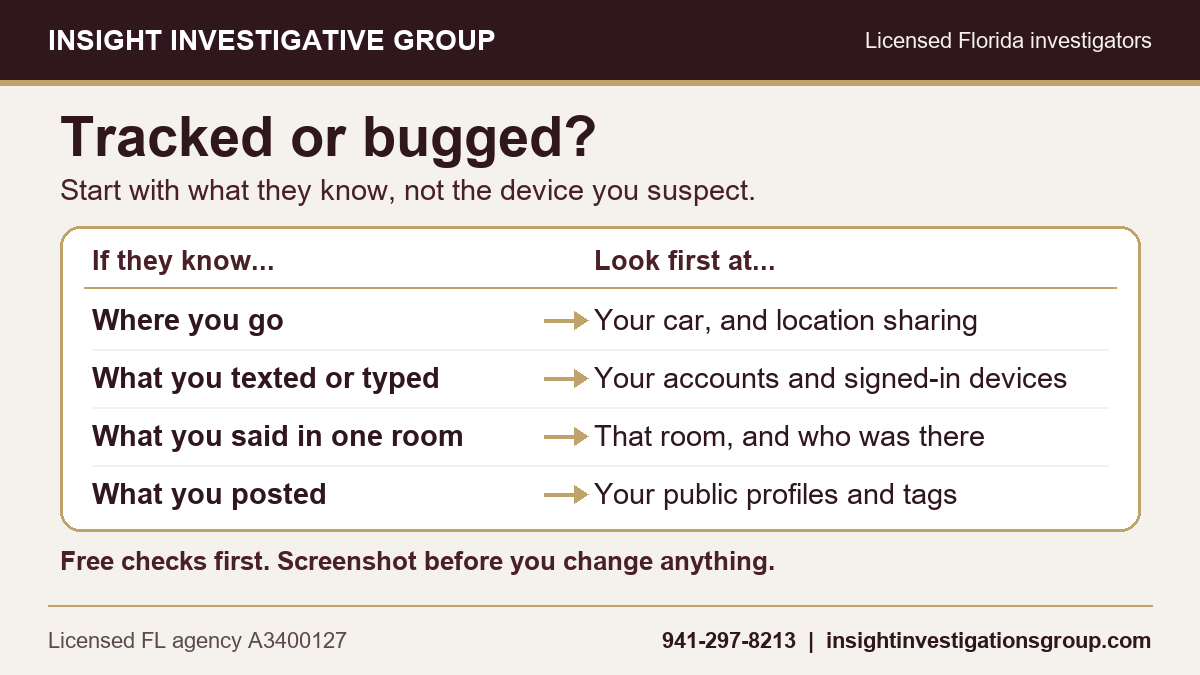
Start with what the other person knows, not with the device you suspect. If they know where you go, look at your car and at the location settings on your phone and accounts. If they know what you texted or typed, look at your accounts. If they repeat what you said out loud in one room, look at that room. Each one has its own check, and the free checks come first.
Insight Investigative Group, LLC is a licensed Florida private investigative agency in Bradenton, agency license A3400127. We sweep a vehicle for $500 flat, sweep homes and offices at $1.50 per square foot with a $500 minimum, and investigate online harassment starting at $600.
If you think someone is tracking you, read the rest of this on a device that person has never used or set up, and do not talk about it inside your home or car until you know more. This is general information about Florida law, not legal advice.
What does the other person know?
Write down three things they knew that you never told them, and how they could have learned each one. The answer usually narrows itself.
- Where you are, or where you went. Look at a tracker on your car, a small item tracker in a bag or vehicle, or location sharing still switched on in your phone or an account you share.
- What you texted, emailed or searched. Look at your accounts: a shared Apple ID or Google account, an old tablet or laptop still signed in, a password the other person knows.
- What you said out loud, in one place. Look at that room or that car, and at who else was there.
- What you posted, or who you are spending time with. Often nothing technical at all: your own posts, photos you were tagged in, friends’ accounts, people you both know.
Why should I check my accounts first?
Because it costs nothing and you can do it tonight, from a device the other person cannot reach. Look for:
- Devices and sessions signed in to your Apple ID, Google account, email and social media that you do not recognize.
- Location sharing you did not turn on, or forgot to turn off: Find My, Google Maps location sharing, family locator apps and phone carrier family plans.
- Recovery email addresses and phone numbers that are not yours.
- Mail forwarding rules and filters you did not create.
- Shared photo albums and cloud backups the other person can still open.
Take screenshots of what you find before you change anything. Removing someone’s access tells them you found it, and it can erase the record of how long they had it.
Florida law covers this. Section 784.048 of the Florida Statutes includes in its definition of cyberstalking accessing, or attempting to access, another person’s online accounts or Internet-connected home electronic systems without permission, when it causes substantial emotional distress and serves no legitimate purpose.
Will my phone tell me if I am being tracked?
Sometimes. Apple says an iPhone running iOS 14.5 or later alerts you when an AirTag or other Find My network accessory that is away from its owner is seen moving with you, and compatible Bluetooth trackers from other makers need iOS 17.5 or later. Apple also says Android devices running 6.0 or later can notify you automatically and let you run a manual scan.
Those alerts are built for Bluetooth item trackers. A GPS unit hidden on a car that reports its position over its own cellular connection is a different kind of device, and your phone is not built to warn you about it. No alert does not mean no tracker.
When is a vehicle sweep the right call?
When the other person knows where the car went, and your accounts and location settings come back clean. A vehicle sweep covers the undercarriage, wheel wells, bumpers, the OBD port and the interior, looking for GPS trackers, audio devices and cameras. It is $500 flat for one vehicle, compact through standard SUV. Larger vehicles, boats and fleets are quoted.
If you find a device yourself, leave it where it is and photograph it in place if you can do so safely. Under section 934.425 of the Florida Statutes, installing a tracking device or tracking application on another person’s property without consent, or using one to follow another person’s location, is generally a crime. It has been a third degree felony since October 1, 2024, and since October 1, 2025 it is a second degree felony when done to commit or help commit a dangerous crime. Our post on whether it is legal to put a GPS tracker on a car in Florida covers the exceptions and what a found device is worth as evidence.
When does a home or office need a bug sweep?
When conversations from one room or one office get out, your accounts check clean, and someone had access to the space: an ex-partner, a former employee, a contractor, a business rival. Do not discuss the sweep inside that space. Call from somewhere else.
Home and office sweeps are $1.50 per square foot with a $500 minimum, so a 1,200 square foot home is $1,800. The sweep combines electronic detection with a hands-on physical inspection for hidden cameras, listening devices and transmitters. A clean result describes the space on the day it was swept, nothing more. Our TSCM bug sweep page covers what we check and what happens if we find something.
When is it a cyber investigation instead?
When the problem is not how they know, but what they are doing with it: repeated messages, new accounts after you block the old ones, posts about you, fake profiles, impersonation. Section 784.048 treats cyberstalking as a course of conduct, so what helps is a documented pattern over time, not one screenshot.
That work is preservation, a written chronology, and attribution of anonymous accounts from open sources. Open source and social media investigation is $600; extended attribution across several platforms is scoped and quoted in writing first. See cyber investigations and how to tell if you are being followed online.
What can a private investigator not do?
We do not get into the other person’s phone, email, cloud storage or social media accounts, and no licensed investigator can. We do not intercept calls or messages, which section 934.03 of the Florida Statutes prohibits without the consent of all parties, and we do not obtain phone records. A bug sweep is not phone forensics.
If you think a monitoring app is on your own phone, bring us the device you own and control. We will tell you plainly whether what you need is within our scope or belongs with a dedicated forensics lab. A firm that offers to get into the other person’s accounts for you is describing a crime.
What should I do today?
- Use a phone and a device the other person has never had access to.
- Write down what they knew, and when they showed they knew it.
- Run the account checks above and screenshot before you change anything.
- Do not confront them, and do not remove anything you find.
- If the person has threatened or hurt you, talk to law enforcement or a domestic violence advocate before you cut off their access, because that tells them you know. The National Domestic Violence Hotline is 1-800-799-7233, or text START to 88788.
- Call 941-297-8213. A licensed investigator answers, day or night, including weekends.
Questions we are asked
Can a private investigator find a GPS tracker on my car?
Yes. A vehicle sweep is a hands-on inspection of the undercarriage, wheel wells, bumpers, OBD port and interior for GPS trackers, audio devices and cameras. Insight Investigative Group charges $500 flat for one vehicle, compact through standard SUV.
Will my iPhone or Android warn me about a tracker on my car?
Only some kinds. Apple says iPhones on iOS 14.5 or later alert you to an AirTag or Find My accessory moving with you, and Android devices on 6.0 or later can notify you and run a manual scan. A GPS unit that reports over its own cellular connection is not covered by those alerts.
Is it a crime to track someone’s car or phone in Florida without consent?
Generally, yes. Section 934.425 makes it a third degree felony to install, place or use a tracking device or tracking application to follow another person without consent, and a second degree felony when done to commit or help commit a dangerous crime. The statute lists exceptions, among them law enforcement acting lawfully in a criminal investigation, a court order, some parents and guardians of minor children, and the owner or lessee of a vehicle under conditions it spells out. Ask an attorney about your own facts.
Should I remove a tracker or monitoring app if I find one?
Not first. Photograph and document it where it is, because it may be evidence of a crime, and removing it tells the other person you found it. If that person has been violent or threatening, make a safety plan with law enforcement or an advocate before you remove anything.
How much does it cost to find out?
A vehicle sweep is $500 flat. A home or office sweep is $1.50 per square foot with a $500 minimum. Open source and social media investigation for online harassment is $600. Florida sales tax is added, and every engagement is quoted and agreed in writing before work begins. Our rates page lists the rest.
Written by Joshua H. Goldberg, Florida private investigator license C3400073, owner of Insight Investigative Group, LLC, agency license A3400127, Bradenton, Florida. General information, not legal advice.
Related: TSCM bug sweeps, cyber investigations and rates.
Ask an investigator
If you think someone is tracking you, contact us from a phone and a device they cannot reach.
Call and a licensed investigator answers, day or night, including weekends. Written inquiries are answered within 48 hours.