
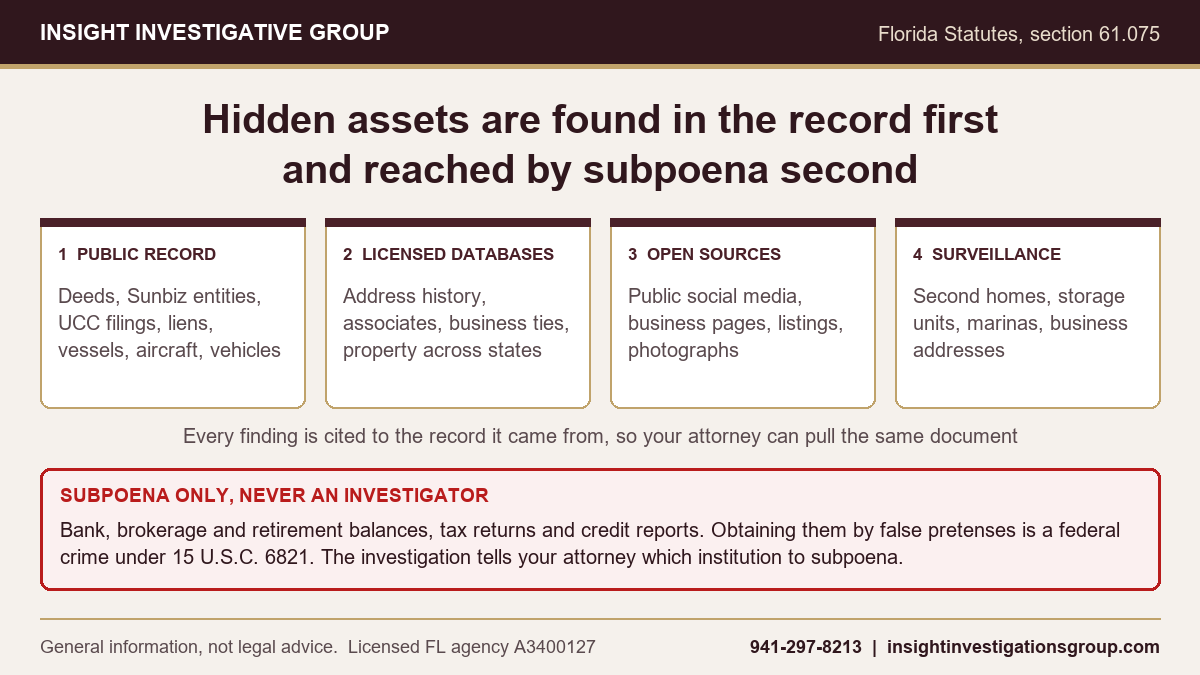
Start with the public record. In Florida, real estate, business entities, liens, boats, aircraft and vehicles are all recorded somewhere, and a licensed investigator finds a spouse’s hidden assets by pulling those records and connecting them back to the person, including the ones held through an LLC, a trust or a relative. Bank, brokerage and retirement balances come second, through the mandatory disclosure and subpoena process that your attorney controls. The investigator’s product is a documented map of what exists and where it sits, so the attorney knows exactly where to send the subpoena.
Insight Investigative Group, LLC is a licensed Florida private investigative agency, agency license A3400127, investigator license C3400073, based in Bradenton and conducting public record asset research for divorce and equitable distribution matters across Sarasota, Manatee and the greater Tampa Bay area. Public record asset research is a fixed $1,200 as the Premium tier of our background investigations. What follows is how we explain the work to clients and their attorneys before a case starts. It is general information about Florida law, not legal advice. For your own situation, talk to a family law attorney.
Why do hidden assets decide a Florida divorce?
Because the court divides what it can see. Section 61.075 of the Florida Statutes tells the judge to begin from the premise that marital assets and liabilities are divided equally, and in a contested case the judgment has to identify each marital asset, value the significant ones and say who receives what, all supported by competent substantial evidence. An asset that never makes it onto that list never gets divided. That is the entire incentive to hide one.
The same section gives the court a tool against it. Under section 61.075(1)(i), the intentional dissipation, waste, depletion or destruction of marital assets after the petition is filed, or within the two years before it, is a factor that can justify an unequal distribution. Money moved out of the marital estate in the run-up to a filing is not gone for legal purposes. It is a reason for the judge to adjust the split, provided someone documents it.
Florida’s premarital agreement statute, section 61.079, runs on the same principle in reverse. A prenuptial agreement can be attacked if it was unconscionable when signed and the challenging party was never given a fair and reasonable disclosure of the other side’s property and financial obligations. Verifying that disclosure before the wedding is the same records exercise as finding assets after the marriage ends.
What does Florida already force each spouse to disclose?
More than most people expect. Florida Family Law Rule of Procedure 12.285 requires each party in a dissolution case to serve a sworn financial affidavit plus a long list of documents, generally within 45 days of service of the initial pleading: three years of complete federal and state tax returns with every schedule and K-1, six months of pay records, twenty-four months of loan applications, financial statements and credit reports, three years of deeds, twelve months of statements for every checking, brokerage, retirement and virtual currency account, life insurance declarations, and three years of corporate, partnership or trust returns where the party holds an ownership interest. The court or the parties can modify most of that list. The financial affidavit itself cannot be waived.
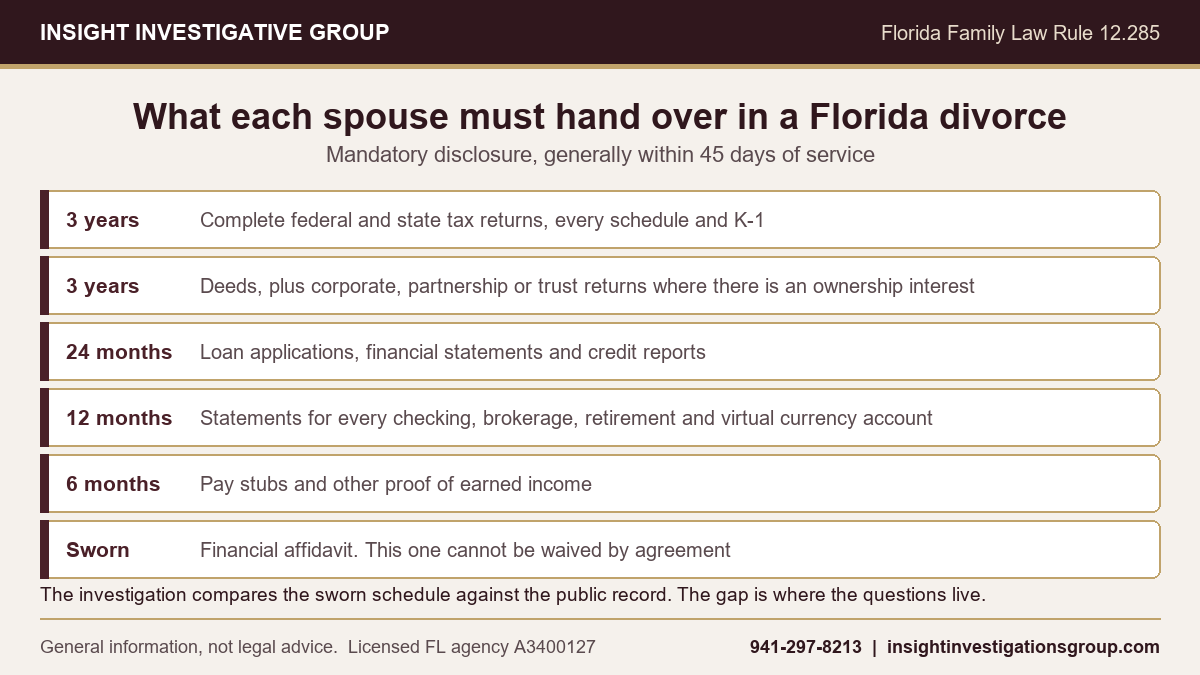
This is why an investigator’s work in a divorce is a comparison exercise. The affidavit is sworn. The public record is independent. The interesting cases live in the gap between the two: the LLC formed eleven months before the filing that appears in Sunbiz and nowhere on the affidavit, the deed recorded in a sibling’s name, the boat registered to a company the spouse “does not own.” Every one of those is a question the attorney gets to ask under oath.
Where do people actually hide assets?
The patterns repeat. In a high-asset Florida divorce, concealment rarely means a suitcase of cash. It means title and timing.
Inside an entity. Real estate is deeded to a new LLC. A vehicle or vessel is titled to the business. A holding company is formed in another state. Florida’s Division of Corporations records every domestic and foreign entity registered here, with officers, managers, registered agents, filing dates and annual reports, and the equivalent registries in other states do the same. Connecting an entity to a person is the actual work, and it is where a database printout and an investigation stop being the same product.
In someone else’s name. A parent, a sibling, a business partner, a new partner. The deed is real and the property is real; only the name on it is a proxy. Address history, recorded mortgages and the pattern of who pays for what tend to expose it.
In a trust. Trust instruments are private in Florida, but the deed that moved a property into the trust is recorded in the county’s official records, and the trustee’s name is on it.
Out of state. Second homes, a condominium bought during the separation, land held through an out-of-state entity. Nationwide property searches exist for this reason.
On the water and in the air. Sarasota and Manatee are boat counties. Florida vessel registrations run through the state’s Department of Highway Safety and Motor Vehicles, larger vessels are often federally documented with the Coast Guard, and aircraft sit in the FAA registry. A slip at a marina is also a place a subject drives to, which matters later.
Inside a business. Deferred bonuses, invoices delayed until after the judgment, a new vendor company that happens to belong to a brother-in-law, payroll to a relative who does not work there, overpaying estimated taxes to collect the refund after the divorce. Tracing that money is a forensic accountant’s job. Identifying the entities, the people and the relationships behind it is ours, and the accountant’s work goes faster when someone has already drawn the map.
In things. Vehicles, jewelry, art, collectibles, a storage unit rented the month before the filing. Vehicle records are available to a licensed investigator for use in connection with litigation under the federal Driver’s Privacy Protection Act. The rest usually surfaces through lifestyle: a sworn affidavit showing modest income next to a lease on a second vehicle, a boat slip and a club membership.
What can a licensed investigator lawfully find?
Four layers, each cited back to its source.
Public records. County property appraiser and clerk of court official records, which in our home counties means Manatee and Sarasota, plus Hillsborough for Tampa matters. Sunbiz and out-of-state corporate registries. The Florida Secured Transaction Registry for UCC filings. Recorded liens, judgments and mortgages. Vessel, aircraft and vehicle records. Federal court and bankruptcy dockets. Civil litigation history. Professional licenses and fictitious name filings.
Licensed databases. Investigators hold access to regulated data platforms that aggregate address history, known associates, business affiliations and property across states. We use them to find the thread, then pull the primary record, so the report cites a document your attorney can obtain independently.
Open source intelligence. Public social media and web presence, viewed as any member of the public could. A boat in the background of a photograph, a business page for a company that is not on the affidavit, a listing for a property the spouse supposedly never owned. We do not log into anyone’s account and we do not use a false identity to gain access.
Surveillance. Where the subject actually goes: a second residence, a storage facility, a marina, a business address that is not on any filing. Physical surveillance from lawful vantage points, silent video and a written log, at $1,000 per day flat with mileage and the report included. Our article on whether surveillance is legal in Florida covers the rules in detail, and our surveillance page covers the fieldwork.
The deliverable is a written report in which every holding is cited to the record it came from, with the connection between each entity and the spouse spelled out. Your attorney can pull the same document and put it in front of a witness.
What will an investigator not do, and why does that protect you?
We do not obtain bank balances, brokerage or retirement holdings, credit reports, tax returns or the contents of a safe deposit box. Obtaining a person’s financial records from an institution by false pretenses is a federal crime under the Gramm Leach Bliley Act, 15 U.S.C. section 6821, and so is asking someone else to do it. Any service that advertises bank account balances for a fee is either lying or committing that crime on your behalf, and the exposure lands on the person who paid.
We do not access a spouse’s phone, email or cloud accounts. Accessing a computer or device without authorization is an offense under section 815.06 of the Florida Statutes, and intercepting a private communication without the consent of everyone involved is a felony under section 934.03. We do not place tracking devices. Section 934.425 makes that a third degree felony, and it presumes consent is revoked the moment a divorce petition is filed, a point our spouse tracking article covers in full.
The reason is not squeamishness. Evidence gathered unlawfully is at risk of exclusion, it taints the case it sits in, and in a family matter the exposure can reach custody and attorney’s fees. Every bank and brokerage record you need is reachable lawfully: your attorney serves a subpoena on the institution the investigation identified, and the records arrive through a process the court recognizes. The investigator’s job is to make that subpoena precise.
How does an attorney turn findings into a better outcome?
The sequence is usually the same. The records search runs early, ideally before the other side’s financial affidavit lands, so counsel can compare the sworn schedule against what is recorded. Discrepancies become requests for production, subpoenas to specific institutions and deposition questions. Where a business is involved, a forensic accountant values it and traces the money, working from the entity map the investigator built. If the picture shows assets moved out in the two years before filing, section 61.075(1)(i) gives the court a basis to adjust the division. Where an asset is at risk of disappearing during the case, section 61.075(5) allows an interim partial distribution on a sworn motion showing extraordinary circumstances.
None of that is a promise about any particular case. Judges weigh the evidence in front of them. What an investigation changes is the quality of that evidence and its timing: findings that arrive before mediation shape a settlement, and findings that arrive after the judgment are a collection problem.
What does this look like in Sarasota and Manatee?
The Twelfth Judicial Circuit, covering Manatee, Sarasota and DeSoto counties, handles a steady flow of high-asset dissolutions, and the local geography shapes the search. Waterfront property on Longboat Key, Siesta Key, Casey Key, Bird Key and Anna Maria Island is frequently held through entities and trusts. Lakewood Ranch and downtown Sarasota are home to closely held businesses, and in those divorces the spouse who runs the company usually holds all the information. Marinas from Cortez to Venice are where the vessels live. The official records of the Manatee County and Sarasota County clerks, and both county property appraisers, are the first stop on nearly every file, and from our Bradenton office the courthouses, the marinas and the neighborhoods are minutes away. Our Sarasota page covers the local work in more depth, and our domestic investigations page covers the surveillance side of these cases.
Discretion matters more in this work than in almost any other. Under section 493.6119 of the Florida Statutes, the contents of an investigative file are confidential to the client, and the fact that you hired anyone at all stays with us. If you believe your spouse has access to your phone, email or home network, contact us from a device they cannot reach.
What does an asset investigation cost?
Public record asset research is included in our Premium background investigation at a fixed $1,200, delivered within 72 hours of complete intake. It covers nationwide property with recorded mortgages and estimated equity, business ownership, UCC filings, liens and judgments, vessel and aircraft registration, and a documented net worth estimate built only from public record. Rush handling moves delivery to 48 hours for an additional $400. Standalone searches involving several entities or several states are scoped and quoted in writing before any work begins. Surveillance is $1,000 per day, flat. Florida sales tax applies to investigative services. Every price we charge is on our rates page, and the service itself is described on our asset search page.
Questions we are asked
Can a private investigator find hidden bank accounts in a Florida divorce?
Not the balances, and not lawfully. Bank, brokerage and retirement records are protected by federal law, and obtaining them under false pretenses is a crime under 15 U.S.C. section 6821. What a licensed investigator can do is identify where the accounts are likely to be, through public records, entity filings and lawful observation, so your attorney can subpoena the right institution.
What happens if my spouse hides assets in a Florida divorce?
Section 61.075(1)(i) of the Florida Statutes lets the court treat the intentional dissipation, waste or depletion of marital assets after filing, or within the two years before it, as a factor justifying an unequal distribution. Assets left off a sworn financial affidavit also expose the spouse who signed it. How a particular court responds depends on the evidence, which is why documentation matters more than suspicion.
Can assets held in an LLC or a trust be found?
Often, yes. Florida’s Division of Corporations records officers, managers, registered agents and annual reports for every registered entity, and the deed that moves property into a trust is recorded in the county’s official records with the trustee’s name on it. Connecting those filings back to a spouse is the substance of an asset search.
Is it legal to hire a private investigator to find my spouse’s assets?
Yes. A licensed Florida investigator works from public records, licensed databases, open sources and surveillance conducted from lawful vantage points, and under section 493.6119 the investigative file is confidential to the client. What no license permits is accessing the other spouse’s accounts, devices or financial institutions, and a firm that offers to is a liability to your case.
How much does a hidden asset search cost in Florida?
Insight Investigative Group includes public record asset research in its Premium background investigation at a fixed $1,200, delivered within 72 hours. Searches involving several entities or several states are quoted in writing before any work begins.
Speak with a licensed investigator
Call 941-297-8213, or use the contact page. Tell us what you already know: the business, the properties, the boat, the timing. We will tell you what the public record can answer, what will need a subpoena and what it will cost, in writing, before any work begins. If your spouse may have access to your devices, contact us from one they cannot reach.