
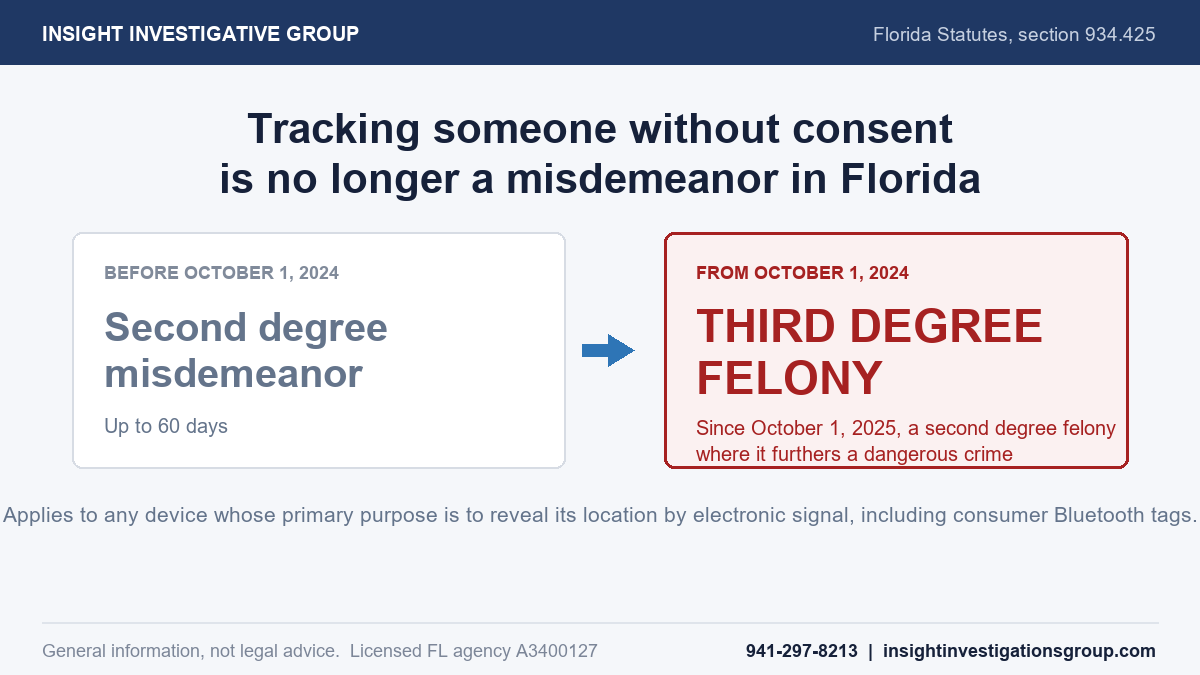
No. Placing a tracking device or a tracking application on another person’s property without their consent is a third degree felony in Florida under section 934.425 of the Florida Statutes. That penalty took effect on October 1, 2024, replacing what had been a second degree misdemeanor. Recording a private conversation without the consent of everyone in it is a separate third degree felony under section 934.03.
Most of the advice still circulating online was written before that change and describes the old misdemeanor. The practical consequence is worth stating plainly. The two things people most commonly do on their own, put a tracker on the car and record a conversation, now carry felony exposure, and neither one tends to produce evidence a Florida court will use.
This is general information about Florida law and not legal advice. Speak with a family law attorney about your own situation.
If you think you are the one being tracked, stop and read this first. Do not research it from a phone, laptop or account the other person can see, and do not discuss it inside a space you suspect. Call 941-297-8213 from a device they have no access to, or have someone call for you. Consultations are confidential under section 493.6119 of the Florida Statutes, including the fact that you called.
What changed on October 1, 2024?
Section 934.425 governs the installation and use of tracking devices and tracking applications. Before October 2024 a violation was a second degree misdemeanor, carrying up to sixty days. The Legislature raised the base offense to a third degree felony effective October 1, 2024, and later added a second degree felony, effective October 1, 2025, where the tracking is done to commit or facilitate a dangerous crime.
The statute defines a tracking device as any device whose primary purpose is to reveal its location or movement by transmitting electronic signals. That language comfortably covers a thirty dollar Bluetooth tag from a supermarket shelf. A tracking application is any software whose primary purpose is to track or identify the location or movement of an individual, which covers the phone monitoring apps marketed for exactly this use.
How cheap or ordinary the device is has never been the test. What matters is whose property it goes on, and whether that person agreed. We cover the mechanics in more detail in our guide to GPS trackers on vehicles in Florida.
What if the car is in both our names?
The statute exempts the owner or lessee of a vehicle, so a jointly titled car is genuinely different from one titled to your spouse alone. It is also where people talk themselves into trouble, for two reasons.
First, owning the vehicle is not the same as having consent from the person. The exemption is written around the property. Where a tracker on a jointly owned car is plainly being used to follow a person rather than protect an asset, that distinction gets examined.
Second, and this is the part almost nobody knows about.
Filing for divorce cancels consent automatically
Section 934.425(3) presumes consent revoked in two situations. One is where a married couple gave consent and one spouse then files a petition for dissolution of marriage. The other is where either party files for an injunction for protection.
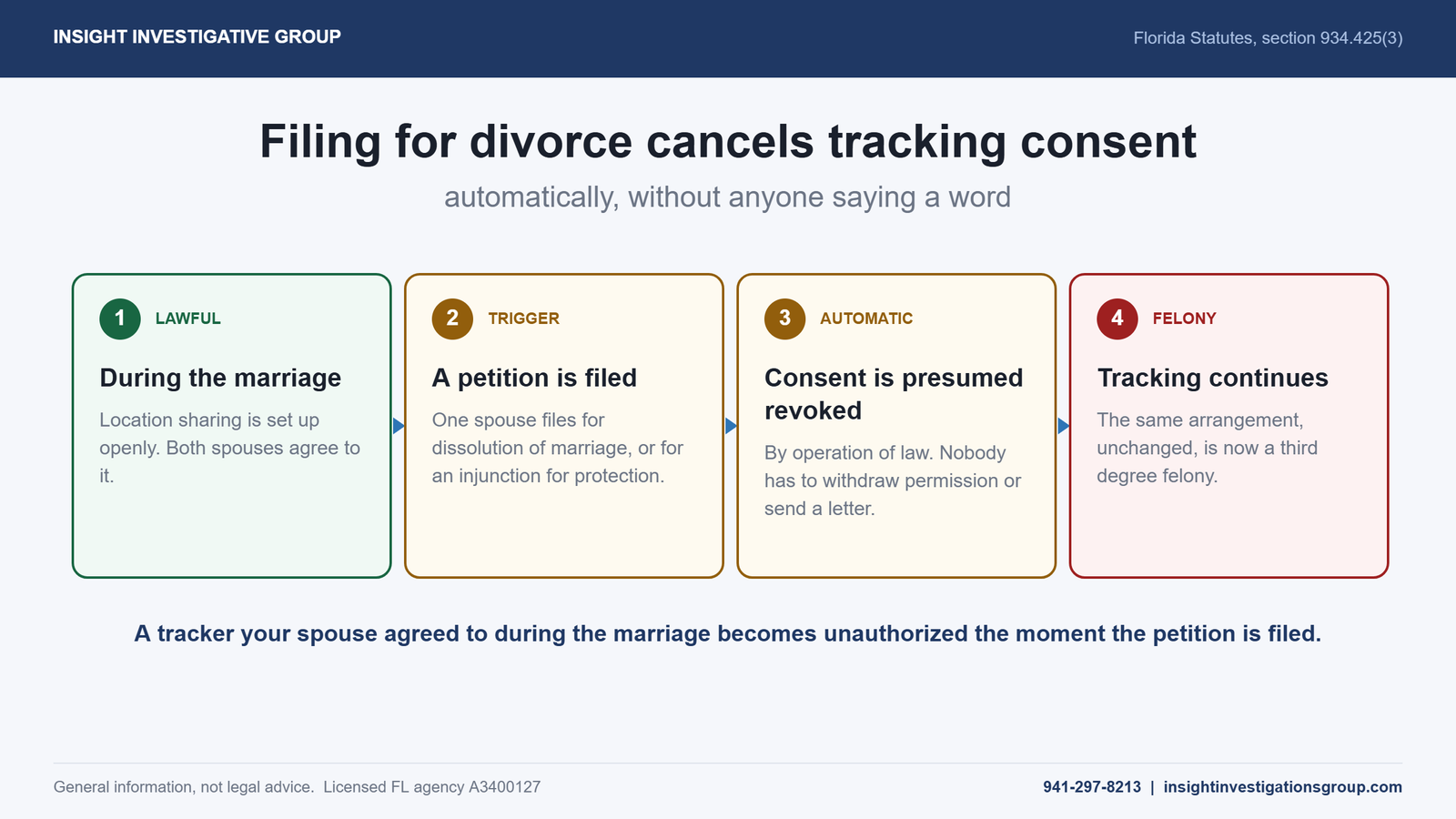
A tracker your spouse knew about and agreed to during the marriage becomes unauthorized by operation of law the moment the divorce petition is filed. Nobody has to remove consent, say anything, or send a letter. The filing does it.
So the spouse who set up family location sharing years ago, openly and with everyone’s knowledge, and keeps watching it after the petition is filed, has moved from a lawful arrangement into a third degree felony without doing anything new. This comes up constantly in contested Florida divorces, and it is almost always discovered by the other side’s attorney rather than by the person who did it.
Can I record my spouse in Florida?
Not unless everyone in the conversation has agreed. Florida is an all party consent state. Section 934.03 makes it a third degree felony to intentionally intercept a wire, oral or electronic communication, and the exception requires prior consent from all parties, not just one of them.
This catches people out, because most states require only one party to consent and most of what is written online reflects that majority rule. Florida does not follow it. A spouse who records a call they are not part of, or leaves a recorder running in a room, has committed a felony, and the recording is very unlikely to be usable.
The protection attaches where the speaker has a reasonable expectation of privacy that society recognizes as reasonable. A conversation in your own kitchen qualifies. A conversation carried across a crowded restaurant is a different question, and it is one for a lawyer rather than an article.
Can I read their texts, email or cloud account?
Accessing another person’s device or account without authorization is a criminal offense under Chapter 815 of the Florida Statutes, which covers offenses against users of computers and electronic devices. Knowing the password is not the same as having authorization, and a shared family phone plan does not make an individual account joint property.
Evidence taken this way causes two problems at once. It exposes the person who took it, and it hands opposing counsel a story about your conduct that has nothing to do with the affair. In a contested case that is a poor trade, and it is one we see people make in the first forty-eight hours, before anyone has advised them.
Does proof of an affair even matter in a Florida divorce?
This is the question worth answering before spending a dollar on any of it, and the honest answer is narrower than most people expect.
Florida is a no fault state. Under section 61.052 the grounds for dissolution are that the marriage is irretrievably broken, or the mental incapacity of a spouse. You do not need to prove adultery to obtain a divorce, and proving it will not get you one faster.
Where it can matter is money, in two specific places.
Alimony. Section 61.08(1), as amended with effect from July 1, 2023, allows a court to consider the adultery of either spouse and any resulting economic impact when determining the amount of alimony. The second half of that sentence is the operative part. The statute points at the financial consequences of the affair, not at the affair as a moral fact.
Equitable distribution. Section 61.075 lets a court consider the intentional dissipation, waste, depletion or destruction of marital assets after the petition is filed, or within the two years before it. This is the provision with real teeth. Marital money spent on someone outside the marriage, hotels, flights, gifts, a second lease, is money taken out of the marital estate, and a court can adjust the division to account for it.
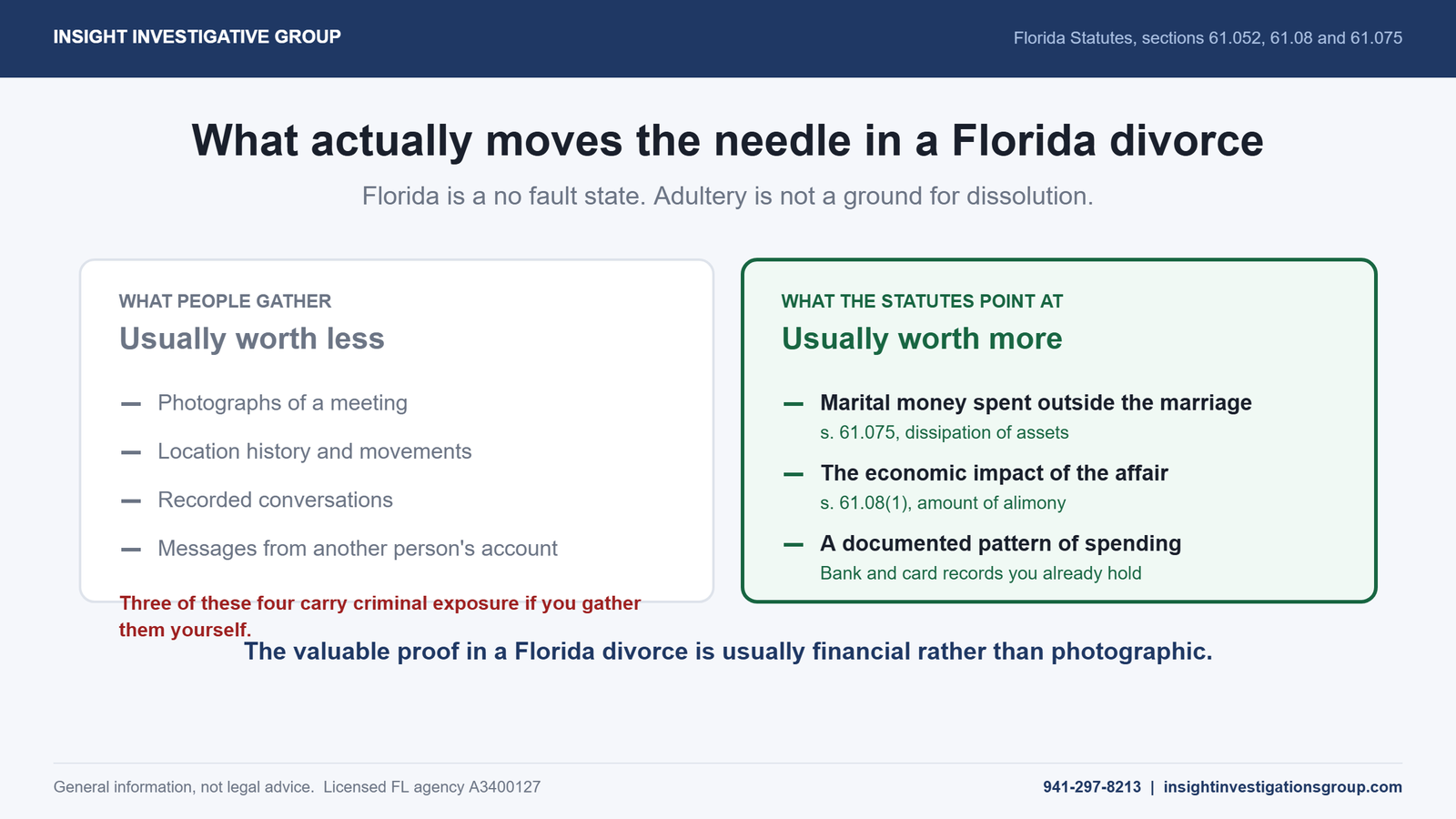
Read together, those two provisions point somewhere specific. In a Florida divorce the valuable proof is usually financial rather than photographic. A documented pattern of spending is worth more than a photograph of two people at dinner. This is the single most common thing people get backward, and it is why do-it-yourself efforts so often produce the wrong evidence at criminal risk.
Timeshare and parenting run on a separate analysis. An affair on its own does not ordinarily drive a parenting plan, although conduct that affects the children can.
Not sure which side of that line your situation falls on? Call 941-297-8213 and a licensed investigator will tell you, at no charge, whether what you are considering is lawful and whether it is worth doing. We have told people the honest answer was to save their money.
What can I legally do myself?
- Gather your own records. Bank and credit card statements and joint account activity you already have lawful access to. Save them whole rather than screenshotting selectively, and note the dates you pulled them.
- Note what is in plain view. What is visible from a public place, or in the shared areas of your own home, is not an interception.
- Use your own devices. Your phone, your accounts, your call log.
- Keep a written log. Dates, times, absences and the explanations given at the time. A contemporaneous record is more useful than people expect, and it costs nothing.
- Speak to a family law attorney before gathering anything further. If the case becomes contested, how the evidence was obtained will matter as much as what it shows.
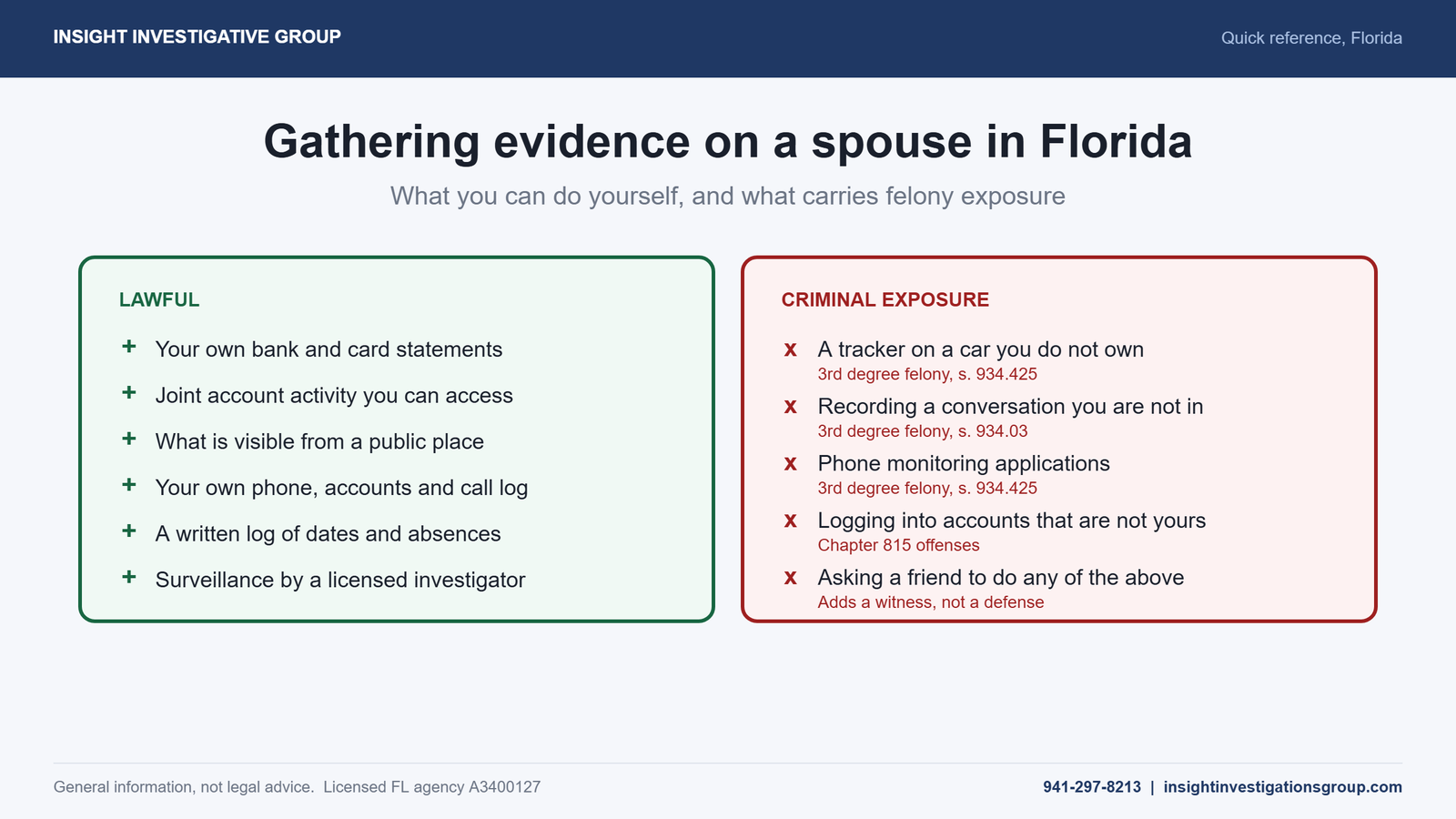
Asking someone else to do the unlawful part does not move the risk. It adds a witness.
What a licensed investigator can do that you cannot
A licensed investigator is not exempt from any of these statutes. We work under the same criminal law you do. What differs is method, and standing.
Surveillance conducted from public vantage points intercepts nothing. Observing where someone goes, photographing what is visible, and documenting a pattern of movement across days produces the timeline a court can actually use. That is different in kind from planting a device and waiting for it to report.
The output differs too. A written case report from a licensed agency documents what was observed and, just as importantly, what could not be confirmed. Chain of custody is maintained on all recorded media, and the investigator who did the work can speak to what he personally saw. Under section 493.6119 of the Florida Statutes a licensed agency may not release the contents of an investigative file to anyone other than the client, subject to narrow statutory exceptions, so the matter stays confidential, including the fact that you hired anyone at all.
For what a lawful infidelity engagement looks like day by day, read how investigators document infidelity in Florida.
We also turn work down. If what you want requires a tracker on someone else’s car or a recorder in a room, the answer is no. A firm that says yes to that is telling you how it intends to handle the rest of your case.
What it costs
Insight Investigative Group publishes prices rather than quoting after a phone call. Surveillance is $1,000 for a full day, flat, including unlimited mileage and travel, HD video and stills, and a written case report. Background investigations are $175, $600 or $1,200 depending on depth. A vehicle bug sweep, if you believe a device has been placed on your own car, is $500 flat.
Surveillance is often better spent in three well chosen hours than in twenty spent guessing. Where a subject’s routine makes a full day unlikely to produce anything, we will say so rather than book it anyway. Our domestic investigations page sets out how these cases usually run.
If you think you are the one being tracked
Do not research it from a device or an account the other person can see. Section 934.425 protects you in the same terms that it restricts you: a tracker placed on your property without your consent is a third degree felony, and the device itself is potential evidence. A sweep documents it where it sits rather than discarding it, so your attorney can decide what to do with it.
Call from a phone the other party has no access to, or have someone call on your behalf.
Questions we are asked
Is it illegal to put an AirTag on my spouse’s car in Florida?
Generally yes, if the car is not yours. Section 934.425 of the Florida Statutes defines a tracking device as any device whose primary purpose is to reveal its location or movement by transmitting electronic signals, which covers consumer Bluetooth tags. Placing one on another person’s property without consent has been a third degree felony since October 1, 2024. There are narrow exceptions, including for the owner or lessee of the vehicle.
Does filing for divorce change whether tracking is legal?
Yes, and automatically. Section 934.425(3) presumes consent revoked once a spouse files a petition for dissolution of marriage, or where either party files for an injunction for protection. Location sharing your spouse previously agreed to becomes unauthorized at the moment of filing, without anyone having to withdraw permission.
Can I record my spouse’s phone calls in Florida?
No, not without the consent of everyone on the call. Florida is an all party consent state under section 934.03, and intentionally intercepting a wire, oral or electronic communication is a third degree felony. This differs from most states, which require only one party to consent.
Does cheating affect alimony in Florida?
It can affect the amount. Florida is a no fault state, so adultery is not a ground for divorce, but section 61.08(1) permits a court to consider the adultery of either spouse and any resulting economic impact when setting the amount of alimony. Separately, section 61.075 allows a court to weigh marital money spent outside the marriage as dissipation of marital assets. The financial trail generally carries more weight than the affair itself.
Can a private investigator legally track my spouse for me?
Not by placing a device. A licensed investigator is bound by section 934.425 exactly as you are, and no license permits planting a tracker on a vehicle the client does not own. What a licensed investigator can lawfully do is conduct physical surveillance from public vantage points and document movement, meetings and timing in a written case report.
What does a cheating spouse investigation cost in Florida?
Insight Investigative Group charges $1,000 for a full day of surveillance, flat, including unlimited mileage and travel, HD video and stills, and a written case report. Background investigations, which frequently matter more in a divorce because they document assets and spending, are $175, $600 or $1,200 depending on depth.
Speak with a licensed investigator
Insight Investigative Group, LLC is a licensed, veteran-owned Florida private investigative agency, agency license A3400127, based in Bradenton and serving Sarasota, Tampa, St. Petersburg and Clearwater. Consultations are confidential under section 493.6119 of the Florida Statutes, including the fact of the call itself.
Call 941-297-8213 and a licensed investigator answers, day or night, including weekends. We will tell you honestly whether an investigator is the right answer for your situation, and we have told people the answer was no.