
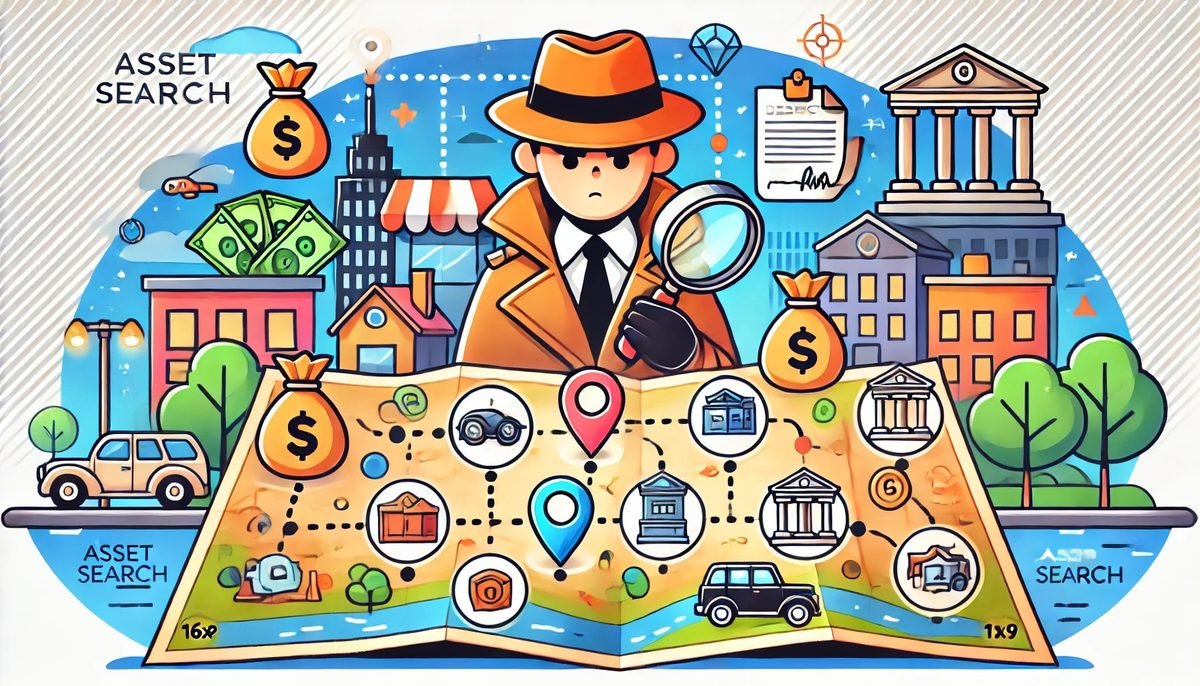
Finding what someone owns is a public records exercise, not a hacking one. Property deeds, recorded mortgages, liens, judgments, corporate filings and vehicle titles are all matters of record, and an asset search is the discipline of assembling them into a picture rather than a list.
How to find property someone owns
Start with the county property appraiser and the clerk of court in every county where the person has lived, then widen nationwide. The complication is almost never the search. It is that people do not hold property in their own names. Title sits in an LLC, a trust, a spouse’s name, or an entity formed in another state, and connecting those back to a person is where the actual work is.
What an asset search will not find
Bank balances and account records are not public and cannot be obtained by an investigator. Neither are brokerage holdings, retirement accounts, or the contents of a safe deposit box. Reaching those requires a subpoena or a court order, which means it requires a case and a judge, not a search. What a public record asset search gives you is the documented picture: what is titled, what is encumbered, what is owned through an entity, and what the recorded history says about how it got there. In a collection or a settlement negotiation that is usually the picture that matters.
Order a licensed background investigation. Prepared by a Florida-licensed investigator, agency A3400127, and documented to evidentiary standards.
In the realm of real estate and business transactions, the importance of title research cannot be overstated. Title research involves delving into the historical and current ownership of property, reviewing liens, claims, and other potential encumbrances that could affect the transfer of property rights. Traditionally, this process has been conducted through public records, but in recent years, the use of specialized private investigator databases like IDI (Information Data Inc.), IDR (Information Data Research), and TLOxp (TransUnion’s Legal & Public Records Database) has transformed how professionals approach title research. These databases not only provide access to public records but also offer proprietary information, which can reveal intricate details about property and business dealings not easily found through conventional methods.
Understanding Advanced Databases
IDI, IDR, and TLOxp are not your average public record search tools. Here’s what makes them unique:
IDI: Known for its comprehensive database that includes property records, liens, judgments, and bankruptcies. IDI’s strength lies in its depth of information, offering insights into historical data that might be overlooked in standard searches.
IDR: Focuses on asset data, providing detailed reports on properties, vehicles, and businesses. This database is particularly useful for tracking down hidden assets or uncovering irregularities in property transactions.
TLOxp: Integrates public records with proprietary data sources, offering a holistic view of individuals and businesses. It’s particularly effective for background checks but also provides robust data for title research by linking individuals to properties through various data points.
Applications in Title Research
Settling Issues with Liens:
Lien Verification: Using databases like IDI, one can verify if a property has liens attached to it that might not appear in local records. This is crucial for understanding the actual financial encumbrances that could affect a property’s sale or refinancing.
Lien Resolution: By accessing detailed information, investigators can trace the origin of liens, understand who holds them, and facilitate negotiations or legal actions for their removal or satisfaction.
Discovering Unusual Sale Patterns:
Business Transactions: TLOxp and IDR can reveal patterns in how businesses purchase, sell, or transfer properties. This might uncover strategies like flipping properties, transferring assets to avoid liabilities, or engaging in fraudulent activities.
Corporate Connections: These databases can link properties to corporate entities, revealing hidden ownership or connections that are not apparent in straightforward property records. This is vital in understanding if a business is involved in speculative real estate activities or asset shuffling.
Asset Location and Valuation:
Hidden Assets: For cases involving divorce, bankruptcy, or litigation, these tools are invaluable in locating undeclared assets. IDR, with its focus on asset data, can provide locations of properties, vehicles, or other valuables that might not be disclosed.
Valuation Insights: By cross-referencing property data with sales records, one can estimate property values more accurately, which is crucial in negotiations or when determining collateral value in loans.
Methodology for Using Databases
Data Collection: Start with basic public records, then expand using the databases. This layered approach ensures no stone is left unturned.
Cross-Referencing: Use multiple databases for verification. Discrepancies or additional details can often be found by comparing data from different sources.
Privacy and Ethical Considerations: Always ensure that the use of these databases complies with legal privacy standards and ethical guidelines. The information gathered should be used responsibly, respecting the rights of individuals and businesses involved.
Written by Joshua Goldberg, Florida private investigator license C3400073, owner of Insight Investigative Group, LLC, agency license A3400127, Bradenton, Florida.
Related: background checks and published rates.
Ask an investigator
Premium background investigations including public record asset research are $1,200.
Call and a licensed investigator answers, day or night, including weekends. Written inquiries are answered within 48 hours.