
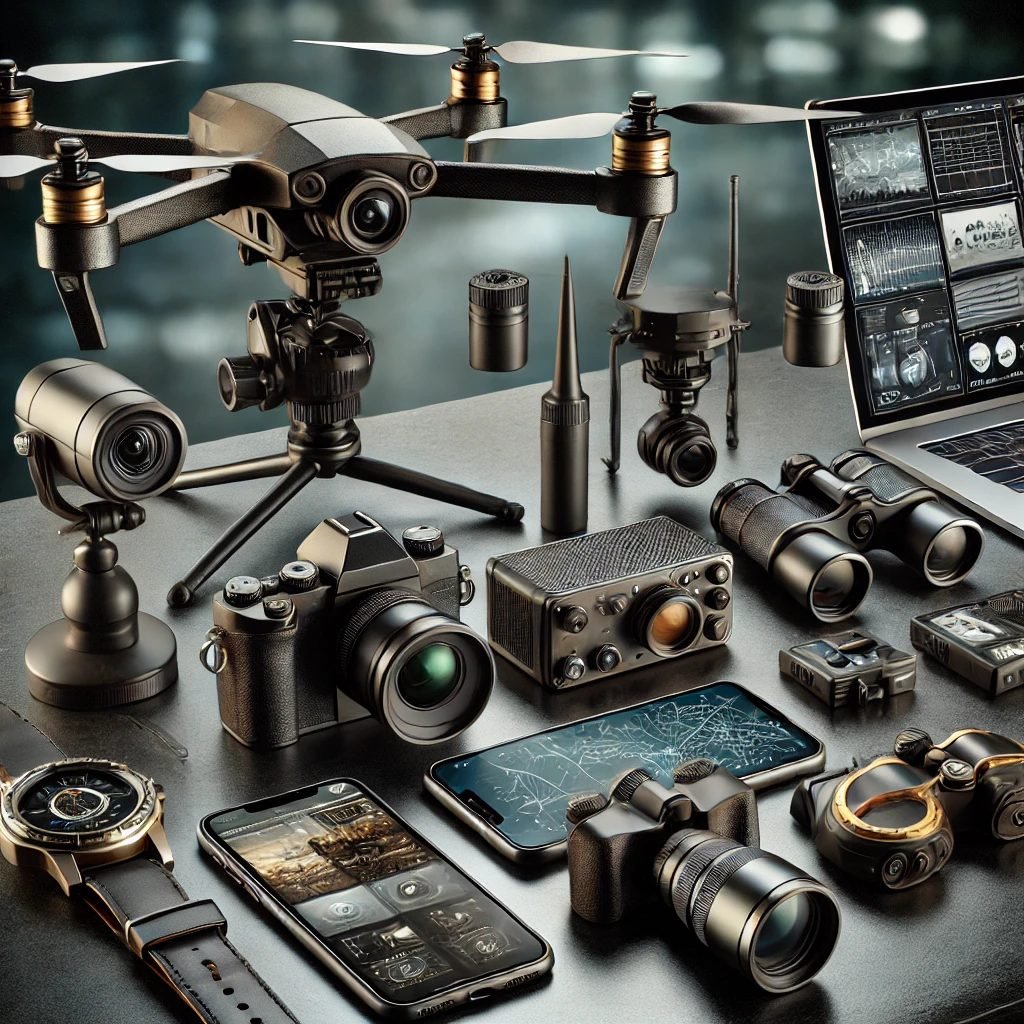
The equipment matters far less than where you park. Every experienced investigator learns this, usually expensively. Position, patience and pattern of life do the work. The kit only determines whether you can document what you were already in place to see.
That said, the right equipment is the difference between footage and evidence. Here is what actually earns its space in the vehicle, and what is illegal to deploy in Florida no matter who is selling it. General information, not legal advice.
What camera equipment does surveillance actually need?
A body with strong low light performance and a long stabilized zoom, because most usable footage is captured at distance in poor light. Optical reach matters more than megapixels: cropping a distant subject out of a wide frame produces something a defense expert will describe as unidentifiable.
A second camera running continuously matters more than people expect. The moment worth having usually arrives while you are adjusting the first one.
What about covert body cameras?
Useful for foot follows and anywhere a handheld camera would be conspicuous, such as a retail interior or a public venue. The legal constraint is audio, not video. Florida requires the consent of all parties to record a private conversation under section 934.03, so professional body camera use is typically video only, with audio disabled.
Do investigators use drones?
Rarely, and carefully. A drone requires an FAA Part 107 remote pilot certificate for commercial operation, and Florida has its own restrictions on the use of drones for surveillance of private property. The situations where a drone is both lawful and more useful than a camera on the ground are narrower than the marketing suggests.
Is a GPS tracker legal for an investigator to use?
Not on a vehicle the client does not own and control. Section 934.425 of the Florida Statutes makes it unlawful to install a tracking device on another person’s property without consent, with limited exceptions. This is the single most common request we decline.
Where a client genuinely owns and controls the vehicle, the analysis is different, and it is a question for your attorney before anything is placed on anything.
What is the most underrated piece of equipment?
The vehicle. An unremarkable model in a common color, with legal window tint and nothing on it that anyone would describe twice. Investigators get burned because of what they are sitting in far more often than because of what they are holding.
After that, a notebook. The written chronological log is what turns a folder of clips into a report that survives cross examination, and it is produced by hand in real time, not reconstructed afterward.
What equipment is illegal to deploy?
Audio recording devices placed to capture private conversations without the consent of all parties. Tracking devices on vehicles a client does not own. Cameras placed inside a space where a person has a reasonable expectation of privacy. Software installed on a device the client does not own and control.
All of it is readily purchasable and none of it is lawful to deploy that way. If a firm’s capabilities depend on any of it, what they are selling is a liability with your name on it.
What should a client receive from a surveillance day?
Video and stills as captured, unedited, with timestamps intact. A written chronological log produced in the field. A report that states what was observed and, just as plainly, what was not. And an investigator who can testify to it.
What you should not receive is a highlights reel. Footage cut down to the interesting parts, with the hours of nothing removed, invites the obvious question about what else was removed. The boring hours are part of the evidence, because they establish that the interesting minutes were not cherry-picked.
How can you tell whether an investigator is properly equipped?
Ask three questions before you hire anyone.
- What is your optical reach, and will you be cropping? A long optical zoom produces an identifiable subject at distance. A crop out of a wide frame produces something a defense expert will call unidentifiable, and the difference is not visible until it matters.
- Do you run a second camera? The moment worth having tends to arrive while the first one is being adjusted.
- How is the log produced? If the answer is that it gets written up afterward from memory, the report is weaker than the footage it describes.
You are not buying equipment. You are buying documentation that holds up when someone hostile examines it, and the kit is only the part of that which is visible on an invoice.
What does a surveillance day cost?
Surveillance is $1,000 per day flat, which includes unlimited mileage and travel, video and stills, and a written case report. There is no multi-day discount and no separate equipment charge. Published rates for every service are on the rates page.
Written by Joshua Goldberg, Florida private investigator license C3400073, owner of Insight Investigative Group, LLC, agency license A3400127, Bradenton, Florida. General information, not legal advice.
Related: surveillance services and TSCM bug sweeps.
Ask an investigator
Surveillance is $1,000 per day flat, including unlimited mileage and travel, video and stills, and a written case report.
Call and a licensed investigator answers, day or night, including weekends. Written inquiries are answered within 48 hours.