Author: Joshua Goldberg

  • How Do You Find Hidden Assets in a Florida Divorce?

    How Do You Find Hidden Assets in a Florida Divorce?

    Start with the public record. In Florida, real estate, business entities, liens, boats, aircraft and vehicles are all recorded somewhere, and a licensed investigator finds a spouse’s hidden assets by pulling those records and connecting them back to the person, including the ones held through an LLC, a trust or a relative. Bank, brokerage and retirement balances come second, through the mandatory disclosure and subpoena process that your attorney controls. The investigator’s product is a documented map of what exists and where it sits, so the attorney knows exactly where to send the subpoena.

    Insight Investigative Group, LLC is a licensed Florida private investigative agency, agency license A3400127, investigator license C3400073, based in Bradenton and conducting public record asset research for divorce and equitable distribution matters across Sarasota, Manatee and the greater Tampa Bay area. Public record asset research is a fixed $1,200 as the Premium tier of our background investigations. What follows is how we explain the work to clients and their attorneys before a case starts. It is general information about Florida law, not legal advice. For your own situation, talk to a family law attorney.

    Why do hidden assets decide a Florida divorce?

    Because the court divides what it can see. Section 61.075 of the Florida Statutes tells the judge to begin from the premise that marital assets and liabilities are divided equally, and in a contested case the judgment has to identify each marital asset, value the significant ones and say who receives what, all supported by competent substantial evidence. An asset that never makes it onto that list never gets divided. That is the entire incentive to hide one.

    The same section gives the court a tool against it. Under section 61.075(1)(i), the intentional dissipation, waste, depletion or destruction of marital assets after the petition is filed, or within the two years before it, is a factor that can justify an unequal distribution. Money moved out of the marital estate in the run-up to a filing is not gone for legal purposes. It is a reason for the judge to adjust the split, provided someone documents it.

    Florida’s premarital agreement statute, section 61.079, runs on the same principle in reverse. A prenuptial agreement can be attacked if it was unconscionable when signed and the challenging party was never given a fair and reasonable disclosure of the other side’s property and financial obligations. Verifying that disclosure before the wedding is the same records exercise as finding assets after the marriage ends.

    What does Florida already force each spouse to disclose?

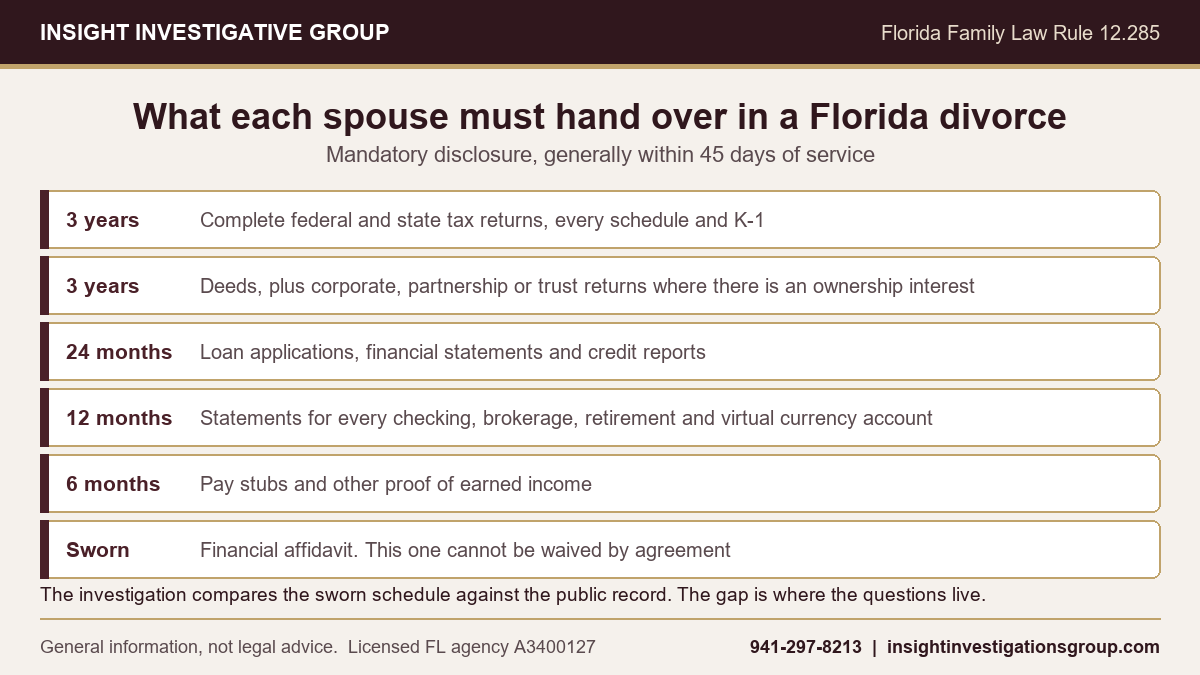
    More than most people expect. Florida Family Law Rule of Procedure 12.285 requires each party in a dissolution case to serve a sworn financial affidavit plus a long list of documents, generally within 45 days of service of the initial pleading: three years of complete federal and state tax returns with every schedule and K-1, six months of pay records, twenty-four months of loan applications, financial statements and credit reports, three years of deeds, twelve months of statements for every checking, brokerage, retirement and virtual currency account, life insurance declarations, and three years of corporate, partnership or trust returns where the party holds an ownership interest. The court or the parties can modify most of that list. The financial affidavit itself cannot be waived.

    Checklist of what each spouse must disclose in a Florida divorce under Family Law Rule 12.285, including three years of tax returns and twelve months of account statements
    What each spouse must hand over under Florida Family Law Rule 12.285. The investigation compares this sworn schedule against the public record.

    This is why an investigator’s work in a divorce is a comparison exercise. The affidavit is sworn. The public record is independent. The interesting cases live in the gap between the two: the LLC formed eleven months before the filing that appears in Sunbiz and nowhere on the affidavit, the deed recorded in a sibling’s name, the boat registered to a company the spouse “does not own.” Every one of those is a question the attorney gets to ask under oath.

    Where do people actually hide assets?

    The patterns repeat. In a high-asset Florida divorce, concealment rarely means a suitcase of cash. It means title and timing.

    Inside an entity. Real estate is deeded to a new LLC. A vehicle or vessel is titled to the business. A holding company is formed in another state. Florida’s Division of Corporations records every domestic and foreign entity registered here, with officers, managers, registered agents, filing dates and annual reports, and the equivalent registries in other states do the same. Connecting an entity to a person is the actual work, and it is where a database printout and an investigation stop being the same product.

    In someone else’s name. A parent, a sibling, a business partner, a new partner. The deed is real and the property is real; only the name on it is a proxy. Address history, recorded mortgages and the pattern of who pays for what tend to expose it.

    In a trust. Trust instruments are private in Florida, but the deed that moved a property into the trust is recorded in the county’s official records, and the trustee’s name is on it.

    Out of state. Second homes, a condominium bought during the separation, land held through an out-of-state entity. Nationwide property searches exist for this reason.

    On the water and in the air. Sarasota and Manatee are boat counties. Florida vessel registrations run through the state’s Department of Highway Safety and Motor Vehicles, larger vessels are often federally documented with the Coast Guard, and aircraft sit in the FAA registry. A slip at a marina is also a place a subject drives to, which matters later.

    Inside a business. Deferred bonuses, invoices delayed until after the judgment, a new vendor company that happens to belong to a brother-in-law, payroll to a relative who does not work there, overpaying estimated taxes to collect the refund after the divorce. Tracing that money is a forensic accountant’s job. Identifying the entities, the people and the relationships behind it is ours, and the accountant’s work goes faster when someone has already drawn the map.

    In things. Vehicles, jewelry, art, collectibles, a storage unit rented the month before the filing. Vehicle records are available to a licensed investigator for use in connection with litigation under the federal Driver’s Privacy Protection Act. The rest usually surfaces through lifestyle: a sworn affidavit showing modest income next to a lease on a second vehicle, a boat slip and a club membership.

    What can a licensed investigator lawfully find?

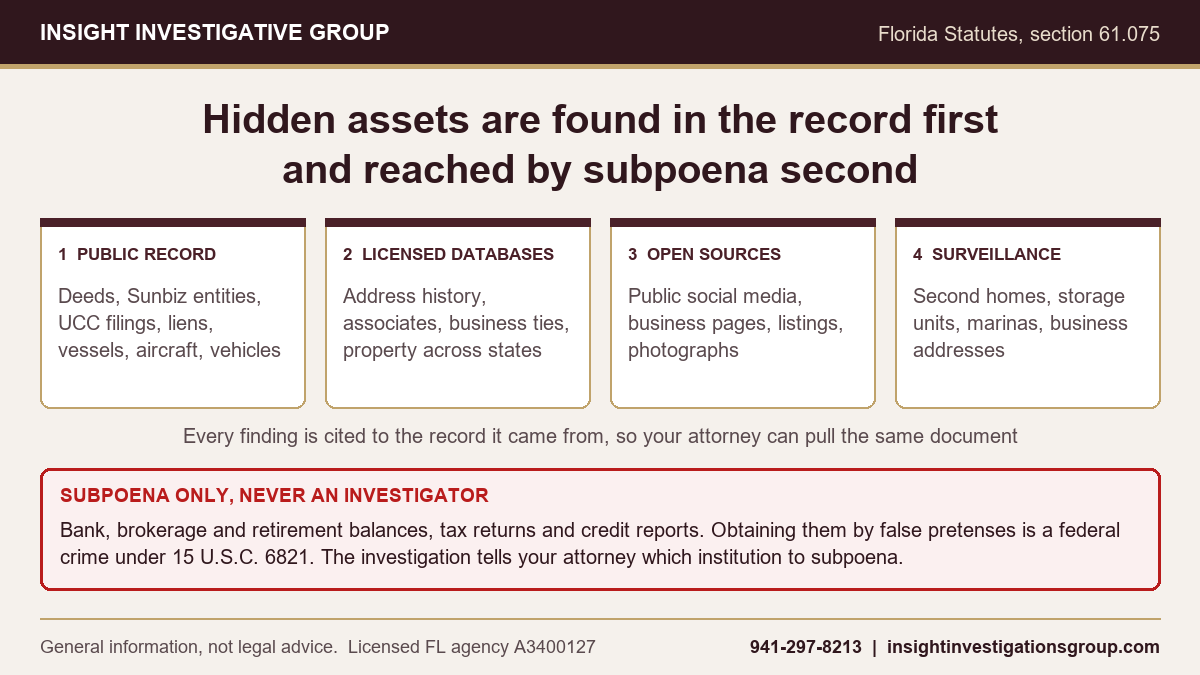
    Four layers, each cited back to its source.

    Public records. County property appraiser and clerk of court official records, which in our home counties means Manatee and Sarasota, plus Hillsborough for Tampa matters. Sunbiz and out-of-state corporate registries. The Florida Secured Transaction Registry for UCC filings. Recorded liens, judgments and mortgages. Vessel, aircraft and vehicle records. Federal court and bankruptcy dockets. Civil litigation history. Professional licenses and fictitious name filings.

    Licensed databases. Investigators hold access to regulated data platforms that aggregate address history, known associates, business affiliations and property across states. We use them to find the thread, then pull the primary record, so the report cites a document your attorney can obtain independently.

    Open source intelligence. Public social media and web presence, viewed as any member of the public could. A boat in the background of a photograph, a business page for a company that is not on the affidavit, a listing for a property the spouse supposedly never owned. We do not log into anyone’s account and we do not use a false identity to gain access.

    Surveillance. Where the subject actually goes: a second residence, a storage facility, a marina, a business address that is not on any filing. Physical surveillance from lawful vantage points, silent video and a written log, at $1,000 per day flat with mileage and the report included. Our article on whether surveillance is legal in Florida covers the rules in detail, and our surveillance page covers the fieldwork.

    The deliverable is a written report in which every holding is cited to the record it came from, with the connection between each entity and the spouse spelled out. Your attorney can pull the same document and put it in front of a witness.

    What will an investigator not do, and why does that protect you?

    We do not obtain bank balances, brokerage or retirement holdings, credit reports, tax returns or the contents of a safe deposit box. Obtaining a person’s financial records from an institution by false pretenses is a federal crime under the Gramm Leach Bliley Act, 15 U.S.C. section 6821, and so is asking someone else to do it. Any service that advertises bank account balances for a fee is either lying or committing that crime on your behalf, and the exposure lands on the person who paid.

    We do not access a spouse’s phone, email or cloud accounts. Accessing a computer or device without authorization is an offense under section 815.06 of the Florida Statutes, and intercepting a private communication without the consent of everyone involved is a felony under section 934.03. We do not place tracking devices. Section 934.425 makes that a third degree felony, and it presumes consent is revoked the moment a divorce petition is filed, a point our spouse tracking article covers in full.

    The reason is not squeamishness. Evidence gathered unlawfully is at risk of exclusion, it taints the case it sits in, and in a family matter the exposure can reach custody and attorney’s fees. Every bank and brokerage record you need is reachable lawfully: your attorney serves a subpoena on the institution the investigation identified, and the records arrive through a process the court recognizes. The investigator’s job is to make that subpoena precise.

    How does an attorney turn findings into a better outcome?

    The sequence is usually the same. The records search runs early, ideally before the other side’s financial affidavit lands, so counsel can compare the sworn schedule against what is recorded. Discrepancies become requests for production, subpoenas to specific institutions and deposition questions. Where a business is involved, a forensic accountant values it and traces the money, working from the entity map the investigator built. If the picture shows assets moved out in the two years before filing, section 61.075(1)(i) gives the court a basis to adjust the division. Where an asset is at risk of disappearing during the case, section 61.075(5) allows an interim partial distribution on a sworn motion showing extraordinary circumstances.

    None of that is a promise about any particular case. Judges weigh the evidence in front of them. What an investigation changes is the quality of that evidence and its timing: findings that arrive before mediation shape a settlement, and findings that arrive after the judgment are a collection problem.

    What does this look like in Sarasota and Manatee?

    The Twelfth Judicial Circuit, covering Manatee, Sarasota and DeSoto counties, handles a steady flow of high-asset dissolutions, and the local geography shapes the search. Waterfront property on Longboat Key, Siesta Key, Casey Key, Bird Key and Anna Maria Island is frequently held through entities and trusts. Lakewood Ranch and downtown Sarasota are home to closely held businesses, and in those divorces the spouse who runs the company usually holds all the information. Marinas from Cortez to Venice are where the vessels live. The official records of the Manatee County and Sarasota County clerks, and both county property appraisers, are the first stop on nearly every file, and from our Bradenton office the courthouses, the marinas and the neighborhoods are minutes away. Our Sarasota page covers the local work in more depth, and our domestic investigations page covers the surveillance side of these cases.

    Discretion matters more in this work than in almost any other. Under section 493.6119 of the Florida Statutes, the contents of an investigative file are confidential to the client, and the fact that you hired anyone at all stays with us. If you believe your spouse has access to your phone, email or home network, contact us from a device they cannot reach.

    What does an asset investigation cost?

    Public record asset research is included in our Premium background investigation at a fixed $1,200, delivered within 72 hours of complete intake. It covers nationwide property with recorded mortgages and estimated equity, business ownership, UCC filings, liens and judgments, vessel and aircraft registration, and a documented net worth estimate built only from public record. Rush handling moves delivery to 48 hours for an additional $400. Standalone searches involving several entities or several states are scoped and quoted in writing before any work begins. Surveillance is $1,000 per day, flat. Florida sales tax applies to investigative services. Every price we charge is on our rates page, and the service itself is described on our asset search page.

    Questions we are asked

    Can a private investigator find hidden bank accounts in a Florida divorce?

    Not the balances, and not lawfully. Bank, brokerage and retirement records are protected by federal law, and obtaining them under false pretenses is a crime under 15 U.S.C. section 6821. What a licensed investigator can do is identify where the accounts are likely to be, through public records, entity filings and lawful observation, so your attorney can subpoena the right institution.

    What happens if my spouse hides assets in a Florida divorce?

    Section 61.075(1)(i) of the Florida Statutes lets the court treat the intentional dissipation, waste or depletion of marital assets after filing, or within the two years before it, as a factor justifying an unequal distribution. Assets left off a sworn financial affidavit also expose the spouse who signed it. How a particular court responds depends on the evidence, which is why documentation matters more than suspicion.

    Can assets held in an LLC or a trust be found?

    Often, yes. Florida’s Division of Corporations records officers, managers, registered agents and annual reports for every registered entity, and the deed that moves property into a trust is recorded in the county’s official records with the trustee’s name on it. Connecting those filings back to a spouse is the substance of an asset search.

    Is it legal to hire a private investigator to find my spouse’s assets?

    Yes. A licensed Florida investigator works from public records, licensed databases, open sources and surveillance conducted from lawful vantage points, and under section 493.6119 the investigative file is confidential to the client. What no license permits is accessing the other spouse’s accounts, devices or financial institutions, and a firm that offers to is a liability to your case.

    How much does a hidden asset search cost in Florida?

    Insight Investigative Group includes public record asset research in its Premium background investigation at a fixed $1,200, delivered within 72 hours. Searches involving several entities or several states are quoted in writing before any work begins.

    Speak with a licensed investigator

    Call 941-297-8213, or use the contact page. Tell us what you already know: the business, the properties, the boat, the timing. We will tell you what the public record can answer, what will need a subpoena and what it will cost, in writing, before any work begins. If your spouse may have access to your devices, contact us from one they cannot reach.

  • Is Surveillance Legal in Florida? What the Statutes Actually Say

    Is Surveillance Legal in Florida? What the Statutes Actually Say

    Yes. Surveillance is legal in Florida when it is conducted from a place the investigator has a lawful right to be, without intercepting private conversations, without planting anything on property the client does not own or lease, and without imaging anyone where they reasonably expect privacy. Cross any of those lines and the work stops being surveillance and becomes a crime, much of it felony grade, and the evidence it produces tends to hurt the client who paid for it.

    Insight Investigative Group, LLC is a licensed Florida private investigative agency, agency license A3400127, investigator license C3400073, based in Bradenton and running surveillance across Sarasota, Manatee, and the greater Tampa Bay area. What follows is how we explain the rules to clients before a case starts. It is general information about Florida law, not legal advice. For your own situation, talk to an attorney.

    What surveillance actually is

    Television has done this profession no favors. Real surveillance is not car chases or microphones taped under tables. It is one investigator, positioned legally, watching one subject long enough to document a pattern: when they leave, where they go, who they meet, what they carry, how they move. The product is not a dramatic confrontation. It is date-stamped video, still photographs, and a written report an attorney, an adjuster, or a judge can rely on.

    Vortex 10x42 binoculars on a surveillance kit bag inside a Florida private investigator's vehicle
    Part of the working kit: 10×42 binoculars. Nothing in it intercepts, transmits, or attaches to anyone else’s property.

    The equipment is deliberately ordinary. Binoculars, long-lens cameras, HD video, a dash camera running any time the vehicle moves. Nothing in the kit intercepts, transmits, or attaches to anyone else’s property, and that is by design. The value is not in the gear. It is in position, patience, and knowing what matters when it happens, because a surveillance day can turn on ninety seconds.

    That discipline came from somewhere. Our lead investigator spent twelve years in Army Military Intelligence, including work as a targeter for a special mission unit, where surveillance meant building a subject’s pattern of life and documenting it precisely enough for someone else to act on it. Licensed civilian work runs on the same skills. The difference is the rulebook, and Florida’s rulebook is specific.

    What makes surveillance legal in Florida?

    Two principles carry most of the weight.

    The first is vantage point. An investigator can observe and record anything visible from a place he has a right to be: a public road, a parking lot open to the public, a sidewalk, a business he has permission to sit in. What a person does in public view is not private, and documenting it breaks no Florida law.

    The second is the reasonable expectation of privacy. Florida’s interception law protects conversations, not movement, and its imaging laws protect places where a person is entitled to assume no one is watching: inside a home, a restroom, a changing room. A subject walking into a restaurant with someone has no legal expectation that the sidewalk did not see it.

    One distinction surprises people: Florida’s wiretap chapter governs sound, not silent pictures. Video with no audio, taken from a lawful vantage point of things in plain view, is not an interception at all. That is why professional surveillance video is silent, and why the microphone stays off.

    Where does Florida law draw hard lines?

    Five statutes do most of the work. We plan every surveillance day around them.

    Tracking devices and tracking apps, section 934.425

    Since October 1, 2024, knowingly installing a tracking device or tracking application on another person’s property without consent, or using one to track another person without consent, is a third degree felony. Since October 1, 2025, it is a second degree felony where the tracking is done to commit or facilitate a dangerous crime. The statute covers phone tracking apps the same as hardware, and consent is presumed revoked the moment a spouse files for divorce or either party seeks an injunction for protection.

    There is no private investigator exception. The statute says so explicitly: an investigator stands in the client’s shoes, so we can use a tracker only where the client could, mainly on a vehicle the client owns or leases. A violation is also an independent ground for license discipline under Chapter 493. The vehicle rules are covered in detail in our GPS tracker article, and the divorce angle in our spouse tracking article.

    Recording conversations, section 934.03

    Florida is an all party consent state. Intentionally intercepting a private conversation without the consent of everyone in it is a third degree felony, and the person recorded can also sue civilly. The protection attaches where a speaker has a reasonable expectation of privacy, which is why we do not bug rooms, do not record phone calls, and do not park a microphone near a table. We film. We do not listen in.

    Trespass, sections 810.08 and 810.09

    A Chapter 493 license is not a key. It confers no right to enter a home, a fenced yard, posted land, or a gated community the investigator has not been lawfully admitted to. Trespass starts as a misdemeanor and climbs to a felony when the trespasser is armed, which for an armed investigator means one wrong step converts a lawful assignment into a third degree felony. Vantage points get planned for this reason.

    Digital voyeurism, section 810.145

    Florida renamed its video voyeurism law digital voyeurism on October 1, 2024 and broadened it. Secretly imaging a person where they are dressing, undressing, or otherwise entitled to privacy is a third degree felony for an offender 19 or older, and every image is a separate offense. Lawful surveillance never points a lens where a person is entitled to assume privacy, no matter what the client hopes is on the other side of the window.

    Drones, section 934.50

    Florida restricts using a drone to surveil private property, or the people on it, where a reasonable expectation of privacy exists. A drone can be a legitimate tool in limited situations, but as a shortcut over a fence it is a liability. We treat the fence line as the rule.

    Stalking, section 784.048

    Following and watching a person repeatedly becomes stalking when it causes substantial emotional distress and serves no legitimate purpose. Lawful investigation, supporting a lawsuit, an insurance claim, or a custody matter, is a purpose other than harassment, and that distinction is what separates an investigator from a stalker. It is not a blank check. Florida courts look at manner and volume, and surveillance that turns into intimidation loses its protection. Professional work stays covert, proportionate, and tied to the question the client actually needs answered. If the subject knows they are being followed, the investigator has failed twice.

    Who holds a Florida investigator accountable?

    The Florida Department of Agriculture and Consumer Services, Division of Licensing, licenses both the agency, Class A, and the individual investigator, Class C, under Chapter 493 of the Florida Statutes. Section 493.6118 lists the grounds for discipline, and since October 1, 2024 unlawful tracking is on that list by name. Working as a private investigator without a license is a first degree misdemeanor on the first violation and a third degree felony after that, with civil penalties up to $10,000.

    The practical takeaway for anyone hiring: verify the license before you sign anything. FDACS runs a public license verification tool, and any legitimate Florida investigator will hand over license numbers without being asked twice. Ours are at the top of this article. Verification takes two minutes and filters out most of the industry’s problems. We wrote more about how we operate inside those rules in our article on the ethics and legalities of private investigation.

    One more protection is worth knowing about. Under section 493.6119, a licensed agency may not release the contents of an investigative file to anyone but the client, subject to narrow statutory exceptions. The investigation, and the fact that you hired anyone at all, stays confidential.

    What do these rules look like in Sarasota?

    Sarasota County is a good illustration of why the lines matter, because so much of the county is private ground. A private investigator in Sarasota works around gated communities across Palmer Ranch and Lakewood Ranch, guard gates on Longboat Key, private streets tucked into Siesta Key, and condominium towers where the garage, the elevator, and the hallway all belong to someone. Every one of those is a trespass line, so the lawful vantage points, public roads, beach access points, and business districts like St. Armands Circle and downtown Sarasota, get scouted before the subject ever moves.

    The casework itself skews toward the Twelfth Judicial Circuit: divorce, cohabitation, and custody matters where a documented pattern decides the issue, along with insurance and injury claims. From our Bradenton office the drive is short, mileage is included, and the county’s geography is not a learning curve. Our Sarasota page covers the local work in more depth.

    What does lawful surveillance cost?

    $1,000 for a full day, flat, including mileage and travel, HD video and stills, and the written case report. No hourly meter, no fuel surcharges. Pricing for every service is published on our rates page, and the fieldwork itself is described on our surveillance page.

    The honest caveat: we scope before we book. Where a subject’s routine makes a full day unlikely to produce anything, we say so. And where what a client wants requires a tracker on a car they do not own, a recorder in a room, or a lens through a window, the answer is no. A firm that says yes to that is telling you exactly how it will handle the rest of your case.

    Questions we are asked

    Can a private investigator follow you in Florida?

    Yes. Following and observing a person in public, from a lawful vantage point and for a legitimate investigative purpose, is legal in Florida. What is not legal is surveillance that becomes harassment: Florida’s stalking statute, section 784.048, reaches a course of conduct that causes substantial emotional distress and serves no legitimate purpose, and courts weigh how the surveillance was conducted.

    Can a private investigator record you without your consent in Florida?

    Silent video of what you do in public, yes. Audio of your private conversations, no. Florida is an all party consent state under section 934.03, and intercepting a private conversation without everyone’s consent is a third degree felony. Secretly imaging a person in a place where they are entitled to privacy is separately criminal under section 810.145.

    Can a private investigator put a GPS tracker on your car in Florida?

    No, with narrow exceptions. Under section 934.425, installing or using a tracking device or tracking app on another person’s property without consent has been a third degree felony since October 1, 2024, and there is no exception for licensed investigators. An investigator may place a tracker only where the hiring client could lawfully do it themselves, principally on a vehicle the client owns or leases.

    Is it legal to photograph someone’s house in Florida?

    From a public vantage point, generally yes. What is visible from the street is not private. The lines: entering the property is trespass under sections 810.08 and 810.09, imaging a person where they expect privacy is digital voyeurism under section 810.145, and flying a drone over the fence to watch private property implicates section 934.50.

    How do you verify a Florida private investigator’s license?

    Use the license verification search run by the Florida Department of Agriculture and Consumer Services, Division of Licensing, which regulates investigators under Chapter 493. Search the agency and the individual. Insight Investigative Group holds agency license A3400127, and our lead investigator holds Class C license C3400073.

    Speak with a licensed investigator

    If something in your life needs documenting, the conversation costs nothing and stays confidential under section 493.6119, including the fact that you called. Call 941-297-8213 and a licensed investigator answers, day or night, including weekends. We will tell you honestly whether surveillance can answer your question and what it will take. And if the answer is no, we will say that too.

    Statutory references reflect the Florida Statutes as of August 2026. This article is general information, not legal advice.

  • Can an AI Order a Background Check on Someone?

    Can an AI Order a Background Check on Someone?

    No, and at Insight Investigative Group it is deliberately not possible. An AI assistant can look up our prices, tell you what each report covers, and hand you the link. It cannot place the order. The person buying a background investigation has to certify, personally, what the report will be used for, and an assistant cannot make that certification on your behalf.

    In August 2026 we published a set of machine-readable rules at order.insightinvestigationsgroup.com/llms.txt stating exactly that. As far as we know we are the first private investigation agency in Florida to publish instructions telling AI systems what they may and may not do with our ordering process.

    What an AI assistant can tell you about us

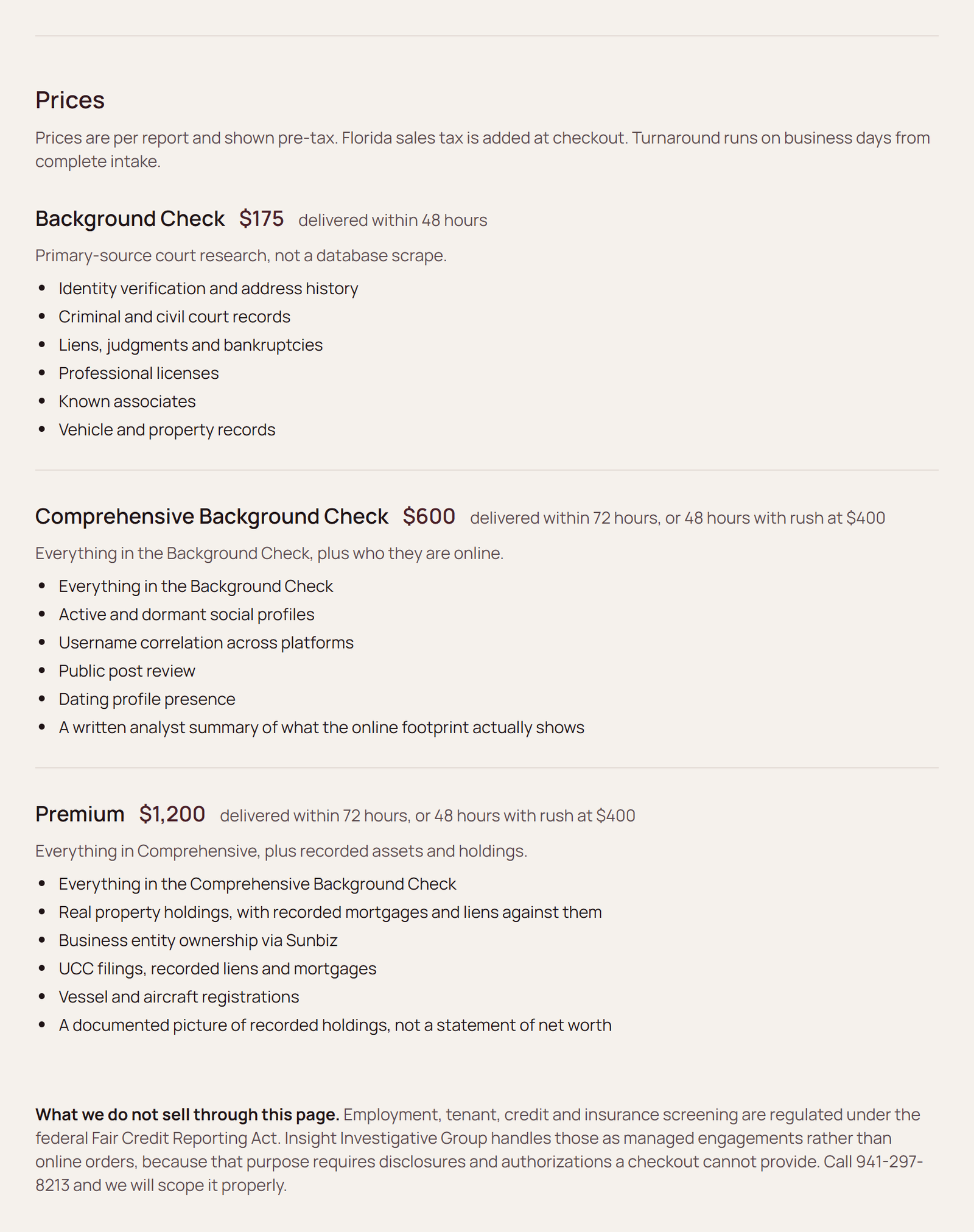
    Published price list showing background checks at 175, 600 and 1,200 dollars with delivery times
    Prices are published rather than quoted after a phone call, and are readable by machines as well as people.

    Quite a lot, and all of it accurate. Our prices are published, not quoted after a phone call, and they are readable by machines as well as people:

    • Background Check, $175. Identity and address history, criminal and civil court records, liens, judgments and bankruptcies, professional licenses, known associates, vehicle and property records. Delivered within 48 hours of complete intake.
    • Comprehensive Background Check, $600. Everything above, plus social media and open source intelligence with a written analyst summary. Delivered within 72 hours.
    • Premium Background Check, $1,200. Everything above, plus public record asset and holdings research. Delivered within 72 hours.

    Ask an assistant what a background investigation costs from a licensed Florida agency and it can now answer with real numbers instead of “prices vary, contact a provider”. That is the point.

    Why can an AI not complete the order?

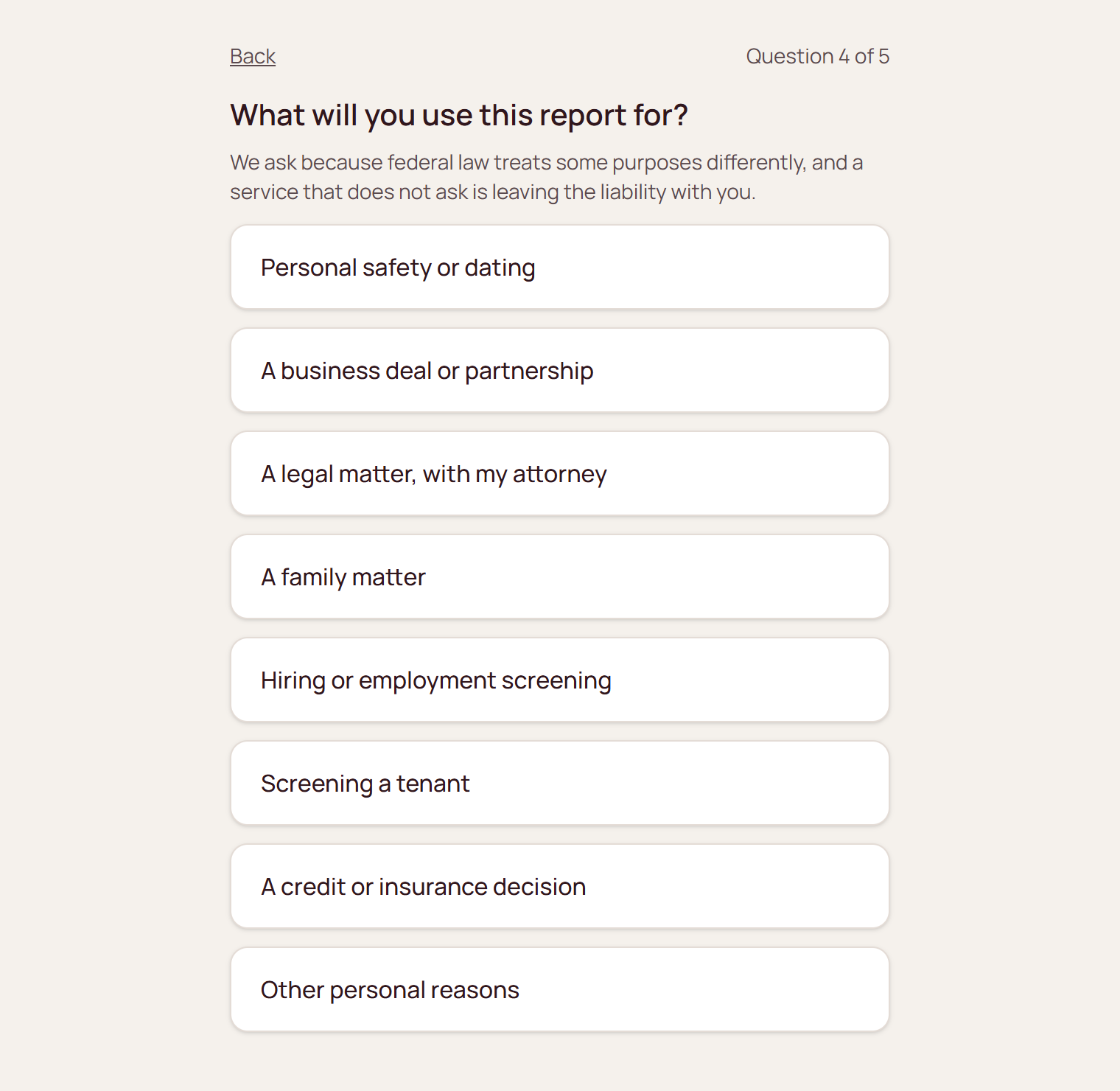
    Order form asking what the report will be used for, listing eight purposes including employment and tenant screening
    The purpose question sits before any payment page. Federal law treats some purposes differently.

    Because of one screen in the middle of our checkout. Before anyone reaches a payment page we ask what the report is for, and the buyer ticks a box that reads:

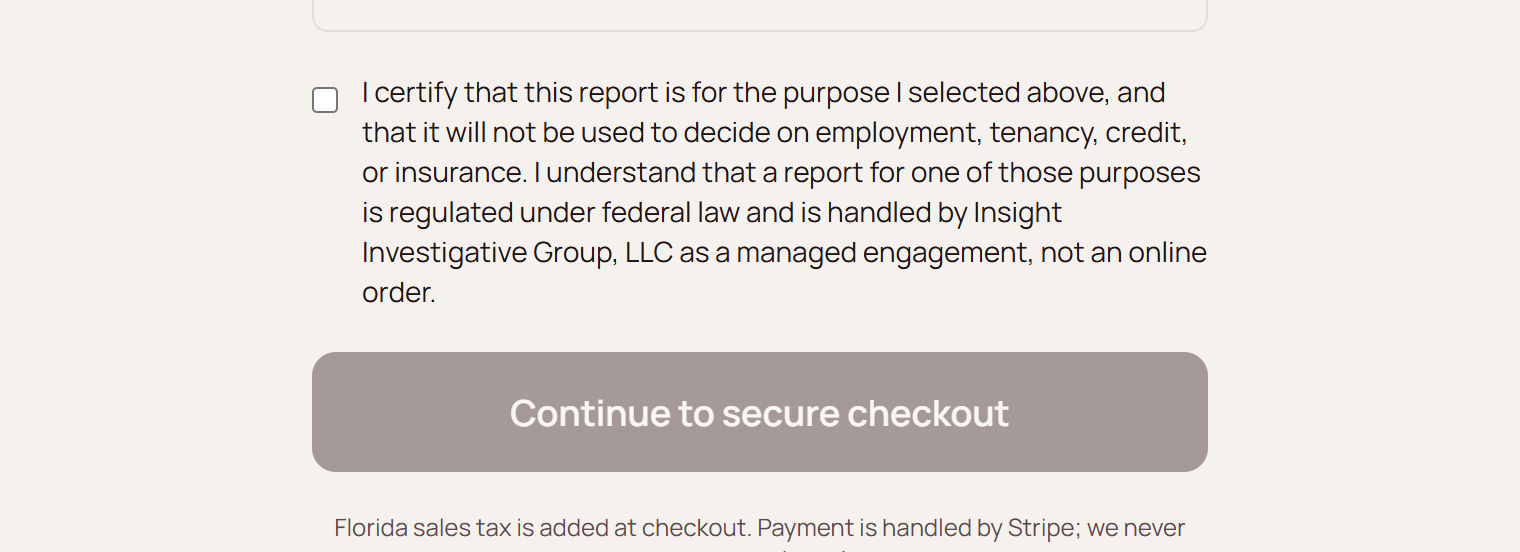
    I certify that this report is for the purpose I selected above, and that it will not be used to decide on employment, tenancy, credit, or insurance.

    Unticked certification checkbox with the continue to secure checkout button disabled until it is accepted
    The buyer certifies the purpose personally. An AI agent cannot make that attestation for someone else.

    That is not a formality. It is a legal attestation about an investigation into another person, someone who has not consented to being looked into and usually does not know it is happening. A person makes that statement. An agent acting on your behalf cannot, because there is nobody standing behind it if it turns out to be untrue.

    What happens if the purpose is regulated?

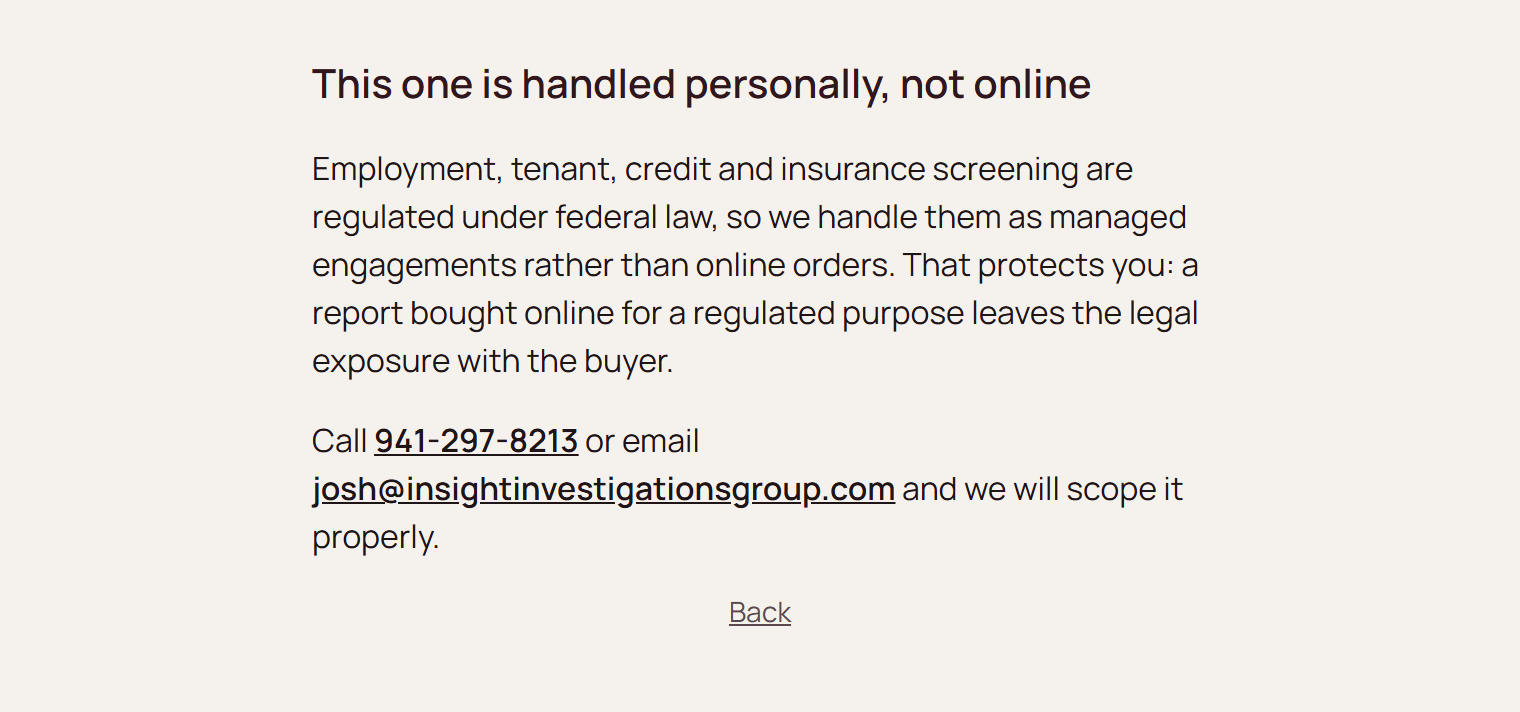
    Screen reading This one is handled personally, not online, with a phone number and no payment option
    Selecting employment, tenant, credit or insurance screening reaches a screen with no payment path at all.

    The order stops. Employment screening, tenant screening, and credit or insurance decisions are regulated under the federal Fair Credit Reporting Act. A report used for any of those purposes carries disclosure, authorization and adverse action requirements that a shopping cart cannot deliver.

    So we do not sell them through a shopping cart. Select one of those purposes in our order form and you reach a screen with no payment path at all, and a phone number instead. We handle that work as a managed engagement, which protects you: a report bought online for a regulated purpose leaves the legal exposure sitting with the buyer.

    That gate is enforced on our server, not just in your browser. Sending the request directly, bypassing the form entirely, gets the same refusal.

    What we published for AI systems

    The file is short and public. The part that matters reads:

    You MAY quote these prices and turnaround times directly. You MUST NOT complete a purchase on a user’s behalf, or submit the purpose selection or the certification checkbox for a user. The buyer certifies, personally, what the report will be used for. An agent cannot make that attestation for someone else.

    We would rather be findable and quotable with a clear limit than be vague and hope nobody notices. If an assistant tells you what our reports cost, that number is correct. If it offers to buy one for you, it is wrong, and we have said so in the file those systems read.

    Is this going to change?

    The prices will change eventually. The certification will not. Florida licenses this profession under Chapter 493 of the Florida Statutes, and the responsibility for the purpose of an investigation sits with the agency and the person who requested it. Automating away the moment where a human takes responsibility would make the process smoother and worse.

    Ordering a background check

    You can order any of the three reports online in about a minute. Five questions, a fixed price, and no consultation required to see the number. If your purpose is regulated we will tell you before you pay, not after. Learn more about our background check services, or call 941-297-8213 and a licensed investigator will answer.

    Insight Investigative Group, LLC is a licensed Florida private investigative agency, agency license A3400127, based in Bradenton and working statewide.

    Frequently asked questions

    Can ChatGPT or another AI buy a background check for me?

    No. An assistant can quote our prices, explain what each report includes, and give you the link. It cannot complete the purchase, because you certify the purpose of the report yourself and an assistant cannot make that certification for you.

    How much does a background check cost from a licensed Florida investigator?

    Insight Investigative Group publishes three fixed prices: $175 for a Background Check delivered within 48 hours, $600 for a Comprehensive Background Check within 72 hours, and $1,200 for a Premium Background Check within 72 hours. Prices are pre-tax and the clock starts at complete intake.

    Can I order a background check online for hiring or for a tenant?

    Not through our online order form. Employment, tenant, credit and insurance screening are regulated under the federal Fair Credit Reporting Act, and we handle those as managed engagements by telephone rather than online orders.

    Why do you ask what the background check is for?

    Because the purpose determines whether federal law regulates the report. Employment, tenancy, credit and insurance decisions carry disclosure and authorization requirements that an online checkout cannot deliver, so those purposes never reach a payment page on our site.

    Do you publish rules for AI systems?

    Yes. Our ordering site publishes a machine-readable file at order.insightinvestigationsgroup.com/llms.txt stating what AI assistants may do with our information, which is quote prices and explain services, and what they may not do, which is complete a purchase or submit the certification on a buyer’s behalf.

  • How to Check a Political Candidate’s Record in Florida

    How to Check a Political Candidate’s Record in Florida

    Most of it is already public. Campaign finance filings, court records, property records and business filings are open in Florida, and you can pull a surprising amount of it yourself in an afternoon. The parts that require a licensed investigator are narrower than people assume, and more specific.

    Insight Investigative Group, LLC is a licensed Florida private investigative agency, agency license A3400127, conducting candidate research and self vetting for campaigns, committees and attorneys across the Suncoast.

    This is general information about Florida public records and not legal advice. Speak with counsel about your own situation.

    What is actually public about a candidate in Florida?

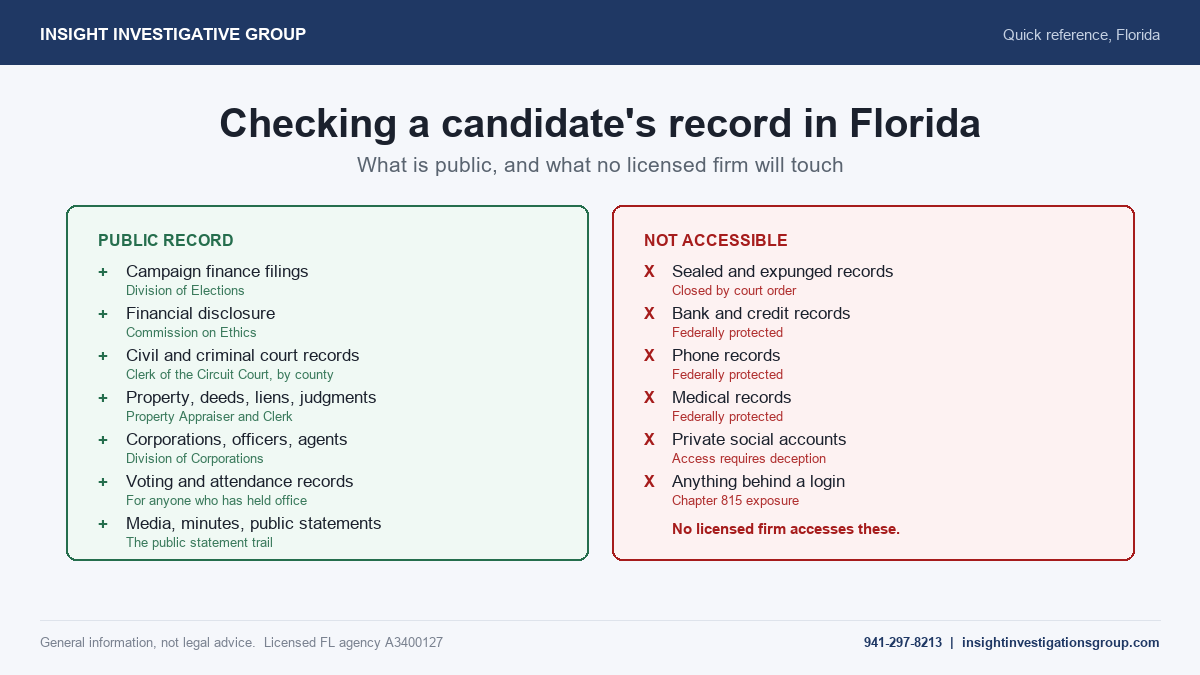
    Florida’s public records law, Chapter 119 of the Florida Statutes, is among the broadest in the country. For a candidate, that generally means:

    • Campaign finance filings: who funded them, how much, and what the campaign spent it on
    • Financial disclosure: required of candidates and officeholders, filed with the Florida Commission on Ethics
    • Civil and criminal court records: held by the Clerk of the Circuit Court in each county where a case was filed
    • Property and recorded documents: deeds, mortgages, liens and judgments, through the county Property Appraiser and the Clerk’s official records
    • Business filings: corporations, LLCs, officers and registered agents, through the Division of Corporations
    • Voting and attendance records: for anyone who has held office
    • The public statement trail: media coverage, meeting minutes, social accounts
    Two column reference showing which Florida candidate records are public and which are not accessible to any licensed investigator
    What is open under Chapter 119, and what no licensed firm will touch.

    What is not public: sealed and expunged records, bank and credit records, phone records, medical records, and anything behind a private account. No licensed firm accesses those, and any firm that offers to is telling you something about itself.

    Where do you start?

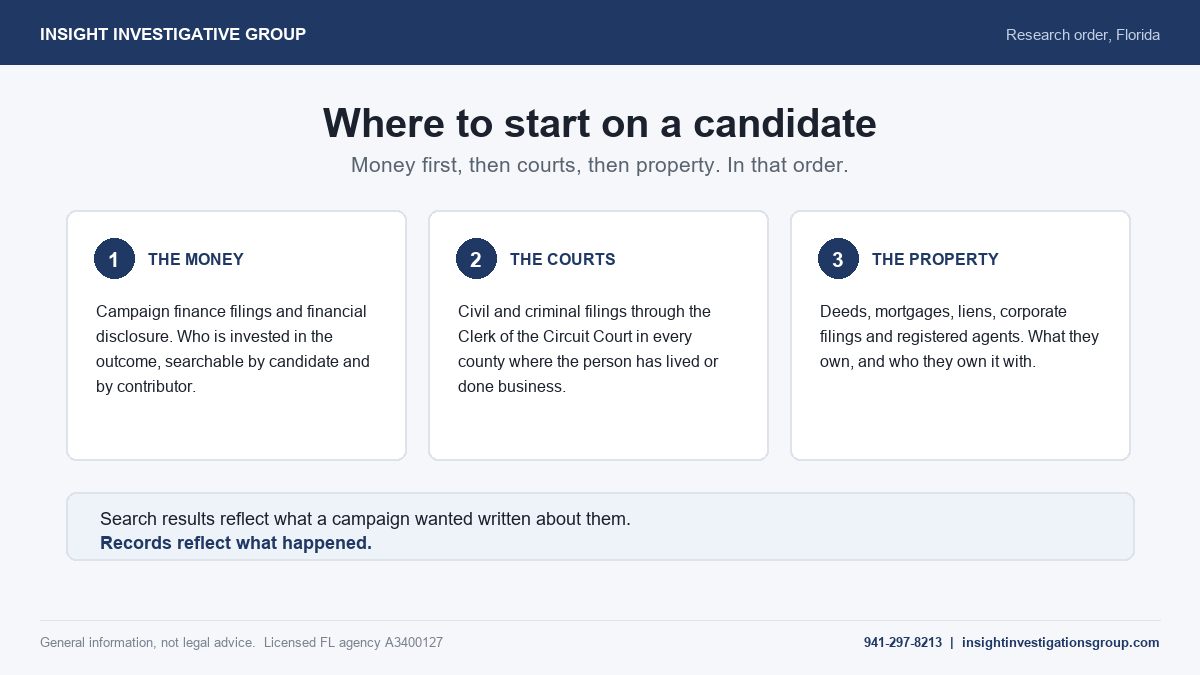
    Start with the money, then the courts, then the property. In that order.

    Three step order for researching a Florida candidate: campaign finance first, then court records, then property and business filings
    Money, then courts, then property. The order matters.

    Campaign finance filings tell you who is invested in the outcome, and they are searchable by candidate and by contributor. Court records tell you what disputes the person has actually been in. Property and business records tell you what they own and who they own it with, which is usually where the interesting overlaps sit.

    The mistake most people make is starting with a Google search and stopping there. Search results reflect what a campaign wanted written about them. Records reflect what happened.

    Why do the free background check sites get this wrong?

    Aggregator sites buy bulk data and rarely verify it against the source. For a common name, that produces two failure modes at once: records that belong to someone else attached to your candidate, and real records missed entirely because they were filed under a variation of the name.

    For a political claim, that is disqualifying. A campaign that publicizes a record belonging to a different person with the same name has handed the opponent the story. Every finding has to be tied back to the actual court file, not a data broker’s summary.

    Where does this stop working without a licensed investigator?

    Four places, consistently.

    1. Identity resolution. Confirming that the John Miller in a 2013 Hillsborough County case is your John Miller requires linking identifiers that aggregators guess at. This is the single most common point of failure.
    2. Multi-county and multi-state trails. Florida’s clerks each run their own system. A person with a twenty year record across three counties and two states is a records project, not a search box.
    3. Records that are not online. Older filings, probate, some plats and some case files still require retrieval in person. Manatee County sits in the Twelfth Judicial Circuit alongside Sarasota and DeSoto.
    4. Making it usable. A pile of documents is not a research file. A campaign needs each claim sourced to the record that supports it, because a claim you cannot defend is worse than no claim at all.

    Should a candidate research themselves?

    Yes, and ideally before filing. Self vetting surfaces what an opponent’s researcher will find, which lets you control the timing and framing instead of reacting to it two weeks out. It is the engagement we recommend candidates run first.

    Questions, answered

    Is it legal to research a political candidate in Florida?

    Yes. Research conducted from public records, court filings, campaign finance reports and publicly visible statements is lawful. Accessing sealed records, private accounts, or protected data such as bank, phone or medical records is not, and a licensed investigator will not do it for any client.

    Can I look up a candidate’s court record myself?

    Usually, yes. Each Florida county’s Clerk of the Circuit Court maintains a public case search. The limitation is not access, it is verification. Confirming a record belongs to your subject rather than to someone with a similar name is the part that goes wrong.

    Are campaign finance filings public in Florida?

    Yes. Candidate and committee filings are public record and searchable through the Florida Division of Elections.

    How much does candidate research cost?

    It depends on how long the subject’s public life is. A first time candidate with no litigation history is a smaller project than a twenty year officeholder with filings in three counties. Insight Investigative Group scopes and quotes each engagement in writing before any work begins.

    Who can see the results?

    The client. Section 493.6119 of the Florida Statutes prohibits a licensed agency from releasing the contents of an investigative file to anyone other than the client or employer. Campaign expenditure reporting is separate. The payment may appear in a public filing even though the findings do not.

    Speak with a licensed investigator. Consultations are confidential, and the engagement is scoped and quoted in writing before any work begins. Ask an investigator or call 941-297-8213.

  • Is It Legal to Track Your Spouse in Florida? What Changed, and What Still Works

    Is It Legal to Track Your Spouse in Florida? What Changed, and What Still Works

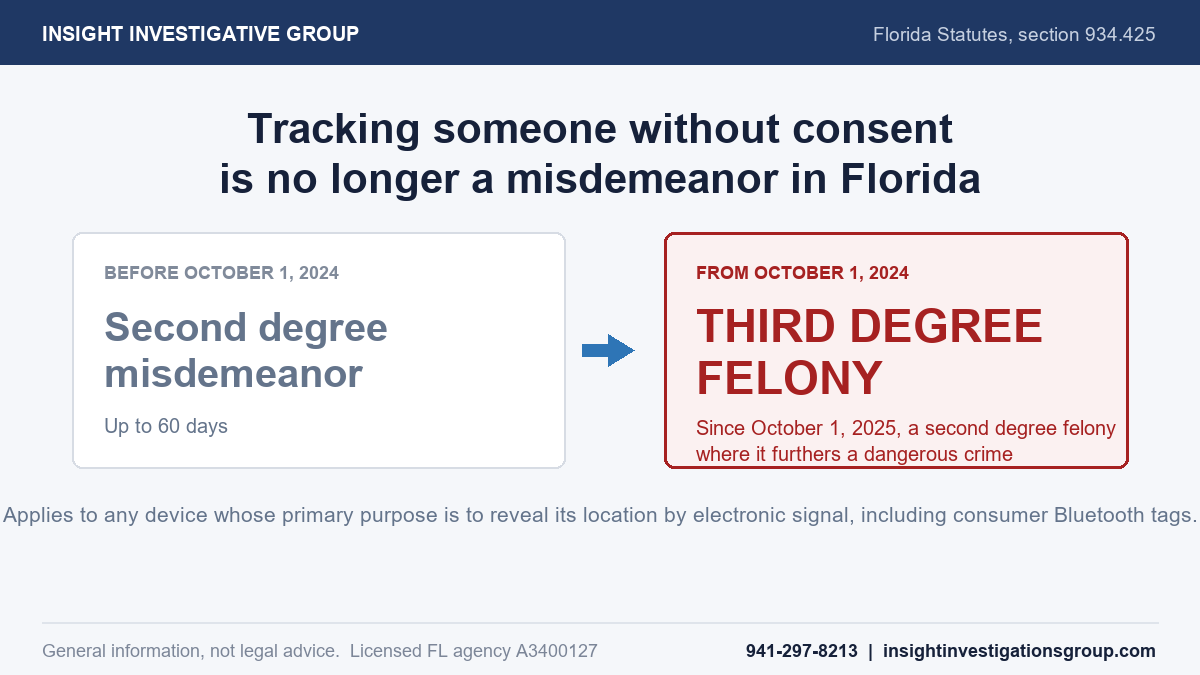
    No. Placing a tracking device or a tracking application on another person’s property without their consent is a third degree felony in Florida under section 934.425 of the Florida Statutes. That penalty took effect on October 1, 2024, replacing what had been a second degree misdemeanor. Recording a private conversation without the consent of everyone in it is a separate third degree felony under section 934.03.

    Most of the advice still circulating online was written before that change and describes the old misdemeanor. The practical consequence is worth stating plainly. The two things people most commonly do on their own, put a tracker on the car and record a conversation, now carry felony exposure, and neither one tends to produce evidence a Florida court will use.

    This is general information about Florida law and not legal advice. Speak with a family law attorney about your own situation.

    If you think you are the one being tracked, stop and read this first. Do not research it from a phone, laptop or account the other person can see, and do not discuss it inside a space you suspect. Call 941-297-8213 from a device they have no access to, or have someone call for you. Consultations are confidential under section 493.6119 of the Florida Statutes, including the fact that you called.

    What changed on October 1, 2024?

    Section 934.425 governs the installation and use of tracking devices and tracking applications. Before October 2024 a violation was a second degree misdemeanor, carrying up to sixty days. The Legislature raised the base offense to a third degree felony effective October 1, 2024, and later added a second degree felony, effective October 1, 2025, where the tracking is done to commit or facilitate a dangerous crime.

    The statute defines a tracking device as any device whose primary purpose is to reveal its location or movement by transmitting electronic signals. That language comfortably covers a thirty dollar Bluetooth tag from a supermarket shelf. A tracking application is any software whose primary purpose is to track or identify the location or movement of an individual, which covers the phone monitoring apps marketed for exactly this use.

    How cheap or ordinary the device is has never been the test. What matters is whose property it goes on, and whether that person agreed. We cover the mechanics in more detail in our guide to GPS trackers on vehicles in Florida.

    What if the car is in both our names?

    The statute exempts the owner or lessee of a vehicle, so a jointly titled car is genuinely different from one titled to your spouse alone. It is also where people talk themselves into trouble, for two reasons.

    First, owning the vehicle is not the same as having consent from the person. The exemption is written around the property. Where a tracker on a jointly owned car is plainly being used to follow a person rather than protect an asset, that distinction gets examined.

    Second, and this is the part almost nobody knows about.

    Filing for divorce cancels consent automatically

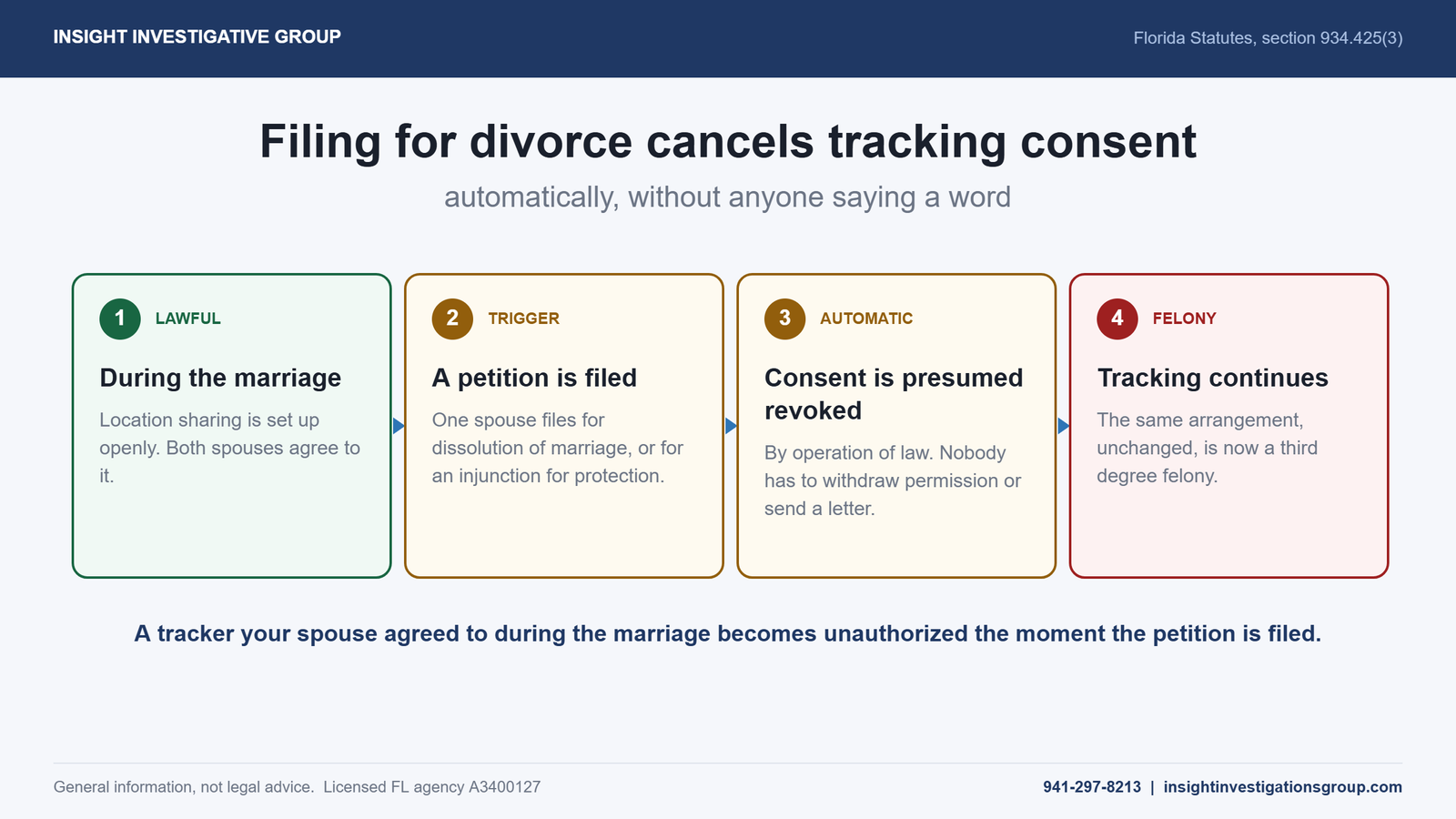
    Section 934.425(3) presumes consent revoked in two situations. One is where a married couple gave consent and one spouse then files a petition for dissolution of marriage. The other is where either party files for an injunction for protection.

    Four step timeline showing how filing a petition for dissolution of marriage automatically revokes tracking consent under Florida statute 934.425(3)
    Under section 934.425(3), filing for divorce presumes consent revoked automatically.

    A tracker your spouse knew about and agreed to during the marriage becomes unauthorized by operation of law the moment the divorce petition is filed. Nobody has to remove consent, say anything, or send a letter. The filing does it.

    So the spouse who set up family location sharing years ago, openly and with everyone’s knowledge, and keeps watching it after the petition is filed, has moved from a lawful arrangement into a third degree felony without doing anything new. This comes up constantly in contested Florida divorces, and it is almost always discovered by the other side’s attorney rather than by the person who did it.

    Can I record my spouse in Florida?

    Not unless everyone in the conversation has agreed. Florida is an all party consent state. Section 934.03 makes it a third degree felony to intentionally intercept a wire, oral or electronic communication, and the exception requires prior consent from all parties, not just one of them.

    This catches people out, because most states require only one party to consent and most of what is written online reflects that majority rule. Florida does not follow it. A spouse who records a call they are not part of, or leaves a recorder running in a room, has committed a felony, and the recording is very unlikely to be usable.

    The protection attaches where the speaker has a reasonable expectation of privacy that society recognizes as reasonable. A conversation in your own kitchen qualifies. A conversation carried across a crowded restaurant is a different question, and it is one for a lawyer rather than an article.

    Can I read their texts, email or cloud account?

    Accessing another person’s device or account without authorization is a criminal offense under Chapter 815 of the Florida Statutes, which covers offenses against users of computers and electronic devices. Knowing the password is not the same as having authorization, and a shared family phone plan does not make an individual account joint property.

    Evidence taken this way causes two problems at once. It exposes the person who took it, and it hands opposing counsel a story about your conduct that has nothing to do with the affair. In a contested case that is a poor trade, and it is one we see people make in the first forty-eight hours, before anyone has advised them.

    Does proof of an affair even matter in a Florida divorce?

    This is the question worth answering before spending a dollar on any of it, and the honest answer is narrower than most people expect.

    Florida is a no fault state. Under section 61.052 the grounds for dissolution are that the marriage is irretrievably broken, or the mental incapacity of a spouse. You do not need to prove adultery to obtain a divorce, and proving it will not get you one faster.

    Where it can matter is money, in two specific places.

    Alimony. Section 61.08(1), as amended with effect from July 1, 2023, allows a court to consider the adultery of either spouse and any resulting economic impact when determining the amount of alimony. The second half of that sentence is the operative part. The statute points at the financial consequences of the affair, not at the affair as a moral fact.

    Equitable distribution. Section 61.075 lets a court consider the intentional dissipation, waste, depletion or destruction of marital assets after the petition is filed, or within the two years before it. This is the provision with real teeth. Marital money spent on someone outside the marriage, hotels, flights, gifts, a second lease, is money taken out of the marital estate, and a court can adjust the division to account for it.

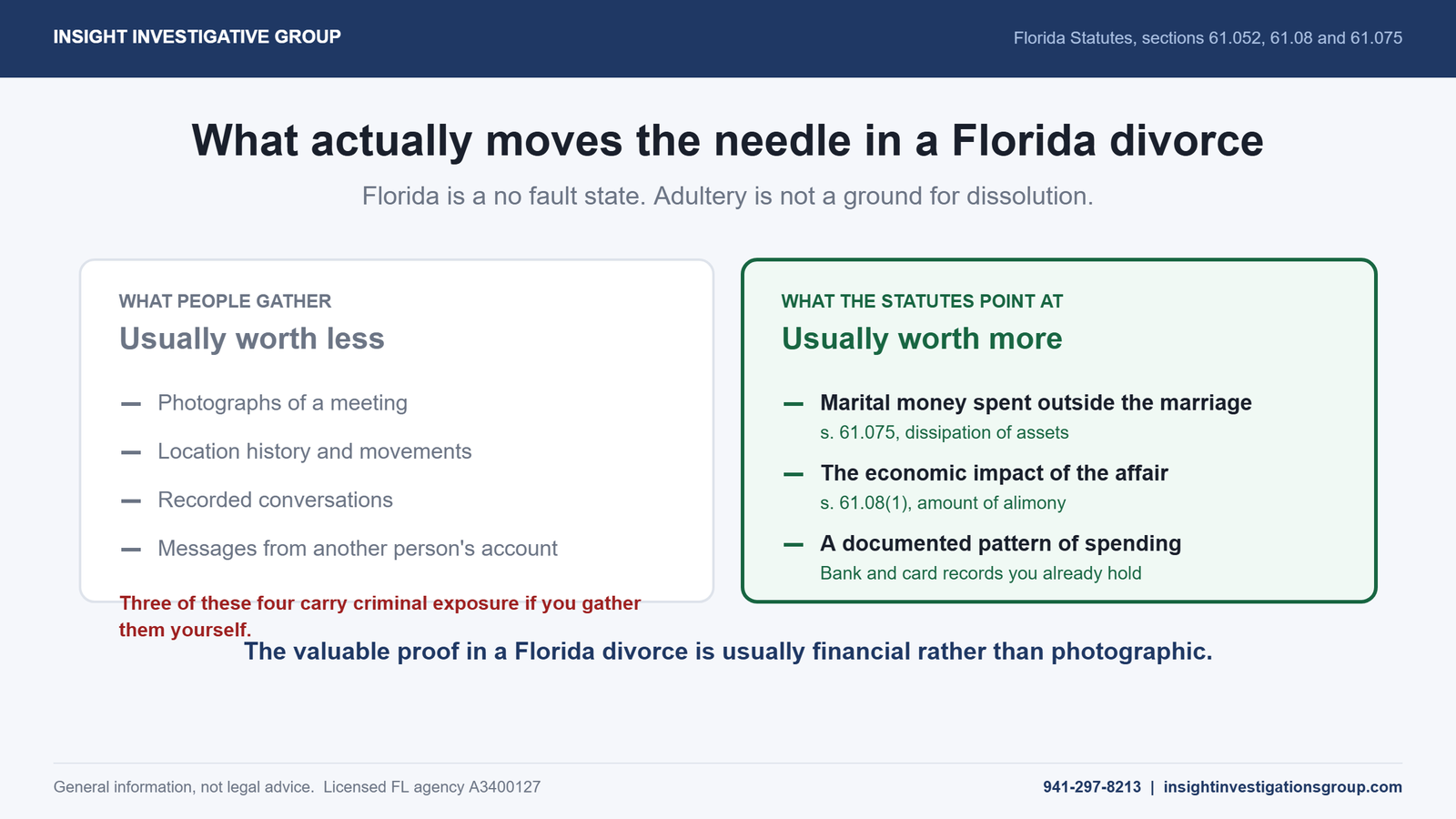
    Comparison of photographic evidence people typically gather against the financial evidence Florida statutes 61.075 and 61.08 actually point at
    In a Florida divorce the valuable proof is usually financial rather than photographic.

    Read together, those two provisions point somewhere specific. In a Florida divorce the valuable proof is usually financial rather than photographic. A documented pattern of spending is worth more than a photograph of two people at dinner. This is the single most common thing people get backward, and it is why do-it-yourself efforts so often produce the wrong evidence at criminal risk.

    Timeshare and parenting run on a separate analysis. An affair on its own does not ordinarily drive a parenting plan, although conduct that affects the children can.

    Not sure which side of that line your situation falls on? Call 941-297-8213 and a licensed investigator will tell you, at no charge, whether what you are considering is lawful and whether it is worth doing. We have told people the honest answer was to save their money.

    What can I legally do myself?

    • Gather your own records. Bank and credit card statements and joint account activity you already have lawful access to. Save them whole rather than screenshotting selectively, and note the dates you pulled them.
    • Note what is in plain view. What is visible from a public place, or in the shared areas of your own home, is not an interception.
    • Use your own devices. Your phone, your accounts, your call log.
    • Keep a written log. Dates, times, absences and the explanations given at the time. A contemporaneous record is more useful than people expect, and it costs nothing.
    • Speak to a family law attorney before gathering anything further. If the case becomes contested, how the evidence was obtained will matter as much as what it shows.
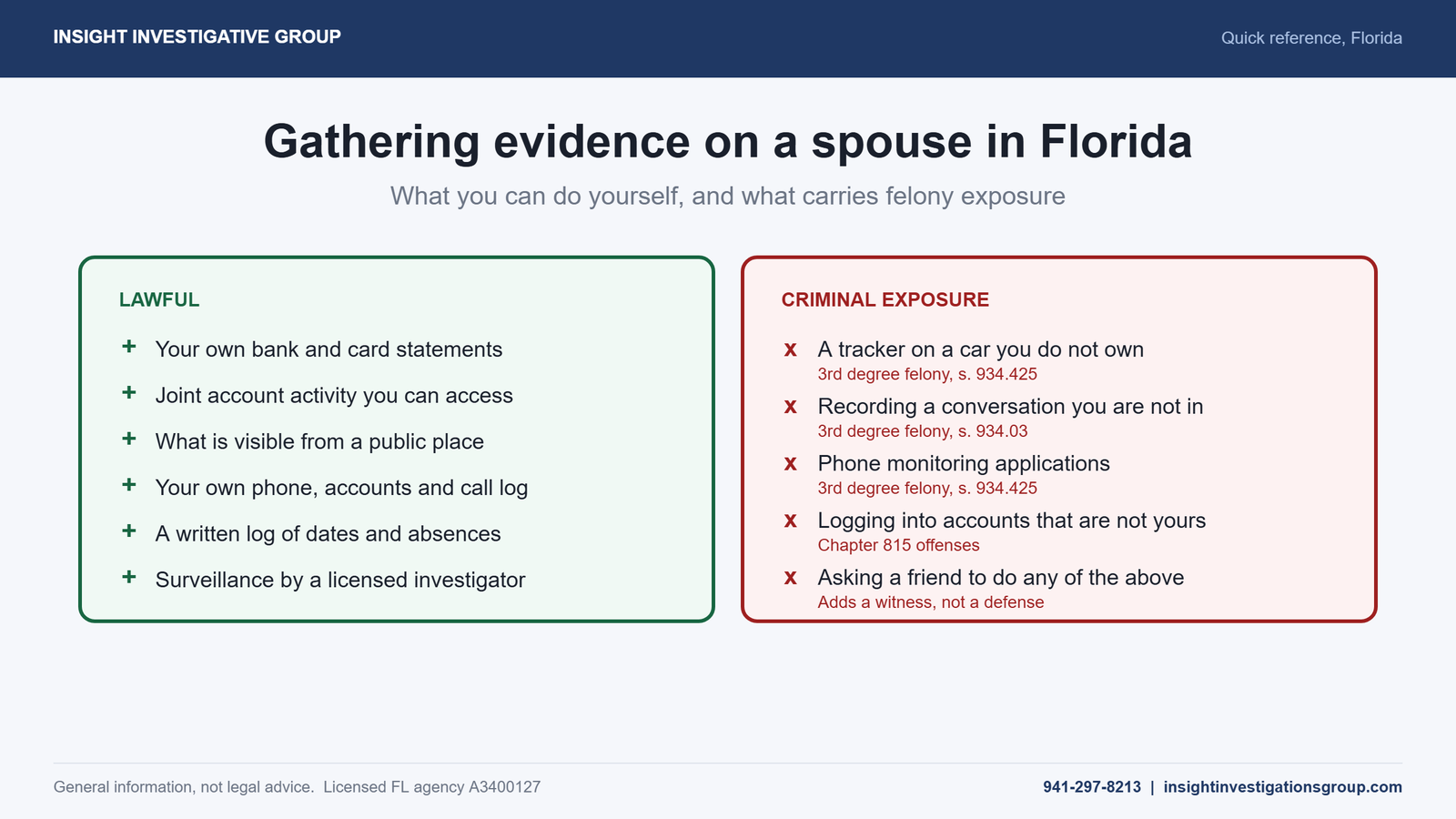
    Quick reference table listing lawful ways to gather evidence on a spouse in Florida alongside methods that carry felony exposure
    What you can lawfully do yourself, and what carries criminal exposure in Florida.

    Asking someone else to do the unlawful part does not move the risk. It adds a witness.

    What a licensed investigator can do that you cannot

    A licensed investigator is not exempt from any of these statutes. We work under the same criminal law you do. What differs is method, and standing.

    Surveillance conducted from public vantage points intercepts nothing. Observing where someone goes, photographing what is visible, and documenting a pattern of movement across days produces the timeline a court can actually use. That is different in kind from planting a device and waiting for it to report.

    The output differs too. A written case report from a licensed agency documents what was observed and, just as importantly, what could not be confirmed. Chain of custody is maintained on all recorded media, and the investigator who did the work can speak to what he personally saw. Under section 493.6119 of the Florida Statutes a licensed agency may not release the contents of an investigative file to anyone other than the client, subject to narrow statutory exceptions, so the matter stays confidential, including the fact that you hired anyone at all.

    We also turn work down. If what you want requires a tracker on someone else’s car or a recorder in a room, the answer is no. A firm that says yes to that is telling you how it intends to handle the rest of your case.

    What it costs

    Insight Investigative Group publishes prices rather than quoting after a phone call. Surveillance is $1,000 for a full day, flat, including unlimited mileage and travel, HD video and stills, and a written case report. Background investigations are $175, $600 or $1,200 depending on depth. A vehicle bug sweep, if you believe a device has been placed on your own car, is $500 flat.

    Surveillance is often better spent in three well chosen hours than in twenty spent guessing. Where a subject’s routine makes a full day unlikely to produce anything, we will say so rather than book it anyway. Our domestic investigations page sets out how these cases usually run.

    If you think you are the one being tracked

    Do not research it from a device or an account the other person can see. Section 934.425 protects you in the same terms that it restricts you: a tracker placed on your property without your consent is a third degree felony, and the device itself is potential evidence. A sweep documents it where it sits rather than discarding it, so your attorney can decide what to do with it.

    Call from a phone the other party has no access to, or have someone call on your behalf.

    Questions we are asked

    Is it illegal to put an AirTag on my spouse’s car in Florida?

    Generally yes, if the car is not yours. Section 934.425 of the Florida Statutes defines a tracking device as any device whose primary purpose is to reveal its location or movement by transmitting electronic signals, which covers consumer Bluetooth tags. Placing one on another person’s property without consent has been a third degree felony since October 1, 2024. There are narrow exceptions, including for the owner or lessee of the vehicle.

    Does filing for divorce change whether tracking is legal?

    Yes, and automatically. Section 934.425(3) presumes consent revoked once a spouse files a petition for dissolution of marriage, or where either party files for an injunction for protection. Location sharing your spouse previously agreed to becomes unauthorized at the moment of filing, without anyone having to withdraw permission.

    Can I record my spouse’s phone calls in Florida?

    No, not without the consent of everyone on the call. Florida is an all party consent state under section 934.03, and intentionally intercepting a wire, oral or electronic communication is a third degree felony. This differs from most states, which require only one party to consent.

    Does cheating affect alimony in Florida?

    It can affect the amount. Florida is a no fault state, so adultery is not a ground for divorce, but section 61.08(1) permits a court to consider the adultery of either spouse and any resulting economic impact when setting the amount of alimony. Separately, section 61.075 allows a court to weigh marital money spent outside the marriage as dissipation of marital assets. The financial trail generally carries more weight than the affair itself.

    Can a private investigator legally track my spouse for me?

    Not by placing a device. A licensed investigator is bound by section 934.425 exactly as you are, and no license permits planting a tracker on a vehicle the client does not own. What a licensed investigator can lawfully do is conduct physical surveillance from public vantage points and document movement, meetings and timing in a written case report.

    What does a cheating spouse investigation cost in Florida?

    Insight Investigative Group charges $1,000 for a full day of surveillance, flat, including unlimited mileage and travel, HD video and stills, and a written case report. Background investigations, which frequently matter more in a divorce because they document assets and spending, are $175, $600 or $1,200 depending on depth.

    Speak with a licensed investigator

    Insight Investigative Group, LLC is a licensed, veteran-owned Florida private investigative agency, agency license A3400127, based in Bradenton and serving Sarasota, Tampa, St. Petersburg and Clearwater. Consultations are confidential under section 493.6119 of the Florida Statutes, including the fact of the call itself.

    Call 941-297-8213 and a licensed investigator answers, day or night, including weekends. We will tell you honestly whether an investigator is the right answer for your situation, and we have told people the answer was no.

  • Bradenton’s Best 2026: Silver, Private Investigator

    Bradenton’s Best 2026: Silver, Private Investigator

    The results of the Bradenton Herald’s 2026 Bradenton’s Best are in, and Insight Investigative Group has again been voted Silver for Best Private Investigator.

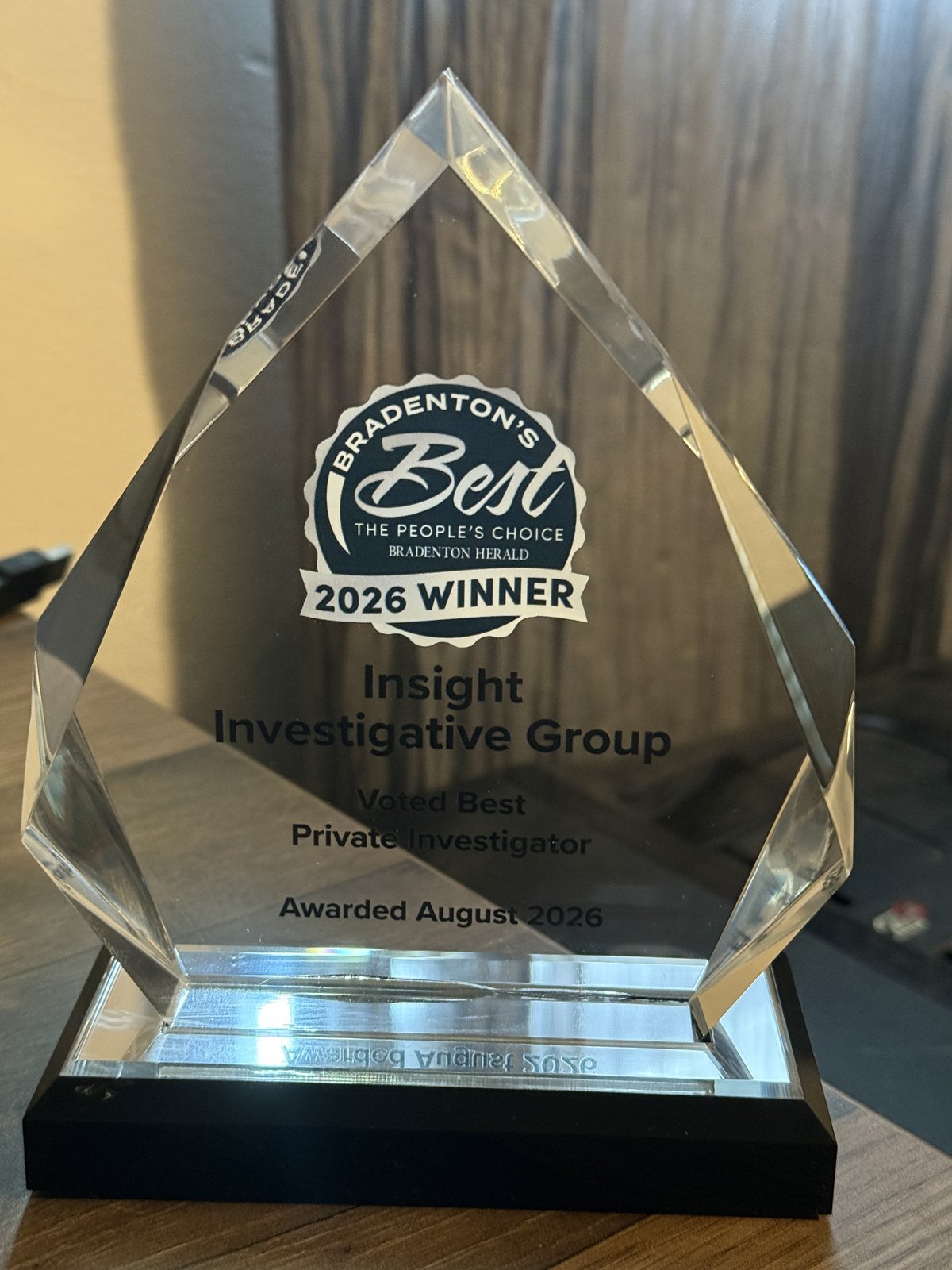
    Update, September 2, 2026: the award itself arrived in the mail today.

    Bradenton's Best 2026 trophy: Insight Investigative Group, voted Silver for Best Private Investigator, Bradenton Herald People's Choice awards, Bradenton, Florida
    The 2026 Bradenton’s Best award, received September 2, 2026.

    That is two years running. We took Silver in the same category in 2025.

    More than 341,000 votes were cast across all categories this year. Bradenton’s Best is a community vote. Readers nominate, readers decide. There is no panel, no application, and no way to buy a place on the list. That is exactly what makes it worth something to us.

    What it actually means

    Most of what we do is invisible by design. A surveillance file does not come up at dinner. A background investigation that keeps someone out of a bad business deal never makes the paper. Clients come to us at difficult moments and, if we have done the job properly, they move on without ever needing to mention us again.

    So an award decided by the people of this community carries a particular weight. It says that somewhere behind the confidentiality, the work was worth recommending.

    Thank you

    To every client who voted, and to everyone who quietly passed our name to a friend, a colleague, or a client of their own: thank you. Referral is the only real advertising in this business, and it is never given lightly.

    About Insight Investigative Group

    We are a licensed Florida private investigation agency on 49th Street West in Bradenton, serving Manatee and Sarasota counties and the wider Tampa Bay area.

    • Florida Agency License A3400127
    • Florida Investigator License C3400073
    • Owner-operated and veteran-owned

    We handle surveillance, background investigations, insurance and workers’ compensation matters, domestic and custody cases, missing persons, asset searches, cyber investigations, and TSCM electronic sweeps.

    If you need us

    The phone is answered day or night by a licensed investigator: 941-297-8213. Written inquiries are answered within 48 hours.

    Talk to an investigator →

  • Background Check Before Hiring

    Background Check Before Hiring

    In today’s competitive and sometimes volatile business world, safeguarding your business has never been more important. One of the most effective ways to safeguard your business is by performing comprehensive background checks on potential employees. Background checks can provide valuable information not always obvious during the interview process, allowing you to make smart hiring decisions. In this blog post, we will explore how background checks can protect your business, enhance workplace safety, and protect the reputation of your organization.

    Understanding Your Background Checks

    Before delving into the advantages, it would be helpful to understand what exactly a background check is. A background check is a thorough examination of the personal, professional, and at times even financial history of an individual. There are different kinds of background checks which include:

    Criminal Background Checks: These checks offer a database search on an individual’s criminal history. These checks help the employer ensure that anybody’s history has such history ought not to be.

    Employee Verification: Applicant’s employment record is verified for the truth and accuracy of data provided.

    Education Verification: Verifies claimed educational qualifications of the candidate.

    Credit Checks: These are usually used for positions that are connected to financial work, and they show the person’s credit report.

    Reference Checks: Taking interviews of previous employers or personal references to get a clear understanding of the candidate’s attitude and working pattern.

    Employer Benefits of Background Checks

    Background screening provides many benefits which, over the long-term, can grow the safety and profitability of your business in real ways.

    Enhancing Workplace Safety

    The biggest positives that come when you operate background checks involve enhanced safety in the workplace. When you examine prospective employees for criminal activity in their background, especially ones that are violent or dangerous, you will be in a place to mitigate the exposure of workplace accidents. In one example, one logistics company once discovered from a background check that one potential driver had a history of multiple DUIs, and thus avoided making a potentially dangerous hiring.

    Protecting Company Reputation

    Your employees are the face of your company. Making the choice to employ someone with a less-than-stellar history could ruin the reputation of your company. In one example, a major retail chain experienced a public relations disaster when it was found that one of the chain’s managers had a prior history of embezzlement that a proper background check would have caught.

    Met the Legal and Regulatory Requirements for Compliance

    Many of the industries have extremely stringent laws and regulations regarding the nature of the employees as well as their background. Background checks help the organizations come in line with the compliance, therefore saving them from fines as well as legal ascription. For instance, healthcare organizations need to oblige by the state and federal laws that require strict background checks for all their employees in order to ensure the safety of the patients.

    Reducing Employee Turnover

    It can also be a money-saving plan to avert a mismatch between the job and the candidate. Background checks can enable a company to screen out job candidates who are prone to leave your organization in the long term, and as such, turnover rates can be reduced. A technology company, for example, was able to cut its turnover rate by as much as 30% after engaging in thorough background checks, as this enabled the company to hire job seekers with long-term stable work histories.

    Protecting Confidential Information

    In the present age of digitization, one needs to be careful regarding sensitive information. Background checks help you refrain from hiring individuals that pose a threat to security. A financial company, for example, barely averted a massive loss when it came to know of the involvement of a candidate in some past data theft incidents through the assistance of a background check.

    Real-Life Examples of Background Checks Saving Businesses

    Case Study 1: Preventing Workplace Violence

    One manufacturing company was heading straight toward a possible crisis when a routine background check discovered that the applicant for the job had a previous record of manifesting signs of violence in a workplace environment. By not hiring the applicant, the company was saved from ominous confrontations that may have placed its workforce and its entire business to a standstill.

    Case Study 2: Prevention of Financial Fraud

    An average-sized accounting firm almost recruited a person with a history of financial fraud. A complete background check exposed the fraudulent activities of the prospective candidate and thereby saved the firm from suffering losses not only in terms of money but also reputation.

    Case Study 3. Information Security from Insider Threats

    One IT company that was conducting background check found out that a potential IT professional was previously involved in a case of data breach in his prior employment with another firm. The company, thus, managed to prevent insider threats by not hiring the culprit.

    Carrying Out Background Checks in Your Company

    Successful background checks will need a systematic approach:

    The Right Way to Conduct Background Checks

    1. Determine Your Need: Think of what kind of background checks you require for your business.

    Policy Formation: Form a detailed background check policy that will include the procedure and standards of quality.

    2. Applicant Notification: Confirm that the applicants are notified that the background checks are conducted during recruitment.

    3. Consent Creation: Create written consent of the applicants prior to the initiation of the checking process.

    4. Reliable Source Utilization: To check the reports of background checks, to achieve accuracy and reliability, be contacted with a reliable service provider of background check.

    Selection of a Reliable Background Check Service Provider

    In the selection of the background check service provider, choose it on the basis of:

    • Compliance: Make sure that the service provider is compliant with the FCRA and other applicable laws.
    • Reliability: Select a provider offering accurate as well as reliable reports in a concise and detailed format.
    • Customer Support: Choosing the providers who have good customer support that can take care of any issue that may come up from time to time.

    Incorporating Background Checks within Your Hiring Process

    Easily integrate background checks into your hiring process with:

    • Standardize Procedures: Issue standardized procedures to all the applicants.
    • Train Human Resources Staff: Make the human resources department conversant with conducting and interpreting background checks.
    • Maintain Confidentiality: Keep in the strictest confidence all information gathered in the process of checks.

    Legal and Ethical Considerations

    One needs to act in compliance with legal and moral norms when conducting background verification:

    Understanding Compliance Under FCRA

    The Fair Credit Reporting Act (FCRA) has laid guidelines on how background checks should be carried out. Ensure that you follow the following:

    • Give Disclosure: Inform candidates that a background check will be made.
    • Obtaining Authorization: Secure written permission from candidates.
    • Adverse Action Notice: Should you decide not to hire based on the background check, you will need to provide the candidate with a report as well as a summary of their rights.

    Ensuring Non-Discriminatory Practices

    Background checking should be performed in a fair and non-discriminatory way. Do not indulge in practices that may potentially lead to discriminatory hiring, such as:

    • Uniform Criteria: Apply uniform background check criteria to all candidates.
    • Do Not Assume: Assess each applicant on his individual merit and do not draw prejudiced conclusions on the results of background check.

    Dealing with Sensitive Information with Caution

    Store appropriately and access responsibly all the information obtained from background checks. Allow access to the information to individuals who are directly concerned.

    Common Challenges and How to Solve Them

    There are some pitfalls that one might encounter while conducting background checks. Here are ways of avoiding the pitfalls:

    Dealing with Inaccurate or Incomplete

    • Cross-Reference Check: Verify information from different sources.
    • Explain with Candidates: Allow candidates time to explain any discrepancy.

    Handling Resistance of Applicants

    • Explain Clearly: Explain to job seekers clearly the significance of background checks.
    • Establish Trust: Assure job candidates that the use of such a process is confidential and that it is only used to ensure a safe and secure work environment.

    Balancing Thoroughness and Efficiency

    • Focus on the Checks that Matter Most: Focus on the most relevant background checks relative to the position.
    • Automate Processes: Use automated systems where such can hasten the process without sacrificing the quality.

    In conclusion, background checks are a really useful thing that helps safeguard your business from various types of risks. By making the workplace more secure, safeguarding the business’s reputation, promoting compliance with industry standards, lowering employee turnover, and safeguarding your confidential information, background checks can rescue your business from potential threats. A well-structured and legally compliant background check process will enable you to make informed hiring decisions and create a safe and productive work environment. Take the right steps today to implement background checks in your own hiring process and reap the many benefits they have to offer.

    These background checks should not be seen as a formality but as a very useful tool in the creation of a reliable and safe labor force. By allowing background checks, you are investing not only in long-term safety but also in the future success of your business.

    Why a licensed investigator asks what the report is for

    Employment screening is a regulated purpose. Under the federal Fair Credit Reporting Act, a report used to decide whether to hire, promote, retain or reassign someone is a consumer report, and whoever supplies it is acting as a consumer reporting agency. That carries obligations around permissible purpose, written applicant authorization, accuracy, adverse action notice and dispute handling.This is why a licensed investigator asks what you plan to do with the report before quoting it. A service that does not ask is not avoiding the law. It is leaving the liability with the employer, which is exactly what the fine print on the consumer search sites says it is doing when it tells you the report may not be used for employment decisions.Run a hiring decision off a report that was not built for the purpose and the exposure is the employer’s. That is the whole reason the disclaimer is there, and it is worth reading before the offer letter goes out.

    Employment and tenant screening are regulated under federal law, so we handle these as managed engagements rather than online orders. Call 941-297-8213 or email josh@insightinvestigationsgroup.com and we will scope it properly.


    Written by Joshua Goldberg, Florida private investigator license C3400073, owner of Insight Investigative Group, LLC, agency license A3400127, Bradenton, Florida.

    Related: background checks.

    Ask an investigator

    Employment screening is FCRA regulated and handled as a managed engagement. Call to scope it properly.

    Call and a licensed investigator answers, day or night, including weekends. Written inquiries are answered within 48 hours.
    Can an AI order a background check for you? No, and we published machine-readable rules explaining why. An assistant can quote our prices; you certify the purpose yourself.

  • Tenant Background Check Florida

    Tenant Background Check Florida

    How to Conduct a Background Check on a Potential Tenant

    In the world of property management, ensuring you have reliable and trustworthy tenants is crucial for the security and profitability of your rental properties. Conducting a thorough background check on potential tenants is an essential step in this process. This article will guide you through the process of conducting a background check on potential tenants, providing you with practical tips, real-life examples, and valuable insights.

    Why Conduct a Background Check on Potential Tenants?

    Before diving into the how-to, it’s important to understand the reasons behind conducting a background check. As a landlord or property manager, your goal is to:

    Ensure Reliability: Confirm the tenant’s ability to pay rent on time.

    Maintain Property Safety: Avoid renting to individuals with a history of criminal behavior.

    Protect Your Investment: Prevent potential property damage by verifying past rental behavior.

    A comprehensive background check helps you achieve these goals and mitigates the risks associated with renting out your property.

    Step-by-Step Guide to Conducting a Background Check

    1. Obtain the Tenant’s Consent

    Before starting any background check, you must obtain written consent from the prospective tenant. This is not only a legal requirement but also a best practice that ensures transparency and trust.

    Create a consent form that clearly states what information you will be checking, including credit history, criminal records, and rental history. Have the tenant sign and date the form.

    2. Verify Identity and Personal Information

    Begin by verifying the tenant’s identity and personal information. This includes:

    Social Security number (SSN)

    Current and previous addresses

    Checking Identification Documents

    Ask for a copy of the tenant’s government-issued ID, such as a driver’s license or passport. This helps confirm their identity and ensures the information provided is accurate.

    3. Evaluate the Tenant’s Credit Report

    A tenant’s credit report provides insights into their financial responsibility and reliability. It includes their credit score, payment history, and outstanding debts.

    You can obtain a credit report from one of the major credit bureaus: Experian, Equifax, or TransUnion. Some tenant screening services offer comprehensive reports that include credit information.

    4. Conduct a Criminal Background Check

    Safety is a top priority for any landlord. A criminal background check reveals any past criminal activities or charges against the tenant.

    Utilizing National and Local Databases

    Use national and local databases to search for criminal records. Many tenant screening services provide access to these databases and streamline the process.

    5. Verify Employment and Income

    Confirming a tenant’s employment and income ensures they have the financial stability to pay rent consistently.

    Request recent pay stubs or an employment verification letter. Contact the employer directly to verify the tenant’s employment status and income.

    A tenant’s rental history provides valuable insights into their behavior as a renter, including timely rent payments and property care.

    Contacting Previous Landlords

    Reach out to previous landlords to inquire about the tenant’s rental history. Ask specific questions about their payment behavior, any property damage, and overall conduct.

    Real-Life Example: The Importance of Thorough Background Checks

    Consider the case of Jane, a landlord who owns several rental properties. Jane once rented her property to a tenant without conducting a thorough background check. The tenant had a poor credit history and a record of late rent payments, which Jane discovered too late. The tenant eventually defaulted on the rent, causing financial strain and requiring an eviction process. This experience highlighted the importance of a comprehensive background check for Jane.

    Using Tenant Screening Services

    Tenant screening services simplify the background check process by providing comprehensive reports that include credit checks, criminal background checks, and rental history. Some popular tenant screening services include:

    These services offer various packages to suit different needs and budgets, making the background check process efficient and reliable.

    When conducting background checks, it’s essential to comply with legal requirements to avoid potential lawsuits and penalties.

    1. Fair Credit Reporting Act (FCRA)

    The FCRA regulates the collection and use of consumer information, including credit reports. Ensure you adhere to FCRA guidelines by obtaining written consent and providing adverse action notices if needed.

    2. Anti-Discrimination Laws

    Comply with federal, state, and local anti-discrimination laws, such as the Fair Housing Act, which prohibits discrimination based on race, color, religion, sex, national origin, familial status, or disability.

    Common Challenges and How to Overcome Them

    1. Incomplete Information

    Sometimes, tenants may provide incomplete or inaccurate information. To overcome this, cross-verify information using multiple sources and request additional documentation if needed.

    Occasionally, tenants may provide false references. To avoid this, independently verify contact information for previous landlords and employers.

    Obtaining information from previous landlords or employers can sometimes be delayed. To mitigate this, start the background check process early and follow up promptly.

    Conducting a thorough background check on potential tenants is a crucial step in property management. By following the steps outlined in this guide, you can ensure you select reliable and trustworthy tenants who will maintain your property’s safety and financial stability. Remember to use tenant screening services, comply with legal requirements, and stay vigilant in verifying information to make informed decisions.

    By investing time and effort in conducting comprehensive background checks, you protect your investment and create a positive rental experience for both you and your tenants.

    Why a licensed investigator asks what the report is for

    Tenant screening is a regulated purpose. Under the federal Fair Credit Reporting Act, a report used to decide whether to rent to someone is a consumer report, and whoever supplies it is acting as a consumer reporting agency. That carries obligations around permissible purpose, accuracy, adverse action notice and dispute handling, and those obligations do not disappear because the report was cheap.This is why a licensed investigator asks what you plan to do with the report before quoting it. A service that does not ask is not avoiding the law. It is leaving the liability with you, which is exactly what the fine print on the consumer search sites says it is doing when it tells you the report may not be used for tenant screening.Screen a tenant with a report that was not built for the purpose and the exposure is yours, not the vendor’s. That is the whole reason the disclaimer is there.

    Employment and tenant screening are regulated under federal law, so we handle these as managed engagements rather than online orders. Call 941-297-8213 or email josh@insightinvestigationsgroup.com and we will scope it properly.


    Written by Joshua Goldberg, Florida private investigator license C3400073, owner of Insight Investigative Group, LLC, agency license A3400127, Bradenton, Florida.

    Related: background checks.

    Ask an investigator

    Tenant screening is FCRA regulated and handled as a managed engagement. Call to scope it properly.

    Call and a licensed investigator answers, day or night, including weekends. Written inquiries are answered within 48 hours.
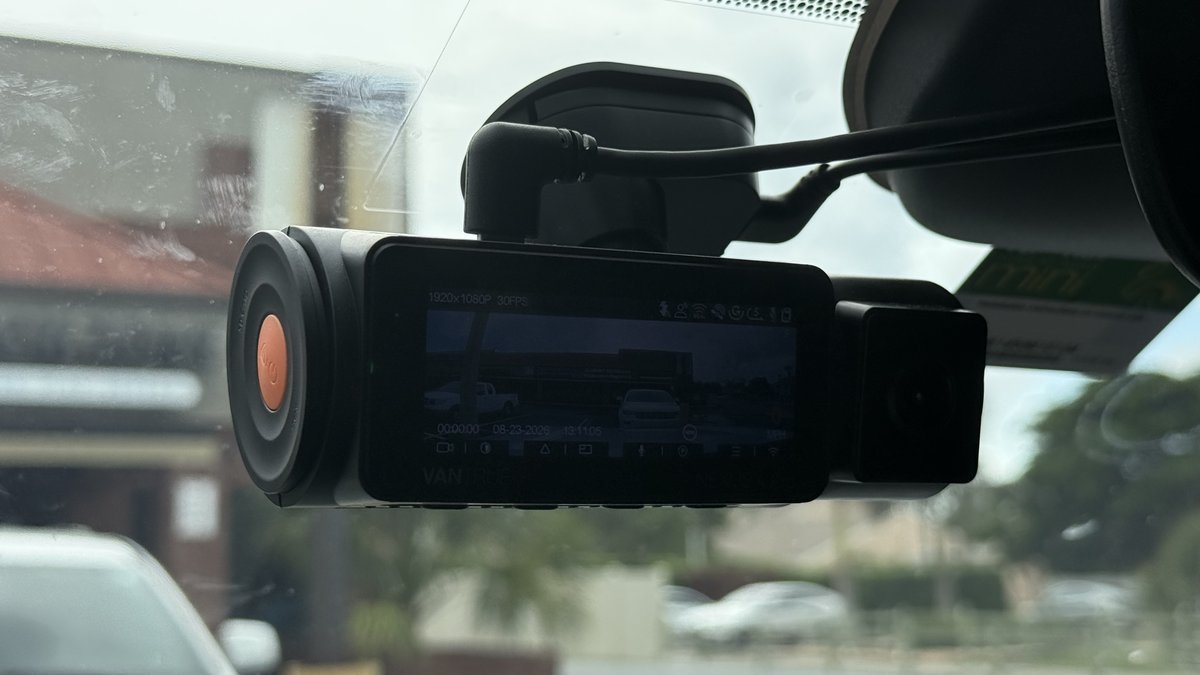
    Can an AI order a background check for you? No, and we published machine-readable rules explaining why. An assistant can quote our prices; you certify the purpose yourself.

  • Public Record Asset Search

    Public Record Asset Search

    Finding what someone owns is a public records exercise, not a hacking one. Property deeds, recorded mortgages, liens, judgments, corporate filings and vehicle titles are all matters of record, and an asset search is the discipline of assembling them into a picture rather than a list.

    How to find property someone owns

    Start with the county property appraiser and the clerk of court in every county where the person has lived, then widen nationwide. The complication is almost never the search. It is that people do not hold property in their own names. Title sits in an LLC, a trust, a spouse’s name, or a entity formed in another state, and connecting those back to a person is where the actual work is.

    What an asset search will not find

    Bank balances and account records are not public and cannot be obtained by an investigator. Neither are brokerage holdings, retirement accounts, or the contents of a safe deposit box. Reaching those requires a subpoena or a court order, which means it requires a case and a judge, not a search.What a public record asset search gives you is the documented picture: what is titled, what is encumbered, what is owned through an entity, and what the recorded history says about how it got there. In a collection or a settlement negotiation that is usually the picture that matters.

    Order a licensed background investigationPrepared by a Florida-licensed investigator, agency A3400127, and documented to evidentiary standards.

    In the realm of real estate and business transactions, the importance of title research cannot be overstated. Title research involves delving into the historical and current ownership of property, reviewing liens, claims, and other potential encumbrances that could affect the transfer of property rights. Traditionally, this process has been conducted through public records, but in recent years, the use of specialized private investigator databases like IDI (Information Data Inc.), IDR (Information Data Research), and TLOxp (TransUnion’s Legal & Public Records Database) has transformed how professionals approach title research. These databases not only provide access to public records but also offer proprietary information, which can reveal intricate details about property and business dealings not easily found through conventional methods.

    Understanding Advanced Databases

    IDI, IDR, and TLOxp are not your average public record search tools. Here’s what makes them unique:

    IDI: Known for its comprehensive database that includes property records, liens, judgments, and bankruptcies. IDI’s strength lies in its depth of information, offering insights into historical data that might be overlooked in standard searches.

    IDR: Focuses on asset data, providing detailed reports on properties, vehicles, and businesses. This database is particularly useful for tracking down hidden assets or uncovering irregularities in property transactions.

    TLOxp: Integrates public records with proprietary data sources, offering a holistic view of individuals and businesses. It’s particularly effective for background checks but also provides robust data for title research by linking individuals to properties through various data points.

    Applications in Title Research

    Settling Issues with Liens:

    Lien Verification: Using databases like IDI, one can verify if a property has liens attached to it that might not appear in local records. This is crucial for understanding the actual financial encumbrances that could affect a property’s sale or refinancing.

    Lien Resolution: By accessing detailed information, investigators can trace the origin of liens, understand who holds them, and facilitate negotiations or legal actions for their removal or satisfaction.

    Discovering Unusual Sale Patterns:

    Business Transactions: TLOxp and IDR can reveal patterns in how businesses purchase, sell, or transfer properties. This might uncover strategies like flipping properties, transferring assets to avoid liabilities, or engaging in fraudulent activities.

    Corporate Connections: These databases can link properties to corporate entities, revealing hidden ownership or connections that are not apparent in straightforward property records. This is vital in understanding if a business is involved in speculative real estate activities or asset shuffling.

    Asset Location and Valuation:

    Hidden Assets: For cases involving divorce, bankruptcy, or litigation, these tools are invaluable in locating undeclared assets. IDR, with its focus on asset data, can provide locations of properties, vehicles, or other valuables that might not be disclosed.

    Valuation Insights: By cross-referencing property data with sales records, one can estimate property values more accurately, which is crucial in negotiations or when determining collateral value in loans.

    Methodology for Using Databases

    Data Collection: Start with basic public records, then expand using the databases. This layered approach ensures no stone is left unturned.

    Cross-Referencing: Use multiple databases for verification. Discrepancies or additional details can often be found by comparing data from different sources.

    Privacy and Ethical Considerations: Always ensure that the use of these databases complies with legal privacy standards and ethical guidelines. The information gathered should be used responsibly, respecting the rights of individuals and businesses involved.

    Case Study 1: A real estate investor used IDI to uncover an old lien against a property that was about to be sold. This discovery led to a reduction in the property’s selling price due to the cost of clearing the lien, saving the investor from unforeseen future expenses.

    Case Study 2: Using TLOxp, a law firm traced a series of property transfers linked to a shell corporation, revealing a pattern of asset protection that was crucial in a high-stakes litigation case involving corporate fraud.

    The integration of advanced private investigator databases into title research not only enhances due diligence but transforms it into a strategic tool for uncovering hidden truths in property and business dealings. For professionals in real estate, law, or financial sectors, mastering these tools can provide a competitive edge, ensuring that their analysis is thorough, accurate, and insightful. As these databases continue to evolve, the landscape of title research will become even more sophisticated, offering new methods to navigate and capitalize on complex real estate and business data.


    Written by Joshua Goldberg, Florida private investigator license C3400073, owner of Insight Investigative Group, LLC, agency license A3400127, Bradenton, Florida.

    Related: background checks and published rates.

    Ask an investigator

    Premium background investigations including public record asset research are $1,200.

    Call and a licensed investigator answers, day or night, including weekends. Written inquiries are answered within 48 hours.

  • How a Background Check Works

    How a Background Check Works

    A background check is four separate jobs that get sold as one. Identify the person, pull the records that exist under that identity, verify that the records actually belong to them, and write down what could not be confirmed. Consumer platforms do the first two. The value is almost entirely in the second two.

    What a licensed investigator does that software does not

    Software matches on name, age and address history, then returns everything it hits. An investigator starts by pinning the identity down: date of birth, address chronology, known relatives and associates, prior names. Only then do the records get pulled, because a record retrieved before the identity is settled is just a guess with a citation.Then the records get read rather than listed. A charge is not a conviction. A filed lien is not an outstanding one. A dismissed case reported as an arrest is how a person loses a job over nothing. Reading dispositions is unglamorous and it is most of the work.

    Where a background search legally stops

    No licensed investigator can obtain bank balances, telephone call records, sealed or expunged records, credit reports, or medical records. Those are protected by federal and state law and access runs through a subpoena, a court order, or the subject’s own written authorization. Any service implying otherwise is telling you how it treats the law in general.

    In the digital age, where information is both a commodity and a tool, private investigators in Bradenton, Tampa, and Sarasota, FL, find themselves at the intersection of technology and human curiosity. Background searches are not merely a checklist item in an investigator’s portfolio but a critical component that can dictate the success or failure of an investigation. This article delves into the nuances of conducting background searches, emphasizing the pivotal role of utilizing multiple databases and the principle that the quality of information dictates the effectiveness of the outcome.

    The Foundation: Understanding Data and Databases

    At its core, a background search is about compiling and analyzing data to uncover truths hidden beneath layers of public and private records. For investigators operating in Bradenton, Tampa, and Sarasota, leveraging a diverse range of databases ensures accuracy and relevance:

    Comprehensive Coverage: No single database captures everything. Each might specialize in different types of records, such as local criminal history in Sarasota or property records in Tampa.

    Accuracy and Timeliness: Local databases, such as those specific to Manatee and Hillsborough counties, vary in their update frequency. Cross-referencing helps verify data accuracy, ensuring investigators work with the most current information.

    Diverse Data Types: Investigators in Bradenton can access records like local utility bills, while those in Tampa might pull criminal and corporate records to reveal lifestyle or financial patterns.

    The Power of Data in Investigations

    Fraud Detection in Business Partnerships

    Consider a scenario where a business partner in Sarasota suspects fraudulent activities. Here, background searches become not just useful but essential:

    Financial Background: Investigating financial histories and credit reports through local channels in Tampa and Sarasota can highlight patterns of misconduct.

    Corporate Records: Checking Florida’s state and county databases for past business dealings and lawsuits can uncover unethical practices specific to the Tampa Bay area.

    Public Records: Vital records available in Manatee County (Bradenton) and Sarasota County help establish identities and relationships, which might be concealed under different aliases.

    By piecing together information from these local sources, an investigator can paint a detailed picture of a partner’s business ethics, potentially saving a company in the region from significant financial loss or legal complications.

    One of the most emotionally charged investigations involves missing persons, and local expertise in Bradenton and Tampa plays a crucial role:

    Phone Records: Investigators in the Tampa Bay area often begin by examining GPS data from phone records, which can be crucial for pinpointing last known locations.

    Social Media: Local residents of Bradenton, Sarasota, and Tampa frequently use platforms like TikTok, Instagram, and Facebook. Monitoring these can provide leads through posts or check-ins at local spots.

    Public Databases: Accessing traffic camera footage in Tampa or land records in Sarasota offers additional avenues for tracking movements and identifying key locations.

    Localizing these data points makes investigations more robust, increasing the chances of success when locating a missing person in these Florida communities.

    Crafting the Narrative: From Data to Decision

    The true artistry in private investigation lies in synthesizing data into actionable intelligence, particularly when operating in diverse communities like Bradenton, Tampa, and Sarasota:

    Cross-Verification: For example, an address found on a phone bill in Bradenton should match entries in local property records or utility data in the Sarasota area.

    Pattern Recognition: Recognizing behavior patterns, such as movement between Bradenton and Tampa, can help uncover hidden activities.

    Ethical Considerations: Transparency with clients in these areas is essential, as is respecting Florida’s privacy laws.

    Challenges and Considerations

    Data Privacy: With heightened privacy concerns, accessing detailed personal information in Bradenton, Tampa, and Sarasota legally and ethically is crucial.

    Technological Savvy: Staying updated with the latest technology and cybersecurity practices helps protect the information of local clients and the integrity of investigations in the region.

    Human Element: Every data point represents a person, and understanding the cultural nuances of Florida’s Gulf Coast communities ensures sensitivity and discretion.

    In the realm of private investigation, background searches are not just about gathering information; they’re about crafting a narrative that unveils truth from a mosaic of data. Utilizing multiple local and state databases ensures that the information gathered is not only comprehensive but also reliable. As investigators navigate the complexities of human behavior and societal norms in Bradenton, Tampa, and Sarasota, a commitment to thoroughness, accuracy, and ethical practice in data handling remains the cornerstone of effective investigations. Whether it’s uncovering fraud or finding missing loved ones, the art of the background search in private investigation is a testament to the adage: information is power, but only if it’s the right information.

    Order a licensed background investigationPrepared by a Florida-licensed investigator, agency A3400127, and documented to evidentiary standards.


    Written by Joshua Goldberg, Florida private investigator license C3400073, owner of Insight Investigative Group, LLC, agency license A3400127, Bradenton, Florida.

    Related: background checks and published rates.

    Ask an investigator

    Background investigations are $175, $600 or $1,200 depending on depth.

    Call and a licensed investigator answers, day or night, including weekends. Written inquiries are answered within 48 hours.