
Most of it is already public. Campaign finance filings, court records, property records and business filings are open in Florida, and you can pull a surprising amount of it yourself in an afternoon. The parts that require a licensed investigator are narrower than people assume, and more specific.
Insight Investigative Group, LLC is a licensed Florida private investigative agency, agency license A3400127, conducting candidate research and self vetting for campaigns, committees and attorneys across the Suncoast.
This is general information about Florida public records and not legal advice. Speak with counsel about your own situation.
What is actually public about a candidate in Florida?
Florida’s public records law, Chapter 119 of the Florida Statutes, is among the broadest in the country. For a candidate, that generally means:
- Campaign finance filings: who funded them, how much, and what the campaign spent it on
- Financial disclosure: required of candidates and officeholders, filed with the Florida Commission on Ethics
- Civil and criminal court records: held by the Clerk of the Circuit Court in each county where a case was filed
- Property and recorded documents: deeds, mortgages, liens and judgments, through the county Property Appraiser and the Clerk’s official records
- Business filings: corporations, LLCs, officers and registered agents, through the Division of Corporations
- Voting and attendance records: for anyone who has held office
- The public statement trail: media coverage, meeting minutes, social accounts
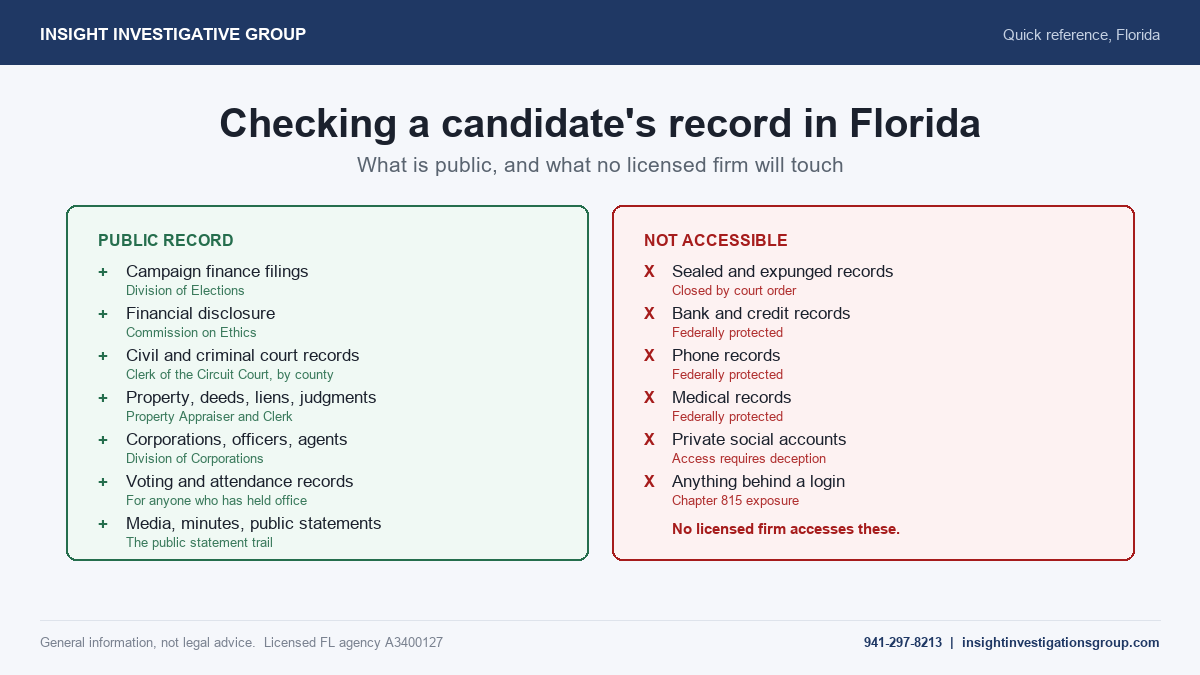
What is not public: sealed and expunged records, bank and credit records, phone records, medical records, and anything behind a private account. No licensed firm accesses those, and any firm that offers to is telling you something about itself.
Where do you start?
Start with the money, then the courts, then the property. In that order.
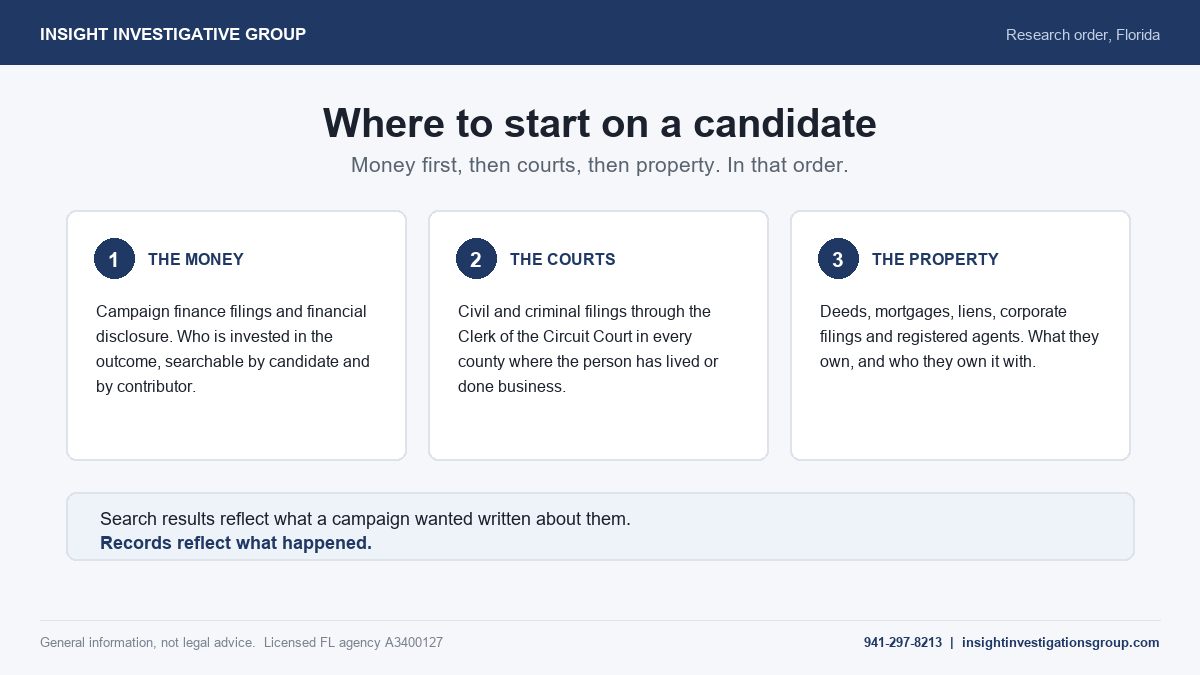
Campaign finance filings tell you who is invested in the outcome, and they are searchable by candidate and by contributor. Court records tell you what disputes the person has actually been in. Property and business records tell you what they own and who they own it with, which is usually where the interesting overlaps sit.
The mistake most people make is starting with a Google search and stopping there. Search results reflect what a campaign wanted written about them. Records reflect what happened.
Why do the free background check sites get this wrong?
Aggregator sites buy bulk data and rarely verify it against the source. For a common name, that produces two failure modes at once: records that belong to someone else attached to your candidate, and real records missed entirely because they were filed under a variation of the name.
For a political claim, that is disqualifying. A campaign that publicizes a record belonging to a different person with the same name has handed the opponent the story. Every finding has to be tied back to the actual court file, not a data broker’s summary.
Where does this stop working without a licensed investigator?
Four places, consistently.
- Identity resolution. Confirming that the John Miller in a 2013 Hillsborough County case is your John Miller requires linking identifiers that aggregators guess at. This is the single most common point of failure.
- Multi-county and multi-state trails. Florida’s clerks each run their own system. A person with a twenty year record across three counties and two states is a records project, not a search box.
- Records that are not online. Older filings, probate, some plats and some case files still require retrieval in person. Manatee County sits in the Twelfth Judicial Circuit alongside Sarasota and DeSoto.
- Making it usable. A pile of documents is not a research file. A campaign needs each claim sourced to the record that supports it, because a claim you cannot defend is worse than no claim at all.
Should a candidate research themselves?
Yes, and ideally before filing. Self vetting surfaces what an opponent’s researcher will find, which lets you control the timing and framing instead of reacting to it two weeks out. It is the engagement we recommend candidates run first.
Questions, answered
Is it legal to research a political candidate in Florida?
Yes. Research conducted from public records, court filings, campaign finance reports and publicly visible statements is lawful. Accessing sealed records, private accounts, or protected data such as bank, phone or medical records is not, and a licensed investigator will not do it for any client.
Can I look up a candidate’s court record myself?
Usually, yes. Each Florida county’s Clerk of the Circuit Court maintains a public case search. The limitation is not access, it is verification. Confirming a record belongs to your subject rather than to someone with a similar name is the part that goes wrong.
Are campaign finance filings public in Florida?
Yes. Candidate and committee filings are public record and searchable through the Florida Division of Elections.
How much does candidate research cost?
It depends on how long the subject’s public life is. A first time candidate with no litigation history is a smaller project than a twenty year officeholder with filings in three counties. Insight Investigative Group scopes and quotes each engagement in writing before any work begins.
Who can see the results?
The client. Section 493.6119 of the Florida Statutes prohibits a licensed agency from releasing the contents of an investigative file to anyone other than the client or employer. Campaign expenditure reporting is separate. The payment may appear in a public filing even though the findings do not.
Speak with a licensed investigator. Consultations are confidential, and the engagement is scoped and quoted in writing before any work begins. Ask an investigator or call 941-297-8213.