
Online background check sites are accurate about some things and unreliable about others, and they do not tell you which is which. They aggregate public records and marketing data, they rarely verify what they aggregate against the source, and they disclaim the accuracy of the result in their own terms of service. That is not a scandal. It is the business model. The problem starts when someone treats the output as a finding.
Are online background check sites accurate?
Partly. The underlying public records are usually real. What goes wrong is the matching. These platforms link records to a person using name, approximate age and prior addresses, which is enough to be right most of the time and enough to be confidently wrong the rest of it. Two people with the same name in the same county is the classic failure, and nobody at the company checks. They also age badly. A charge that was later dropped, a lien that was satisfied, an address someone left in 2014: all of it keeps showing up, because refreshing a record costs money and leaving it there does not.
TruthFinder, like the other consumer search platforms, states in its own terms that it is not a consumer reporting agency, that its reports may not be used for employment, tenant, credit or insurance decisions, and that it does not warrant the information it returns is accurate or current. Read that as written. The company is telling you the output is a lead, not a fact. It is often a useful lead. It is not a verified record, and no licensed professional is accountable for it.
Why is my background check information wrong?
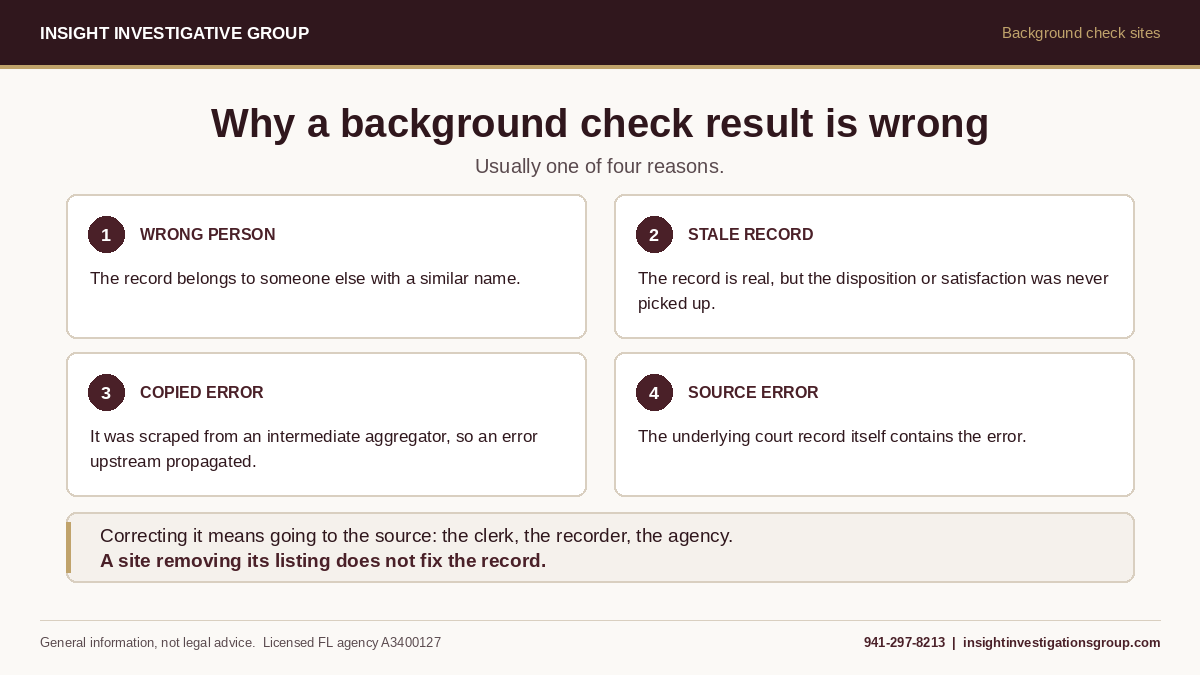
Usually one of four reasons. The record belongs to someone else with a similar name. The record is real but stale, and the disposition or satisfaction was never picked up. The record was scraped from an intermediate aggregator rather than the county source, so an error upstream propagated. Or the underlying court record itself contains the error, which happens more than people expect.
Correcting it means going to the source: the clerk of court, the recorder, the agency that created the record. A consumer platform will remove its listing on request, but that does not fix the record, and the entry frequently reappears on the next data refresh.
What can a private investigator find that a search site cannot?
Less than people imagine, and more than it sounds. A licensed investigator has access to regulated databases that consumer platforms cannot resell, but the real difference is verification. We pull the record from the source, we read the disposition rather than the charge, we confirm the record actually belongs to your subject, and we tell you what we could not confirm. A search site cannot do the last one, because it does not know. We also go where no database reaches. Courthouse terminals for counties that never digitized, corporate filings across states, property records under an entity name rather than a personal one, and social media analysis done by an analyst instead of a scraper.
Who is accountable for the record?
This is the part that never shows up in a feature comparison. A Florida licensed investigative agency operates under Chapter 493 of the Florida Statutes. Section 493.6121(2) requires it to maintain the case file for at least two years and to produce that file to the state regulator on request. Section 493.6119 prohibits it from divulging the contents of an investigative file to anyone other than the client. Section 493.6119(4) makes a willfully false report to a client a licensing matter, not merely a service failure.A consumer data broker is bound by none of that. It holds no state license that can be suspended, it owes you no statutory duty of confidentiality, and there is no regulator to call about a wrong result. The records may overlap. The accountability does not.
When a search site is the right tool
When you want a starting point and nothing depends on the answer. Checking whether a name is worth looking into, confirming a city, getting oriented before you decide whether to spend real money. For that it is fine, and it is cheap for a reason. When something does depend on the answer, when it will be shown to a judge, a board, an insurer or a counterparty, an unverified aggregate is a liability wearing the costume of a report.
Order a licensed background investigation. Prepared by a Florida-licensed investigator, agency A3400127, and documented to evidentiary standards.
Written by Joshua Goldberg, Florida private investigator license C3400073, owner of Insight Investigative Group, LLC, agency license A3400127, Bradenton, Florida.
Related: background checks.
Ask an investigator
A licensed investigator sources every fact to a record we can name.
Call and a licensed investigator answers, day or night, including weekends. Written inquiries are answered within 48 hours.